One distance is double another; can we find a locus?
Question
Given that A is the point (0,3) and B is the point (0,−3), a point P(x,y) moves so that PA=2PB. Show that the equation of the locus of P is x2+y2+10y+9=0.
Suggestion
How can we work out the distances PA and PB (in terms of x and y)?
In this applet, changing θ will move P, such that PA=2PB. What shape is the locus of P?
Download GeoGebra file
Solution
The point
P
has the coordinates
(x,y)
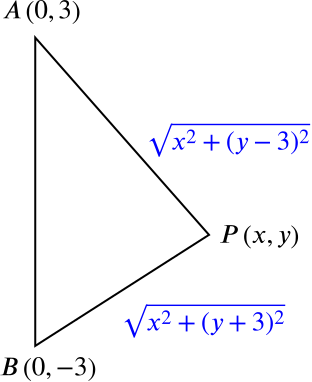
, so we can apply Pythagoras’ theorem to find the distances
PAPB=x2+(y−3)2=x2+(y+3)2,
as seen in this sketch:
We can now insert the expressions for PA and PB into the constraint PA=2PB, giving x2+(y−3)2=2x2+(y+3)2.
Next, we square both sides and expand the brackets. We have
Collecting like terms gives 3x2+3y2+30y+27=0 which, on dividing by 3, gives the equation of the locus of P in the form requested, namely x2+y2+10y+9=0.
A more general problem with detailed suggestions and solutions can be found in The Circle of Apollonius.