Coastal Processes (Cambridge International IGCSE Geography)
Spec point —
2.3.1· Demonstrate an understanding of the work of the sea in eroding, transporting & depositing
Coastal Processes
Coastal regions
- The coast is the area where land and sea meet
- The shoreline is the boundary of the land defined by the high water mark on a low-lying coast or the base of a steeply sloping coast
- The shore is the area between the highest and lowest tide points
- Tides are usually twice a day but vary from coast to coast and with the time of the year
- The difference between low and high tide is known as the tidal range
- The tide determines the waves' height and depth
- The movement of waves and currents affects coastal features
Waves
-
Winds blowing across the sea's surface create waves, which are marine processes that erode, move, and deposit material
-
The size of a wave depends on:
- The speed of the wind
- The fetch(distance the wind travels)
- The amount of time the wind blows (in the same direction)
-
The wave size increases with wind speed, strength, and fetch
-
Friction from the seabed pushes a wave forward as it gets closer to the coast and into shallower water, where it will finally crest and crash onto the beach
-
The movement of water up the beach is called the swash, and the return movement is the backwash
-
There are two types of waves:
-
Destructive waves erode the beach and have:
- a steep wave gradient
- a short wavelength with high height
- a high-frequency wave rate of 10-12 per minute
- high energy
- a strong, abrasive backwash that drags material out to sea and forms shingle beaches
-
Constructive waves are beach builders and have:
- a long wavelength with low height
- a low-frequency wave rate of 6-8 per minute
- a shallow wave gradient
- low energy
- a stronger swash that carries material up onto the beach and deposits a sandy beach
-
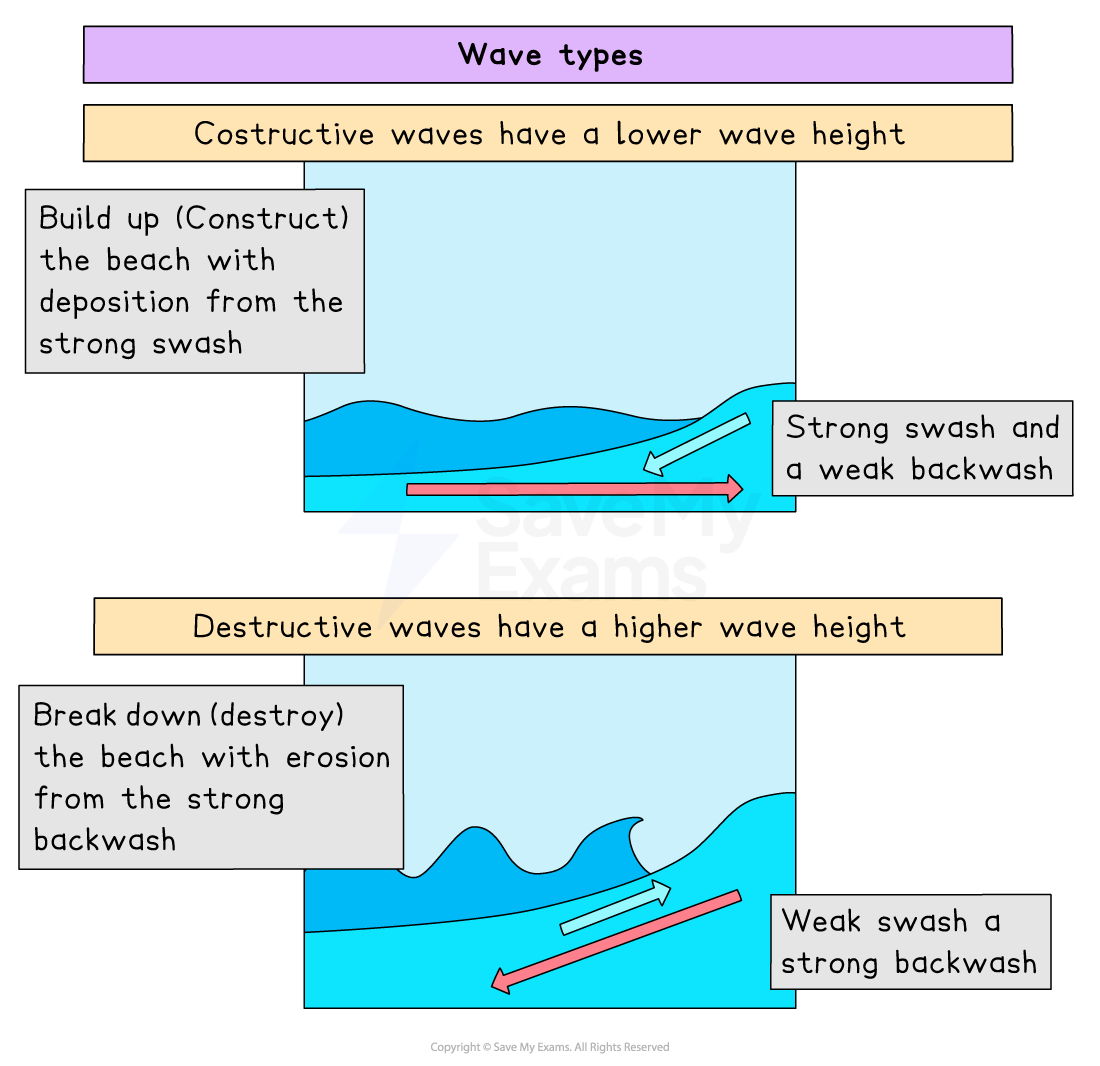
Illustration showing constructive and destructive waves
Exam Hint Make sure you are familiar with the way waves are formed and their different characteristics. Don't be surprised if you are asked to identify the type of wave.
Worked Example **Circle the statement below that best describes the characteristics of a destructive wave?
[1 mark]
A: long wavelength and weak backwash
B: short wavelength and weak backwash
C: short wavelength and strong backwash
D: long wavelength and strong backwash
Solution
- C is the correct answer [1 mark]**
- A destructive wave has a short wavelength, high-frequency rate, steep wave gradient and a strong backwash
Marine erosion
-
Destructive waves are responsible for the majority of erosion that happens along a coast
-
They cut into the coastline in four ways:
- Hydraulic Action
- Attrition
- Corrosion
- Abrasion
-
A large, rough boulder is gradually reduced into round sand grains (quartz) the longer it remains in the ocean and the farther it travels along the shore
-
The effects of attrition are amplified when the waves carry material farther and longer
-
Rounded pebbles on a beach are known as shingle
Exam Hint Make sure you know the difference between the four types of erosion, particularly between abrasion (corrasion) and attrition. So many students confuse these two terms. A tip for you is to think of abrasion as rubbing with sandpaper or maybe you have grazed your knees or elbows when you fell off your bike/skateboard. Those grazes were abrasions on your knees, elbows, etc.
Marine Transportation
Spec point —
2.3.1
-
The sea transports sediment that it gets from erosion in the same way rivers do
-
Material in the sea arrives from many sources:
- eroded from cliffs
- transported by longshore drift along the coastline
- brought inland from offshore by constructive waves
- carried to the coastline by a river
-
Once in the water, the material is moved in different ways:
- Traction
- Saltation
- Suspension
- Solution
Longshore drift (LSD)
- Longshore drift (LSD) is the main process of transportation along the coast
- Waves approach the beach at an angle due to the prevailing wind
- As the waves break, the swash carries material up the beach at the same angle
- As the swash dies away, the backwash carries the material down the beach at right angles (90°)
- The process repeats, transporting material along the beach in a zig-zag movement
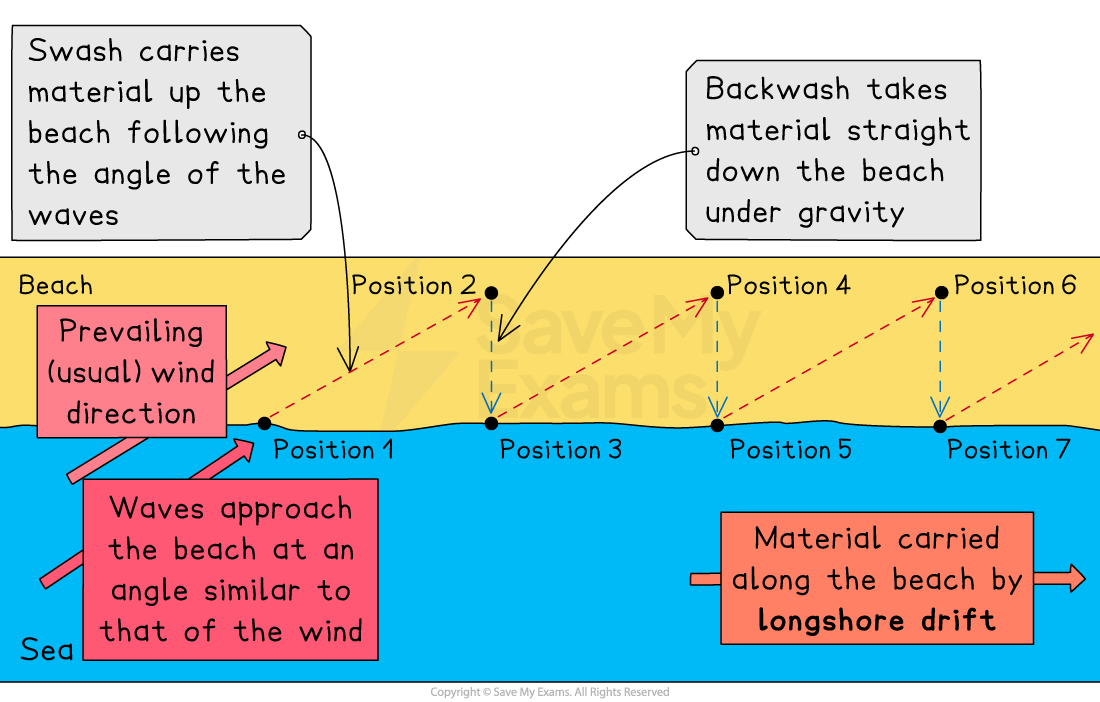
Illustration of the process of longshore drift
-
Beach sediment is carried farther down the coast on coasts where longshore drift is one way; if it is blocked, sediment cannot move and the area farther down the coast is deprived of sediment. This results in two problems:
- Smaller beaches are less attractive to tourists, causing a loss of income
- Removes natural coastal protection
Worked Example Describe and explain the process of longshore drift
[4 Marks]
Solution
- Longshore drift is the process where the waves transport material, such as sand, along the beach in the direction of the prevailing wind [1 mark]. The swash moves material up the beach at an angle [1 mark] **as the waves approach in a similar direction to the wind. The backwash moves material back down the beach at 90° due to gravity [1 mark]. This movement continues along the beach in a zigzag motion in the direction of the prevailing wind [1 mark].
Marking guidance
- The answer above is just one example of a response to this question
- The commands are to** describe and explain and answers should detail the steps and reasons for longshore drift
- The focus must be on the process of 'longshore drift' and what it does
Exam Hint
- You can gain full marks using well-annotated diagrams to support your answer. Just as you like having a visual prompt, it helps the examiner to see that you do know the answer. Sometimes a diagram is easier than actually writing it all out.
- Longshore drift does not produce landforms; it is the process of transportation that supplies the sediment for the process of deposition (which does form features).
Marine Deposition
Spec point —
2.3.1
-
The waves carry sand or shingle as they travel
- Backwash carries it away, while swash carries it onto a shore
-
The largest material is deposited along the upper reach of the swash when a constructive wave carries sediment up the beach
-
The backwash loses water and energy as it travels because of the sand's porosity, resulting in smaller and smaller deposits.
-
When a constructive wave carries sediment up the beach, the largest material is deposited along the upper reach of the swash
-
During a storm, large shingle is thrown above the usual high tide level to form a ridge at the top of the beach called a berm
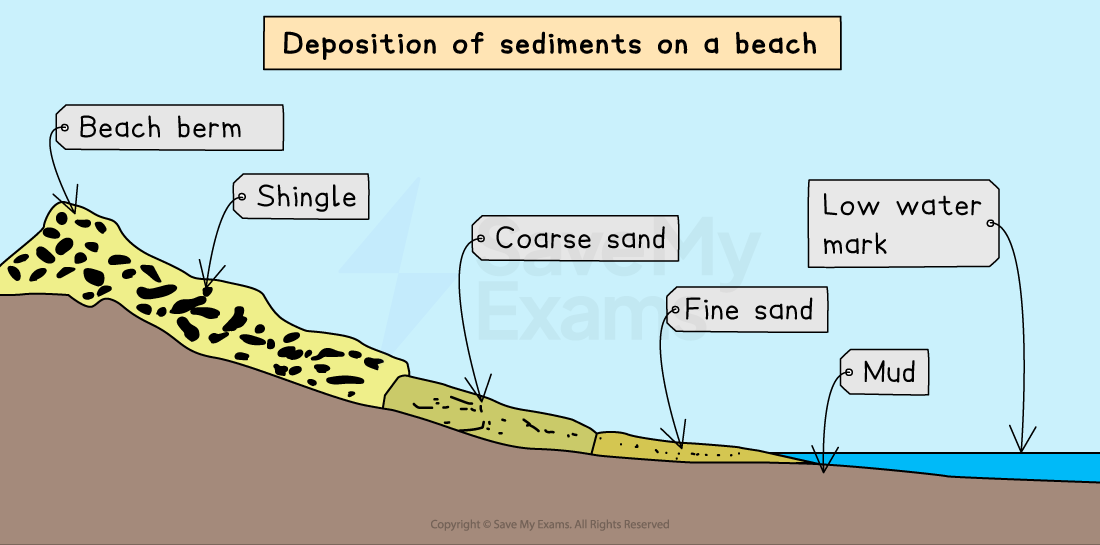
Sediment deposition
Was this revision note helpful?
Build on this topic