Electrolysis of Aqueous Sodium Chloride & Dilute Sulfuric Acid (Cambridge International IGCSE Chemistry)
Spec point —
4.1.3· Identify the products formed at the electrodes and describe the observations made during the electrolysis of: concentrated aqueous sodium chloride dilute sulfuric acid using inert electrodes made of platinum or carbon/ graphite
Electrolysis of aqueous sodium chloride & dilute sulfuric acid
Electrolysis of aqueous sodium chloride
-
Brine is a concentrated solution of aqueous sodium chloride
-
It can be electrolysed using inert electrodes made from platinum or carbon / graphite
-
The ions in brine are:
- Na+ and Cl– ions from the brine / aqueous sodium chloride
- H+ and OH– ions from the water
-
When electrolysed, it produces bubbles of gas at both electrodes
- The gases chlorine and hydrogen are produced
- Sodium hydroxide solution is the product remaining in the electrolysis chamber / container
-
These substances all have important industrial uses:
- Chlorine is used to make bleach
- Hydrogen is used to make margarine
- Sodium hydroxide is used to make soap and detergents
Product at the negative electrode:
- The H+ ions are discharged at the cathode as they are less reactive than sodium ions
- The H+ ions gain electrons to form hydrogen gas
Product at the positive electrode:
- The Cl– ions are discharged at the anode
- They lose electrons and chlorine gas forms
- The Na+ and OH– ions remain behind and form the NaOH solution
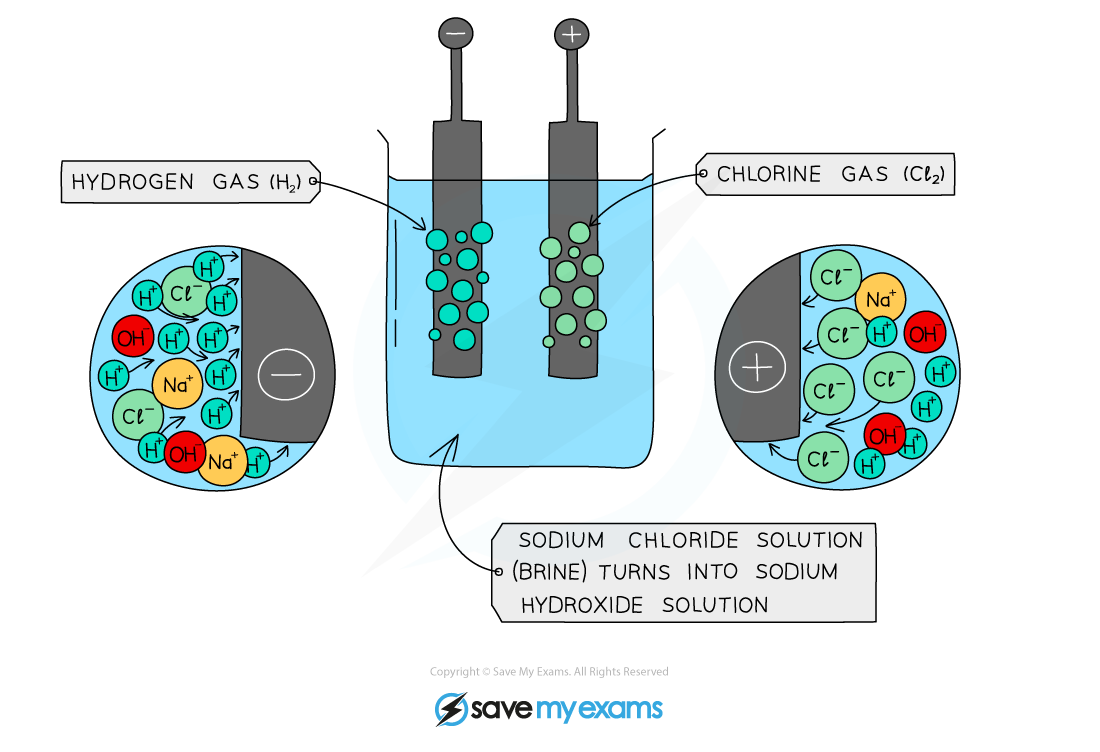
Diagram showing the products of the electrolysis of aqueous sodium chloride
Electrolysis of dilute sulfuric acid
-
Dilute sulfuric acid can be electrolysed using inert electrodes made from platinum or carbon / graphite
-
The ions in dilute sulfuric acid are:
- H+ and SO42– ions from the sulfuric acid
- H+ and OH– ions from the water
-
When electrolysed, it produces bubbles of gas at both electrodes
- The gases oxygen and hydrogen are produced
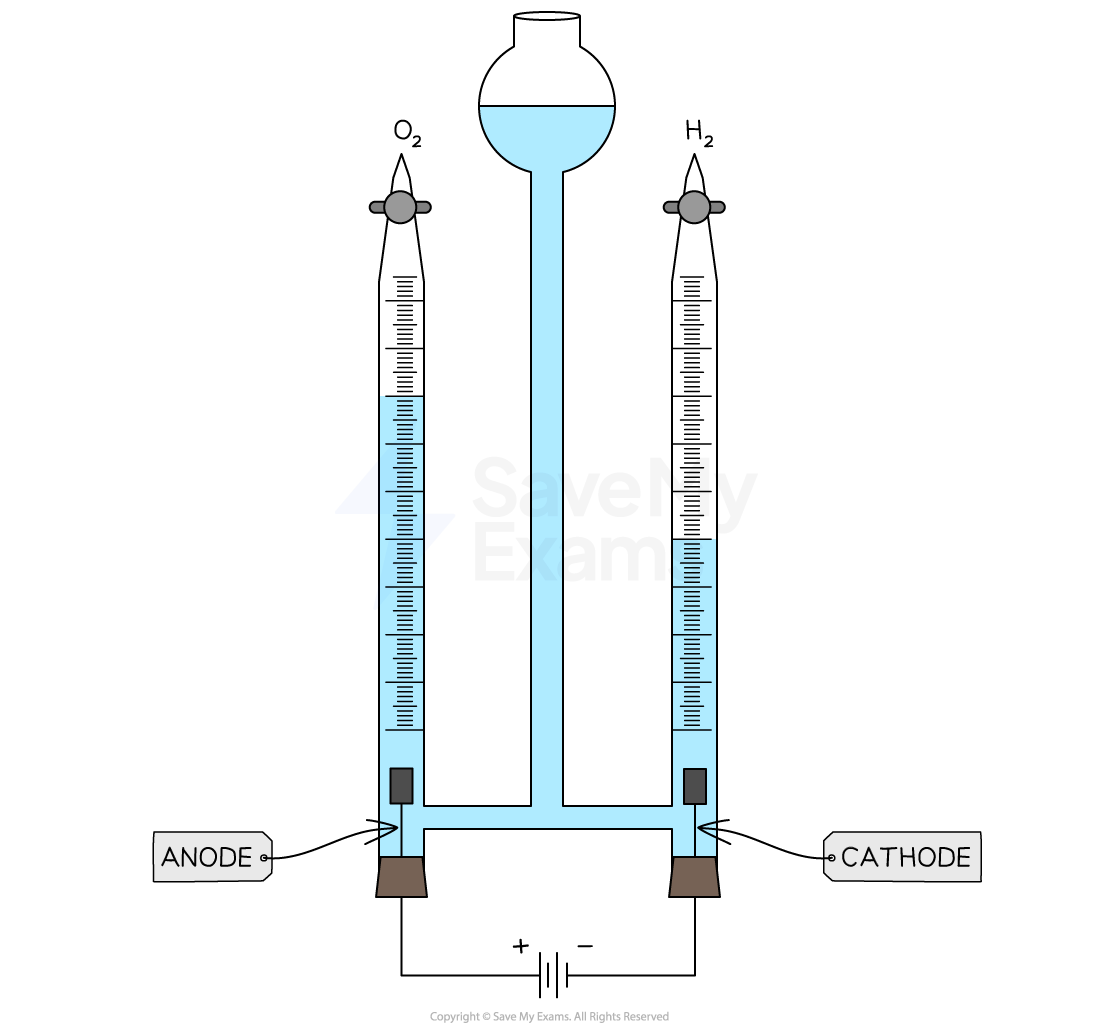
Electrolysing dilute sulfuric acid in a Hoffman voltameter shows that twice as much hydrogen is produced, compared to oxygen
Product at the negative electrode:
- H+ ions are attracted to the cathode
- The H+ ions gain electrons to form hydrogen gas
Product at the positive electrode:
- OH- ions are attracted to the anode
- They lose electrons and form oxygen gas and water
Exam Hint
When a gas is produced during electrolysis, you should be able to give the appropriate gas test:
- Oxygen - if a glowing splint is dipped into a sample of the gas, then the splint will relight
- Hydrogen - if a lit splint is dipped into a sample of the gas, then a squeaky pop will be heard
- Chlorine - if damp litmus paper is dipped into a sample of the gas, it will turn red and then bleach to a white colour
Was this revision note helpful?
Build on this topic