Kinetic Theory (Cambridge International IGCSE Chemistry)
Solids, Liquids & Gases
Spec point —
1.1.1· State the distinguishing properties of solids, liquids & gases Describe the structure of solids, liquids & gases in terms of particle separation, arrangement & types of motion
Solids, liquids & gases
-
The properties of solids, liquids, and gases can be explained by the kinetic theory of matter
-
This model describes matter as consisting of tiny particles that are in constant motion
-
The arrangement and movement of these particles are different in each state of matter
- This leads to their different physical properties
Solids
- Solids have a fixed volume and shape and they have a high density
- The particles are packed very closely together in a fixed and regular pattern
- The particles vibrate in position but can’t change location
Liquids
- Liquids also have a fixed volume but adopt the shape of the container
- They are generally less dense than solids (an exception is water), but much denser than gases
- The particles are still close together but are arranged randomly
- The particles move and slide past each other which is why liquids adopt the shape of the container and are able to flow freely
Gases
- Gases do not have a fixed volume, and, like liquids, take up the shape of the container
- Gases have a very low density
- The particles are far apart and move randomly and quickly (around 500 m/s) in all directions.
- Since there is a lot of space between the particles, gases can be easily compressed.
- They collide with each other and with the sides of the container (this is how pressure is created inside a can of gas)
Summary of the properties of solids, liquids and gases
| Solid | Liquid | Gas | |
|---|---|---|---|
| Diagram | 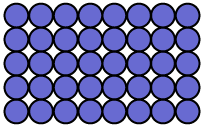 | 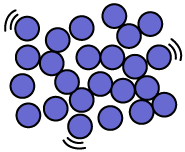 | 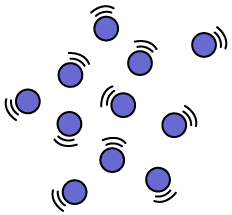 |
| Arrangement of particles | Regular arrangement | Randomly arranged | Randomly arranged |
| Movement of particles | Vibrate about a fixed position | Move around each other | Move quickly in all directions |
| Closeness of particles | Very close | Close | Far apart |
| Density | High | Medium | Low |
| Energy of particles | Low energy | Greater energy | Highest energy |
Exam Hint In your exam, you will need to apply the kinetic theory of matter to explain the properties of solids, liquids, and gases.
This means focusing on the key differences in particle arrangement, movement, and the energy of the particles in each state.
Was this revision note helpful?
Build on this topic