Electrolysis of Aqueous Solutions (Cambridge International IGCSE Chemistry)
Spec point —
4.1.4· Predict the identity of the products at each electrode for the electrolysis of a halide compound in dilute or concentrated aqueous solution Identify the products formed at the electrodes and describe the observations made during the electrolysis of aqueous copper(II) sulfate using inert carbon/ graphite electrodes and when using copper electrodes
Electrolysis of aqueous solutions
Extended tier only
- Aqueous solutions always have water, H2O, present
- In the electrolysis of aqueous solutions, the water molecules dissociate producing H+ and OH– ions:
H2O ⇌ H++ OH–
- These ions are also involved in the process and their chemistry must be considered
- We now have an electrolyte that contains ions from the compound plus ions from the water
- Which ions get discharged and at which electrode depends on the relative reactivity of the elements involved
- Concentrated and dilute solutions of the same compound give different products
- For anions, the more concentrated ion will tend to get discharged over a more dilute ion
Positive electrode - anode
-
Negatively charged OH– ions and non-metal ions are attracted to the positive electrode
-
If halide ions (Cl–, Br–, I–) are present, the halogen is produced at the anode
- The halide ions lose electrons and forms the halogen (chlorine, bromine or iodine)
-
If there are no halide ions but OH– ions are present, oxygen is produced at the anode
- The hydroxide ions lose electrons and forms oxygen gas (and water)
-
In both cases, the other negative ion remains in solution
How concentration affects products at the anode
-
The concentration of the solution affects the ion being discharged:
- If a concentrated halide solution is being electrolysed, the halogen forms at the anode
- If a dilute halide solution is being electrolysed, oxygen forms at the anode
-
For example:
-
For concentrated barium chloride solution :
- Cl– ions are discharged more readily than the OH– ions
- So, chlorine gas is produced at the anode
-
For dilute barium chloride solution:
- Only OH– ions are discharged
- So, oxygen is produced at the anode
-
Negative electrode - cathode
-
Positively charged H+ and metal ions are attracted to the negative electrode but only one will gain electrons
-
Either hydrogen gas or metal will be produced
-
If the metal is above hydrogen in the reactivity series:
- The ions of the more reactive metal remain in solution
- This causes the less reactive hydrogen ions, H+, to be discharged
- So, hydrogen will be produced and bubbling will be seen at the cathode
-
If the metal is below hydrogen in the reactivity series:
- The less reactive metal ions are discharged
- So, the metal is produced and this will be seen plating onto the cathode
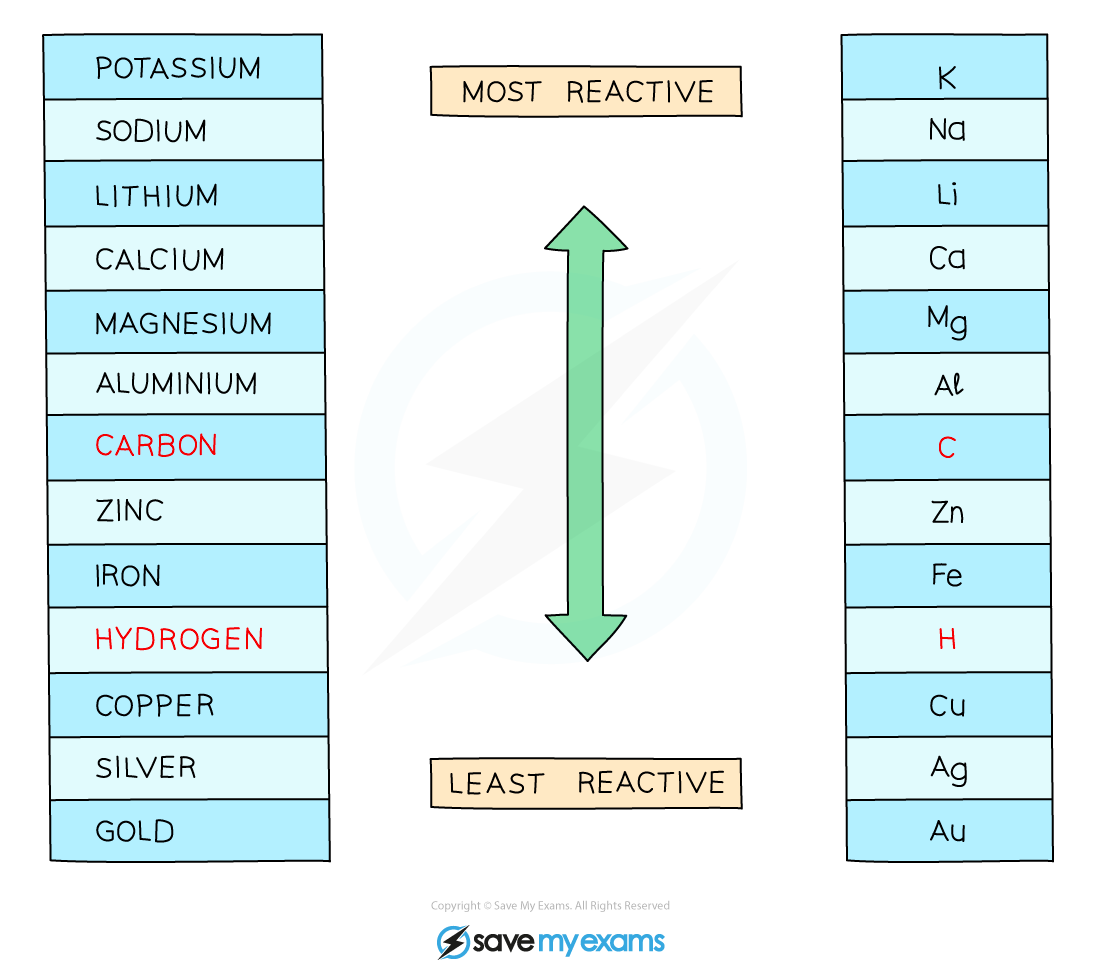
The reactivity series of metals including hydrogen and carbon
Electrolysis of aqueous copper sulfate
-
Aqueous copper sulfate contains the following ions:
- Cu2+ and SO42– from the copper sulfate
- H+ and OH– from the water
Using graphite electrodes:
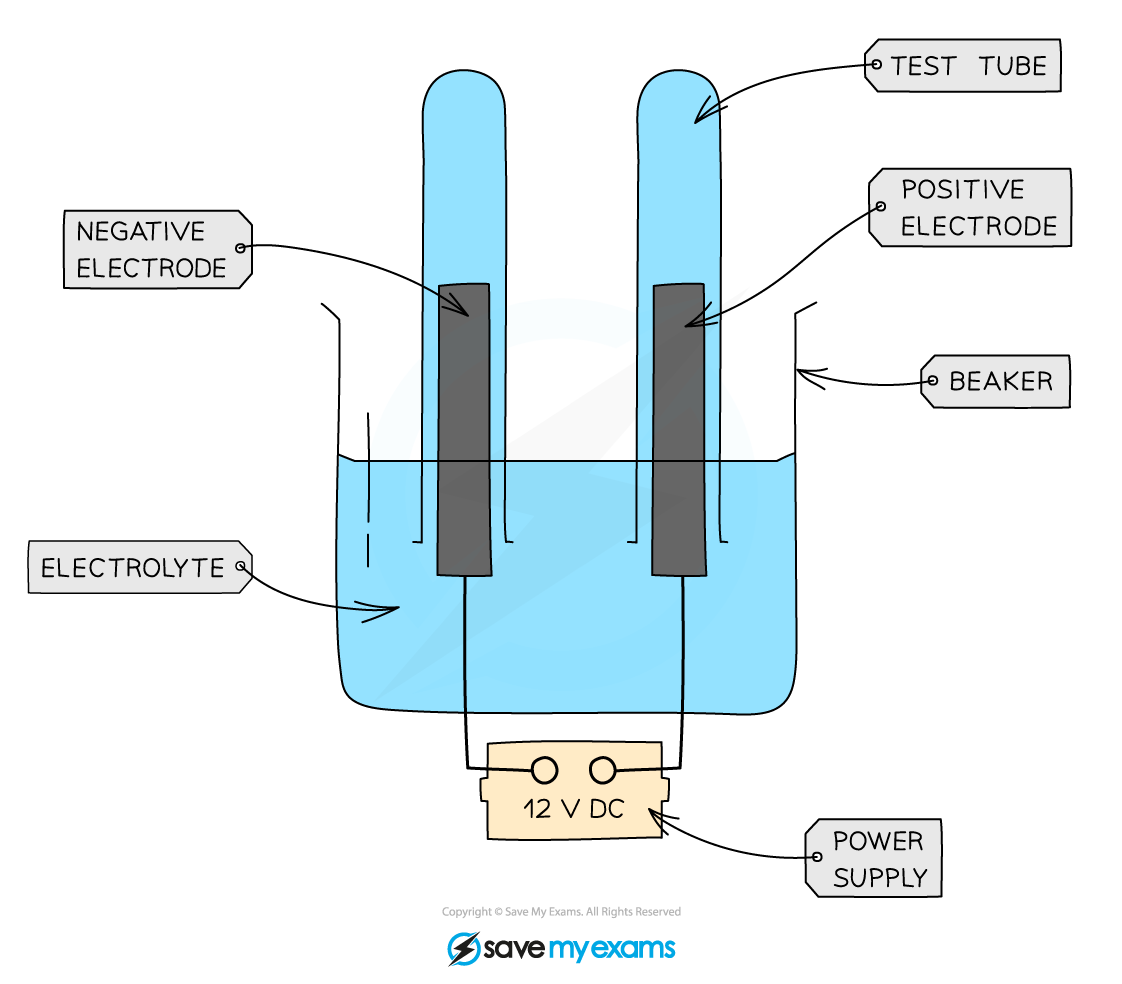
Apparatus for the electrolysis of copper(II)sulfate using inert / passive graphite electrodes
Observations:
- The cathode is coated with a pink-brown layer of copper metal
- Bubbles of a colourless gas (oxygen) are seen forming at the anode
- The blue colour of the copper(II) sulfate solution fades over time
Product at the cathode:
-
Cu2+ and H+ will both be attracted to the cathode but the less reactive ion will be discharged
-
In this case, copper is less reactive than hydrogen
-
Copper ions are discharged at the cathode
- They gain electrons and are reduced to form copper metal
-
The half equation for the reaction at the electrode is:
-
Cu2+ + 2e– → Cu
Product at the anode:
-
SO42– and OH– are both attracted to the anode
- OH– ions lose electrons more readily than SO42-
- OH– lose electrons and are oxidised to form oxygen gas
- The half equation for the reaction at the anode is
4OH– ⟶ O2 + 2H2O + 4e–
Using copper electrodes:
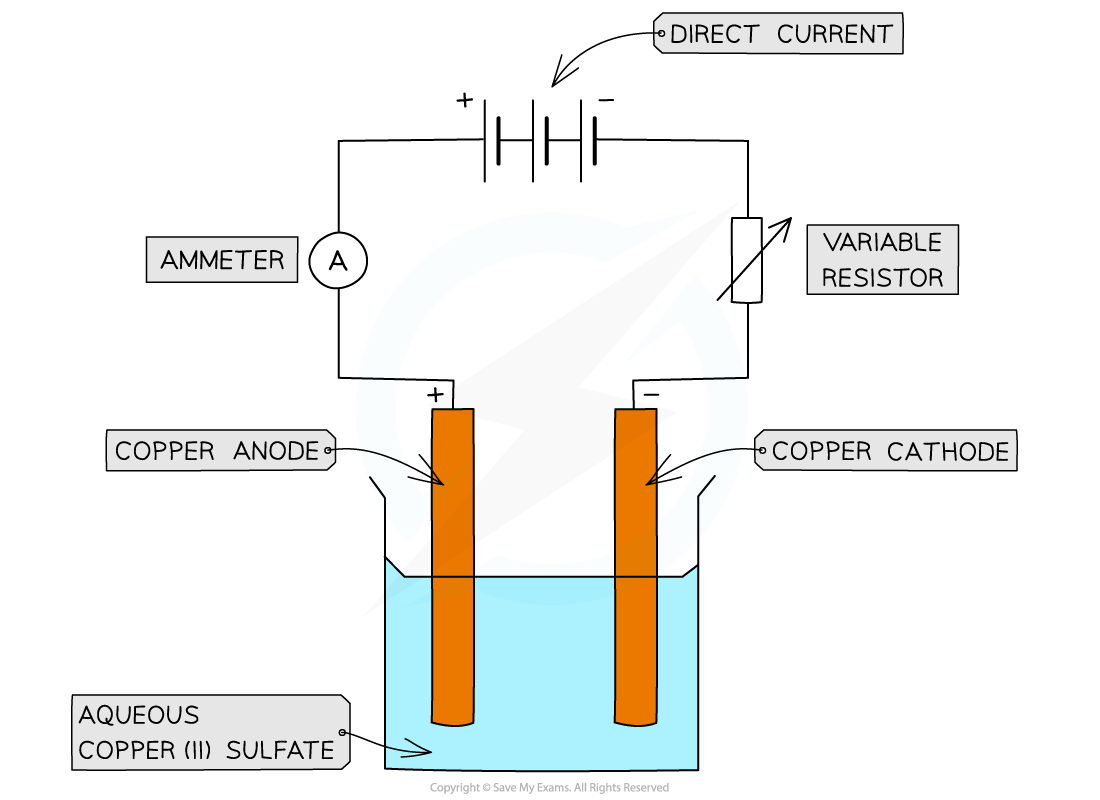
Apparatus for the electrolysis of copper(II)sulfate using active copper electrodes
Observations at the anode and cathode:
-
The blue colour of the copper(II) sulfate solution remains unchanged
-
The cathode increases in mass as it is coated with a layer of copper
- This is because copper ions, Cu2+, are reduced at the cathode and form copper atoms
-
The anode decreases in mass as it dissolves
- This is because copper atoms are oxidised at the anode and form copper ions, Cu2+
-
The gain in mass by the negative electrode is the same as the loss in mass by the positive electrode
- Therefore, the copper deposited on the negative electrode must be the same copper ions that are lost from the positive electrode
-
This implies that the concentration of the Cu2+ ions in the solution remains constant
Products formed for common aqueous solutions
| Aqueous solution - ions present | Product at the anode | Product at the cathode |
|---|---|---|
| Concentrated sodium chloride, NaCl | Chlorine gas | Hydrogen gas |
| Dilute sodium chloride, NaCl | Oxygen gas | Hydrogen gas |
| Concentrated aqueous copper(II) sulfate, CuSO4 | Oxygen gas | Copper |
| Dilute sulfuric acid, H2SO4 | Oxygen gas | Hydrogen gas |
Was this revision note helpful?
Build on this topic