Diffusion (Cambridge International IGCSE Chemistry)
Spec point —
1.1.4· Describe & explain diffusion in terms of kinetic particle theory
Diffusion
-
Diffusion occurs in gases and liquids, due to the random motion of their particles
-
It is where particles move from an area of high concentration to an area of low concentration
-
Eventually the concentration of particles is even as the particles are evenly spread throughout the available space
-
Diffusion happens on its own and no energy input is required
- Although, it occurs faster at higher temperatures because the particles have more kinetic energy
Diffusion in liquids
- Potassium manganate(VII), KMnO4 , in water is a typical demonstration of diffusion in liquids:
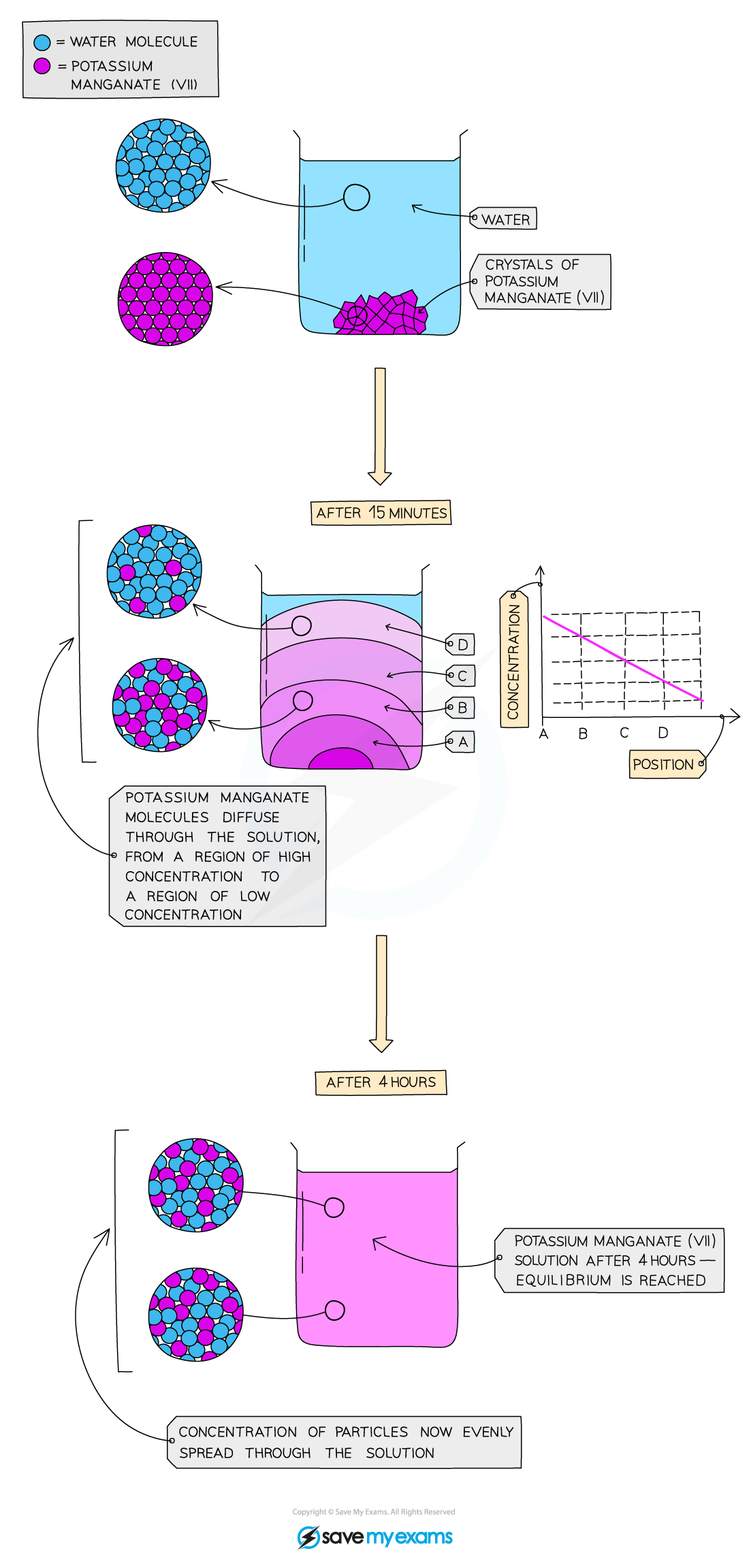
Diffusion of potassium manganate(VII), KMnO4 , in water. After a few hours, the concentration of KMnO4is the same throughout the solution
Diffusion in gases
-
Diffusion is faster in gases than in liquids
- This is because gaseous particles have more energy and move faster than liquid particles
-
For example, the diffusion of bromine gas and air:
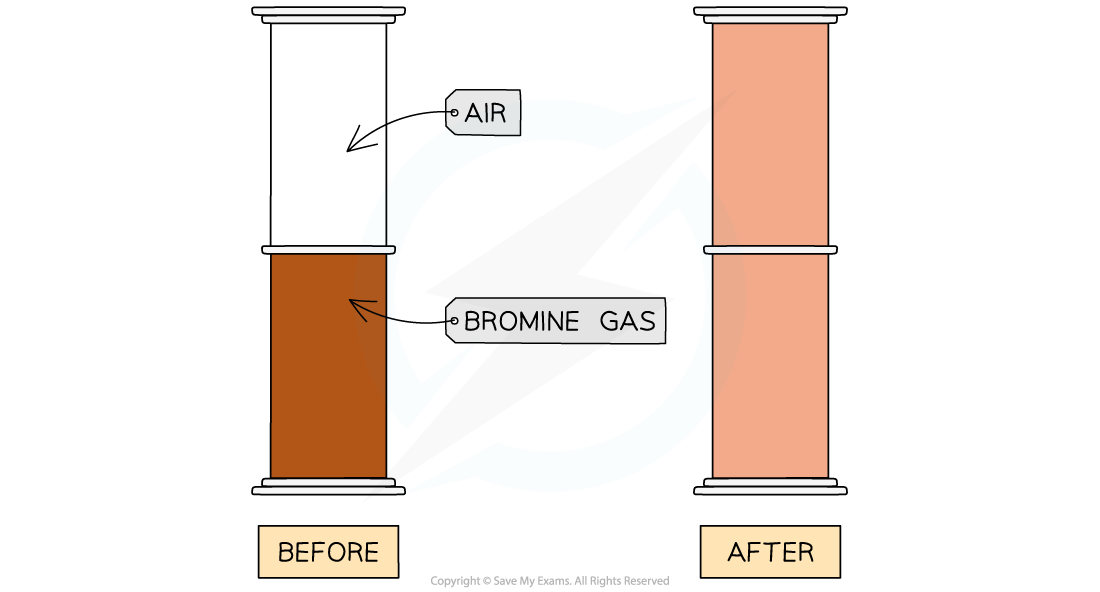
Bromine diffuses until it is evenly spread throughout the container
-
At the start, the orange-brown bromine gas is in an area of high concentration
-
It diffuses from an area of high concentration to an area of low concentration
-
After 5 minutes, the bromine gas will have diffused from the bottom jar until it is evenly spread throughout both containers
- The same can be said for the air, although it is less obvious as it is colourless
Exam Hint When you are talking about diffusion, you should (where appropriate) include:
- Ideas about areas of high and low concentration
- The energy / movement of the particles
Diffusion & Molecular Mass
Spec point —
1.1.4· Describe & explain the effect of relative molecular mass on the rate of diffusion of gases
Extended tier only
How molecular mass affects diffusion
-
At the same temperature, different gases do not diffuse at the same rate.
-
This is due to the difference in their relative molecular masses
-
Gases with a lower relative molecular mass are "lighter" which means that they:
- Travel faster
- Travel further in the same amount of time
-
The reverse argument is true for gases with a high relative molecular mass, they:
- Travel slower
- Do not travel as far in the same amount of time
-
For example, the reaction between ammonia and hydrogen chloride
Diffusion of ammonia and hydrogen chloride
- Ammonia gas and hydrogen chloride gas react together to form solid ammonium chloride
NH3(g) + HCl (g) → NH4Cl (s)
-
The Mr of ammonia is 17, while the Mr* *of hydrogen chloride is 36.5
-
This means that ammonia will travel faster and further than hydrogen chloride
-
Therefore, the ammonium chloride will form nearer to the hydrogen chloride
- This is seen as a white "smoke" ring inside the gas tube
-
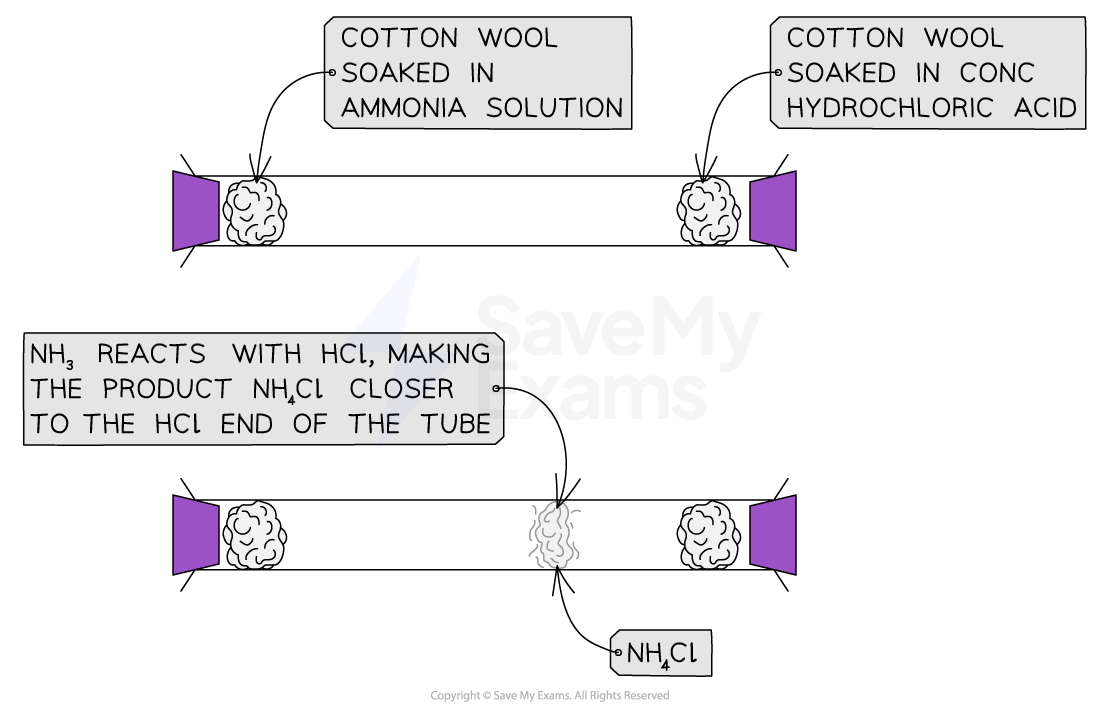
Ammonia molecules have less mass than HCl molecules so they diffuse faster and the product forms closer to the HCl end
Was this revision note helpful?
Build on this topic