Classifying Oxides (Cambridge International IGCSE Chemistry)
Exam board Cambridge International · IGCSEUpdated 2026-01-15
Spec point —
7.1.4· Classify oxides as acidic, including SO2 and CO2, or basic, including CuO and CaO, related to metallic and non-metallic character
Classifying oxides
What are oxides?
-
Oxides are compounds made from one or more atoms of oxygen combined with one other element
-
Examples of oxides include:
- Magnesium oxide - MgO
- Zinc oxide - ZnO
- Potassium oxide - K2O
- Carbon dioxide - CO2
- Sulfur dioxide - SO2
- Water - H2O
-
Oxides can be classified based on their acid-base characteristics
Acidic oxides
- Acidic oxides are formed when a non-metal element combines with oxygen
- They react with bases to form a salt and water
- When dissolved in water they produce an acidic solution with a low pH
- Common examples include CO2, SO2, NO2 and SiO2
Basic oxides
- Basic oxides are formed when a metal element combines with oxygen
- They react with acids to form a salt and water
- When dissolved in water they produce a basic solution with a high pH
- Common examples include CuO and CaO
Basic and acidic oxides
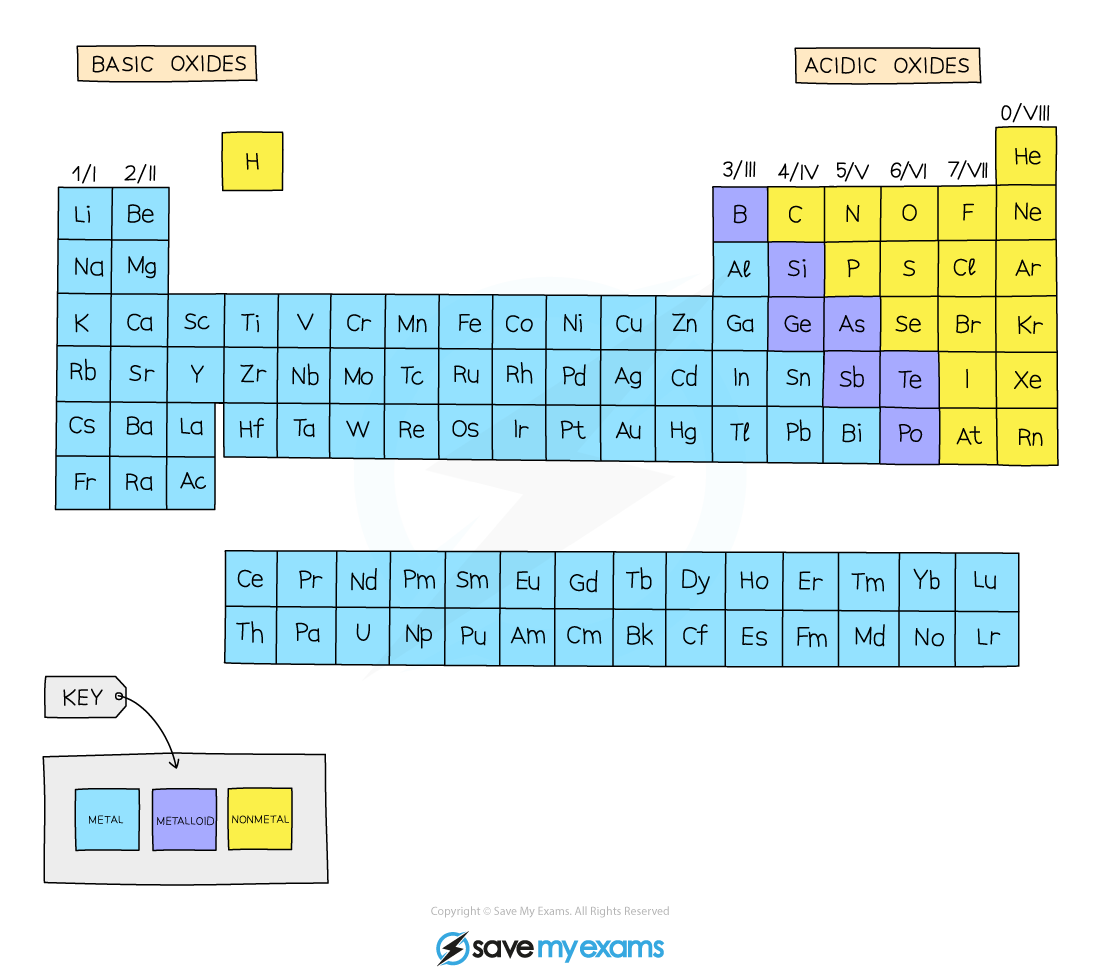
Metals form basic oxides while non-metals form acidic oxides
Amphoteric oxides
Spec point —
7.1.4· Describe amphoteric oxides as oxides that react with acids and with bases to produce a salt and water Classify Al2O3 and ZnO as amphoteric oxides
Amphoteric oxides
Extended tier only
Neutral oxides
- Some oxides do not react with either acids or bases and thus are said to be neutral
- Examples include N2O, NO and CO
Amphoteric oxides
- Amphoteric oxides are a curious group of oxides that can behave as both acidic and basic, depending on whether the other reactant is an acid or a base
- In both cases salt and water are formed
- Two of the most common amphoteric oxides are zinc oxide,ZnO and aluminium oxide,Al2O3
- The hydroxides of both of these elements also behave amphoterically
- Example of aluminium oxide behaving as a base:
Al2O3+ 6HCl → 2AlCl3+ 3H2O
- Example of aluminium oxide behaving as an acid:
Al2O3+ 2NaOH → 2NaAlO2+ H2O
Was this revision note helpful?