Proton Transfer, Strong & Weak Acids (Cambridge International IGCSE Chemistry)
Spec point —
7.1.3· Define acids as proton donors and bases as proton acceptors Define a strong acid as an acid that is completely dissociated in aqueous solution and a weak acid as an acid that is partially dissociated in aqueous solution State that hydrochloric acid is a strong acid, as shown by the symbol equation, HCl(aq) → H+ (aq) + Cl–(aq) State that ethanoic acid is a weak acid, as shown by the symbol equation,CH3COOH(aq) ⇌ H+ (aq) + CH3COO–(aq)
Proton transfer, strong & weak acids
Proton transfer
Extended tier only
- Acids are **proton donors **as they ionise in solution producing protons, which are H+ ions
- These H+ ions make the aqueous solution acidic
- Bases are** proton acceptors** as they accept the protons which are donated by the acid
Proton transfer between hydrochloric acid and water
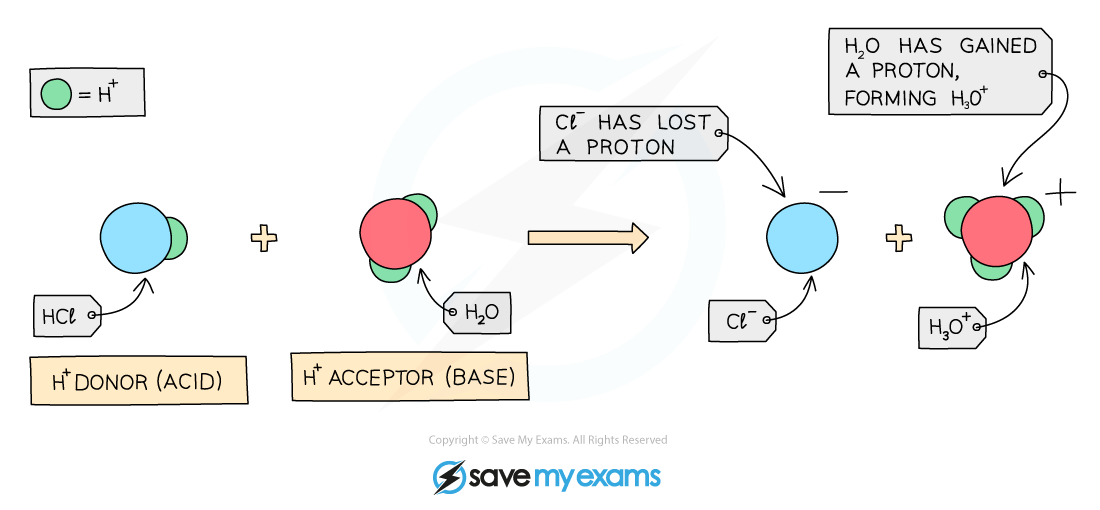
Diagram showing the role of acids and bases in the transfer of protons - here water acts as a base as it accepts a proton
What is a strong acid?
- Acids can be either strong or weak, depending on how many H+ ions they produce when dissolved in water
- Strong acids completely dissociate(or ionise) in water, producing solutions of a very low pH
- Strong acids include HCl and H2SO4
- Example of a strong acid: hydrochloric acid
HCl (aq) → H+(aq) + Cl-(aq)
What is a weak acid?
- Weak acids partially dissociate(or ionise) in water and produce pH values which are closer to the middle of the pH scale, whilst still being below 7
- For weak acids, there is usually an equilibrium set-up between the molecules and their ions once they have been added to water
- Example of a weak acid: propanoic acid
CH3CH2COOH ⇌ H++ CH3CH2COO-
- The equilibrium lies to the left, indicating a high concentration of intact acid molecules, with a low concentration of H+ ions in the solution
- Another example of a weak acid is ethanoic acid which will react with alkalis such as sodium hydroxide to form ethanoate salts
ethanoic acid + sodium hydroxide → sodium ethanoate + water
CH3COOH + NaOH → CH3COONa + H2O
Effect of concentration on strong and weak acids
-
A concentrated solution of an acid is one that contains a higher number of acid molecules per dm3 of solution
-
It does not necessarily mean that the acid is strong
- A concentrated weak acid only partly dissociates so the H+ concentration remains relatively low
Comparing strong and weak acids at the same concentration:
-
A strong acid at a given concentration has a lower pH than a weak acid at the same concentration
-
This is because the strong acid completely dissociates, producing a higher concentration of H+ ions
-
A weak acid only partially dissociates, so fewer H+ ions are produced and the pH is higher (less acidic)
- For example, at the same concentration, hydrochloric acid has a lower pH than ethanoic acid
-
Weak acids typically give pH values in the range 3 – 6, not pH 1 or 2
Reactivity:
-
Since strong acids produce more H+ ions at the same concentration, they are more reactive than weak acids
- For example, hydrochloric acid reacts more vigorously with a metal or carbonate than ethanoic acid at the same concentration
Concentration vs strength:
- A dilute solution of a strong acid (e.g. HCl) can be more acidic than a concentrated solution of a weak acid (e.g. CH3COOH), because the strong acid dissociates completely even when dilute
Was this revision note helpful?