Resistance (Cambridge International AS Physics)
Defining Resistance
-
Resistance is defined as the opposition to current
- For a given potential difference: the higher the resistance, the lower the current
-
Wires are often made from copper because copper has a low electrical resistance
-
Materials with low electrical resistance are good conductors
-
The resistance of a conductor is calculated using the following equation, sometimes referred to as Ohm's law:
-
Where:
- = resistance, measured in Ω
- = potential difference, measured in V
- = current, measured in A
-
One ohm is equivalent to one volt per ampere
-
The resistance in a circuit determines the amount of charge that can flow (current)
- A higher resistance means a smaller current
- A lower resistance means a larger current
-
All electrical components, including wires, have some value of resistance
Calculating Resistance
- To find the resistance of a component, we can set up a circuit like the one shown below
Determining resistance
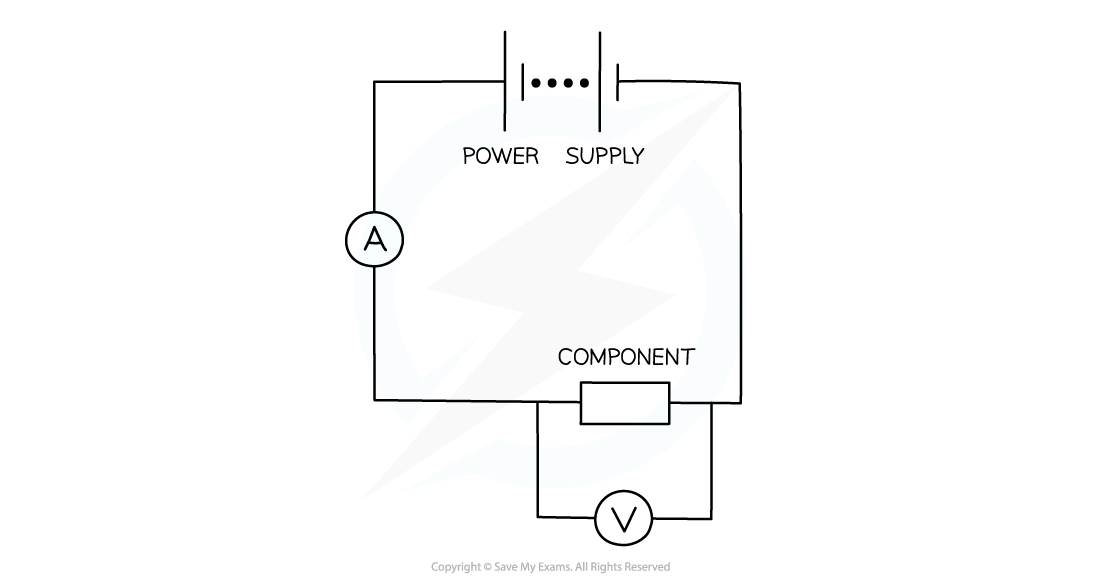
A circuit to determine the resistance of a component
- The power supply should be set to a low voltage to avoid heating the component, typically 1-2 V
- Measurements of the potential difference and current should then be taken
- Finally, these readings should be used to calculate resistance
Worked Example A charge of 5.0 C passes through a resistor of resistance R Ω at a constant rate in 30 s. If the potential difference across the resistor is 2.0 V, calculate the value of R.
Answer:
Step 1: Recall the Resistance equation
Step 2: Calculate the current from the charge and time
- Rearrange for I
Step 3: Substitute values into the resistance equation
Was this revision note helpful?
Build on this topic