Resistance in Sensory Resistors (Cambridge International AS Physics)
Resistance in a Light-Dependent Resistor
- A light-dependent resistor (LDR) is a non-ohmic conductor and sensory resistor
- Its resistance automatically changes depending on **light **(illumination)
- As the** light intensity increases**, the resistance of an LDR decreases
- This is shown by the following graph:
LDR graph
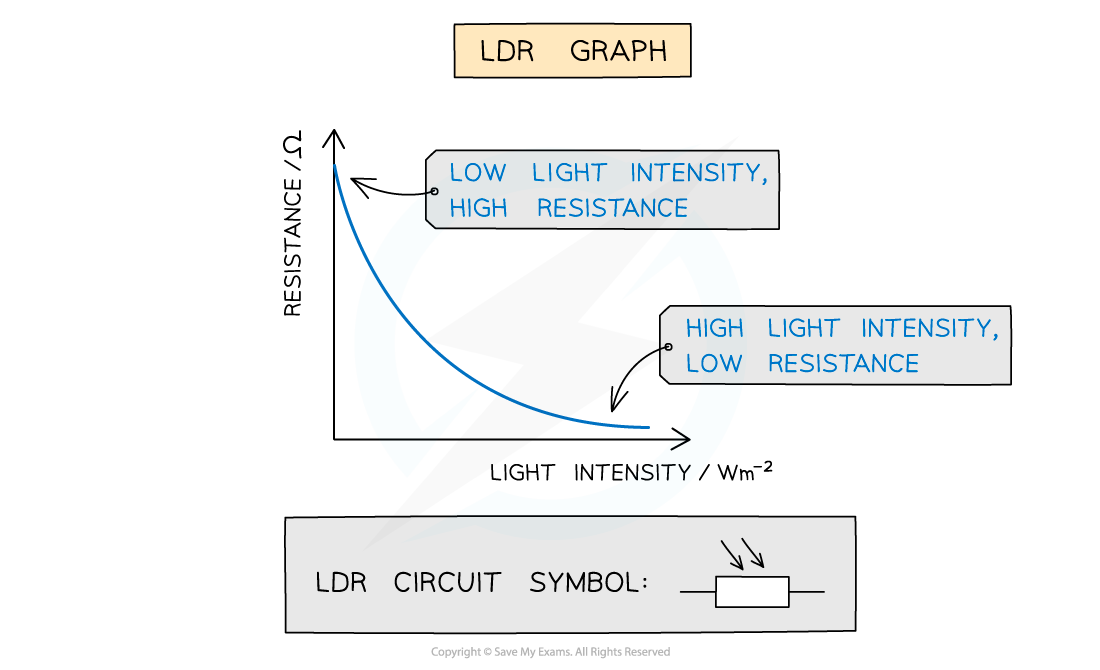
Graph of light intensity and resistance for an LDR
-
LDRs can be used as light sensors, so, they are useful in circuits which automatically switch on lights when it gets dark, for example, street lighting and garden lights
- In the dark, its resistance is very large (millions of ohms)
- In bright light, its resistance is small (tens of ohms)
Resistance of an LDR
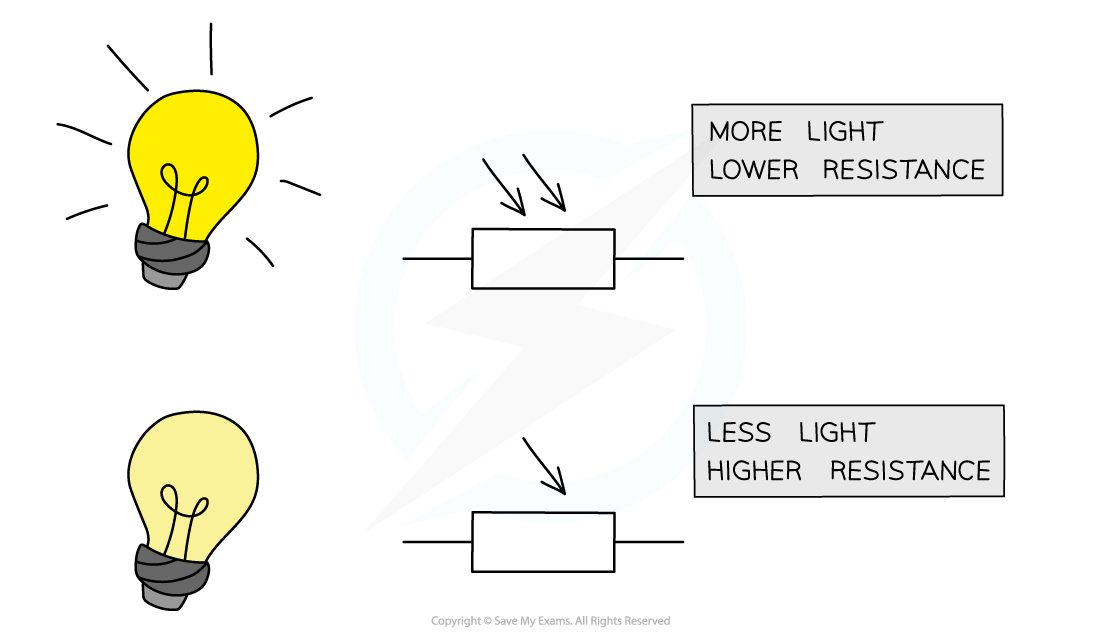
Resistance of an LDR depends on the light intensity falling on it
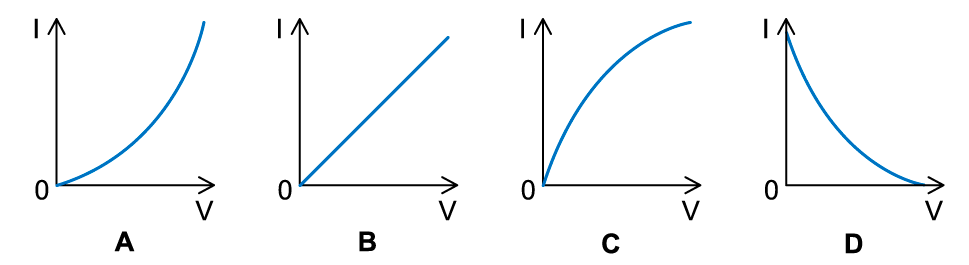
Worked Example Which graph represents the variation of current with potential difference for a light-dependent resistor (LDR) in constant light intensity?
Answer: B
- An LDR is a type of resistor whose resistance decreases as light intensity increases
- For a given light intensity, the LDR obeys Ohm's law, i.e. it has constant resistance
- If resistance is constant, then current and potential difference will be directly proportional, since V= IR
- The graph is therefore a straight line rather than a curve
Resistance in a Thermistor
- A thermistor is a non-ohmic conductor and sensory resistor
- Its resistance changes depending on its temperature
- As the temperature increases, the resistance of a thermistor decreases
- This is shown by the following graph:
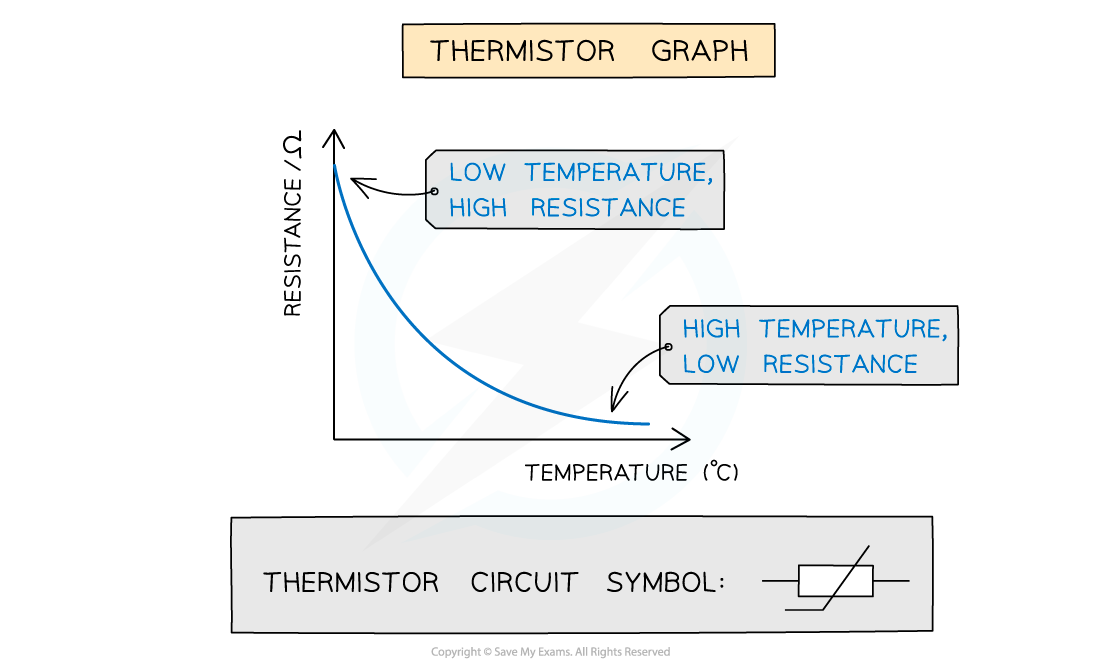
Graph of temperature and resistance for a thermistor
-
Thermistors are temperature sensors and are used in circuits in ovens, fire alarms and digital thermometers
- As the thermistor gets hotter, its resistance decreases
- As the thermistor gets cooler, its resistance increases
Resistance through a thermistor
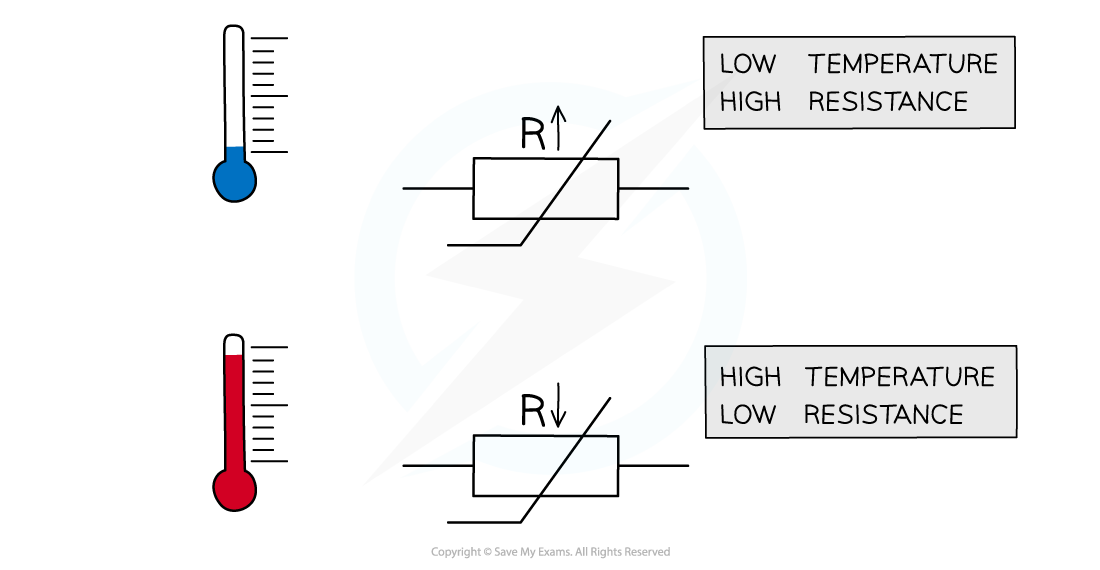
The resistance through a thermistor is dependent on the temperature of it
Worked Example A NTC thermistor is connected in series with a resistor R and a battery.
The resistance of the thermistor is equal to the resistance of R at room temperature. When the temperature of the thermistor decreases, which statement is correct?
A. The p.d across the thermistor increases
B. The current in R increases
C. The resistance of the thermistor decreases
D. The p.d across R increases
Answer: A
- The resistance of the thermistor increases as the temperature decreases
- Increasing the thermistor’s resistance increases the total resistance of the series circuit
- This reduces the current supplied by the battery
- The p.d. across a component is given by Ohm’s law V = IR
- Although the total current decreases, the fraction of the p.d. across the thermistor increases because its resistance becomes larger relative to R
- Therefore, the p.d. across the thermistor increases
- Hence, A is correct
B is incorrect because the current decreases as the total resistance of the circuit is increased
C is incorrect because for a negative temperature coefficient thermistor, the resistance increases as the temperature decreases
D is incorrect because the p.d. decreases due to resistor R now having a smaller share of the total resistance

Was this revision note helpful?
Build on this topic