Resistivity (Cambridge International AS Physics)
Resistivity
- All materials have some resistance to the flow of charge
- As free electrons move through a metal wire, they collide with the vibrating ions
- As a result of the collisions, the electrons transfer some of their kinetic energy to the metal ions in the wire
- The faster the ions vibrate, the greater the temperature of the wire
- In this way, resistance causes heating of the wire
Free electrons and resistivity
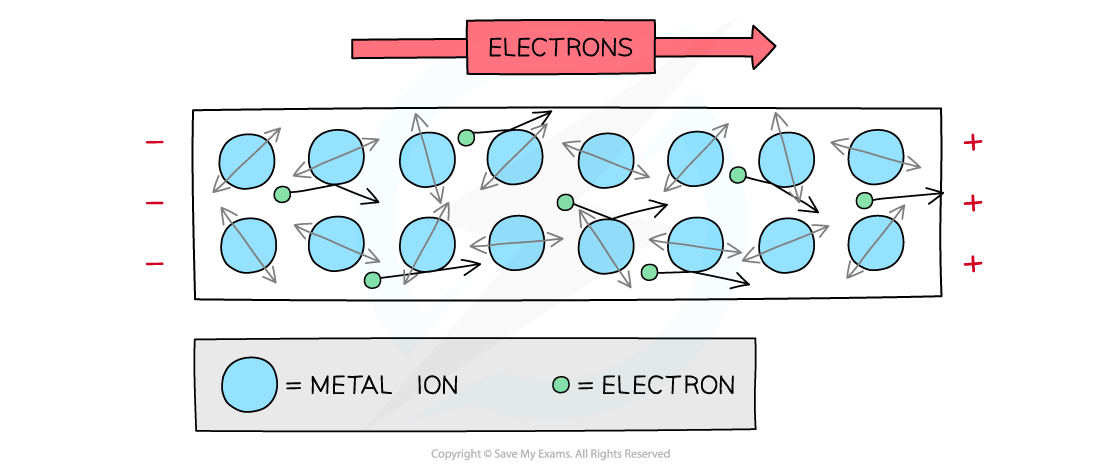
Free electrons collide with metal ions in the wire, which resists their flow
-
Resistance depends on:
- the length of the wire
- the cross-sectional area through which the current is passing
- the resistivity of the material
-
Where:
- R = resistance (Ω)
- ρ = resistivity (Ω m)
- L = length (m)
- A = cross-sectional area (m2)
-
The resistivity equation shows that:
- the longer the wire, the greater its resistance
- the thicker the wire, the smaller its resistance
Wire properties and resistance
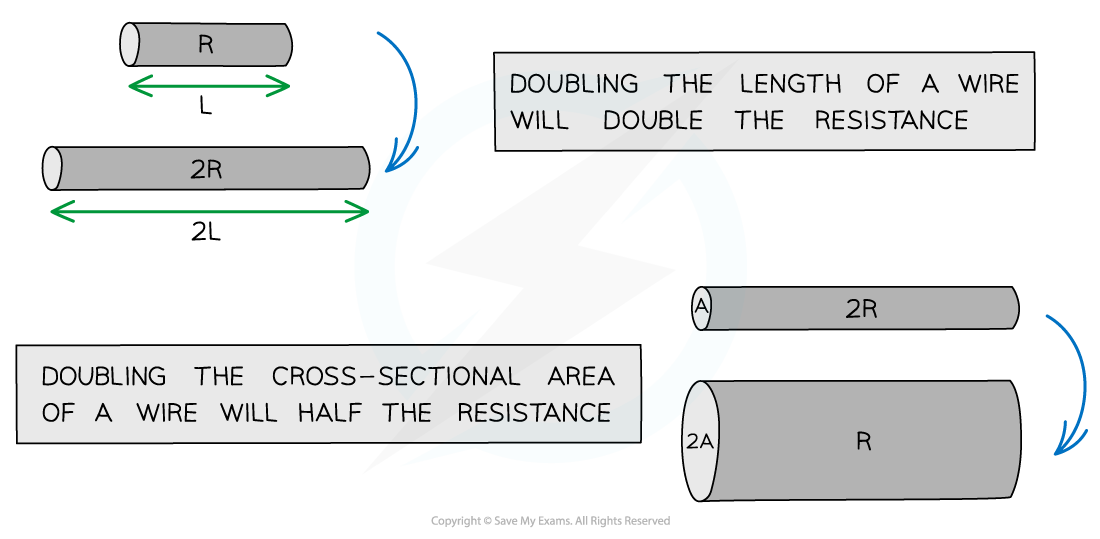
The length and width of the wire affect its resistance
-
Resistivity is a property of a material
- It describes the extent to which a material opposes the flow of electric current through it: , the resistance of a sample of unit length and unit cross-sectional area
- It depends on the material and its temperature, not on the sample's length or cross-sectional area
-
Resistivity is measured in Ω m
Resistivity of materials at room temperature table
| Material | Resistivity ρ / Ω m | |
|---|---|---|
| Metals | Copper | 1.7 x 10⁻⁸ |
| Gold | 2.4 x 10⁻⁸ | |
| Aluminium | 2.6 x 10⁻⁸ | |
| Semiconductors | Germanium | 0.6 |
| Silicon | 2.3 x 10³ | |
| Insulators | Glass | 1012 |
| Sulfur | 1015 |
-
The higher the resistivity of a material, the greater its resistance
- For example, copper has a relatively low resistivity at room temperature, making it the ideal material for use in electrical wires, as current flows through it very easily
-
Insulators have such a high resistivity that virtually no current will flow through them
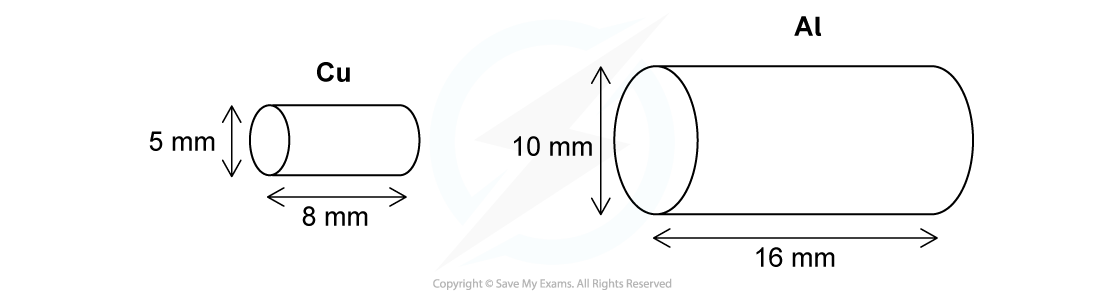
Worked Example Two electrically-conducting cylinders made from copper and aluminium respectively.
Their dimensions are shown below.
Copper resistivity = 1.7 × 10⁻⁸ Ω m
Aluminium resistivity = 2.6 × 10⁻⁸ Ω m
Which cylinder is the better conductor?
Answer:
Step 1: State the resistivity equation:
Step 2: Determine the resistance of the copper cylinder
R = (( 1.7 x 10 ^ - 8 ) ( 8 x 10 ^ - 3 ))/(2.0 x 10 ^ - 5 ) = 6.8 x 10 ^ - 6 capital omegaStep 3: Determine the resistance of the aluminium cylinder
Step 4: State which is the better conductor
- The better conductor will have lower resistance
- The resistance of the aluminium cylinder is less than the copper cylinder
- Therefore, the aluminium cylinder is the better conductor
Exam Hint You won’t need to memorise the value of the resistivity of any material, these will be given in the exam question.
Remember, for a circular wire, , so the cross-sectional area is proportional to the diameter squared. This means if the diameter doubles, the area increases by a factor of four, causing the resistance to drop by a quarter.
Was this revision note helpful?
Build on this topic