Isotopic Abundance & Relative Atomic Mass (Cambridge International AS Chemistry)
Exam board Cambridge International · ASUpdated 2026-07-02
Calculating Relative Atomic Mass
-
Isotopes are different atoms of the same element that contain the same number of protons and electrons but a different number of neutrons.
- These are atoms of the same elements but with different mass numbers
-
Because of this, the mass of an element is given as relative atomic mass (Ar) **by using the average mass of the isotopes
-
The relative atomic mass of an element can be calculated by using the** relative abundance values
- The relative abundance of an isotope is either given or can be read off the mass spectrum
-
Worked Example Calculate the relative atomic mass, Ar, of oxygen to 2 d.p.
Isotope Percentage abundance 16O 99.76 17O 0.04 18O 0.20 Answer:
- Ar =
- Ar = 16.0044
- Ar = 16.00 (to 2 d.p)
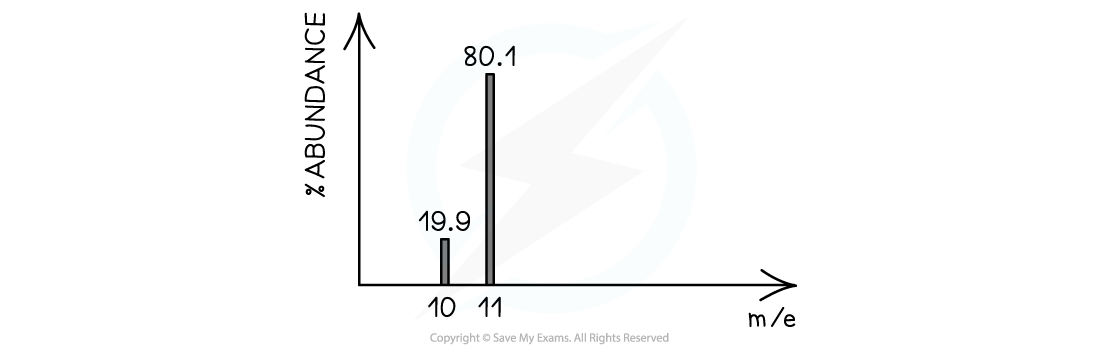
Worked Example Calculate the relative atomic mass of boron using its mass spectrum, to 2 d.p.
Answer:
- Ar = 10.801
- Ar = 10.80 (to 2 d.p)
Was this revision note helpful?
Build on this topic