Mass Spectrometry (Cambridge International AS Chemistry)
Interpreting Mass Spectra
-
Mass spectrometry is an analytical technique used to identify unknown compounds
-
The molecules in the small sample are bombarded with high energy electrons which can cause the molecule to lose an electron
-
This results in the formation of a positively charged molecular ion with one unpaired electron
- One of the electrons in the pair has been removed by the beam of electrons
MOLECULEMOLECULE+• + e–
-
MOLECULE+• represents the molecular ion
-
The molecular ion can further fragment to form new ions, molecules, and radicals
Fragmentation of a molecule in mass spectrometry
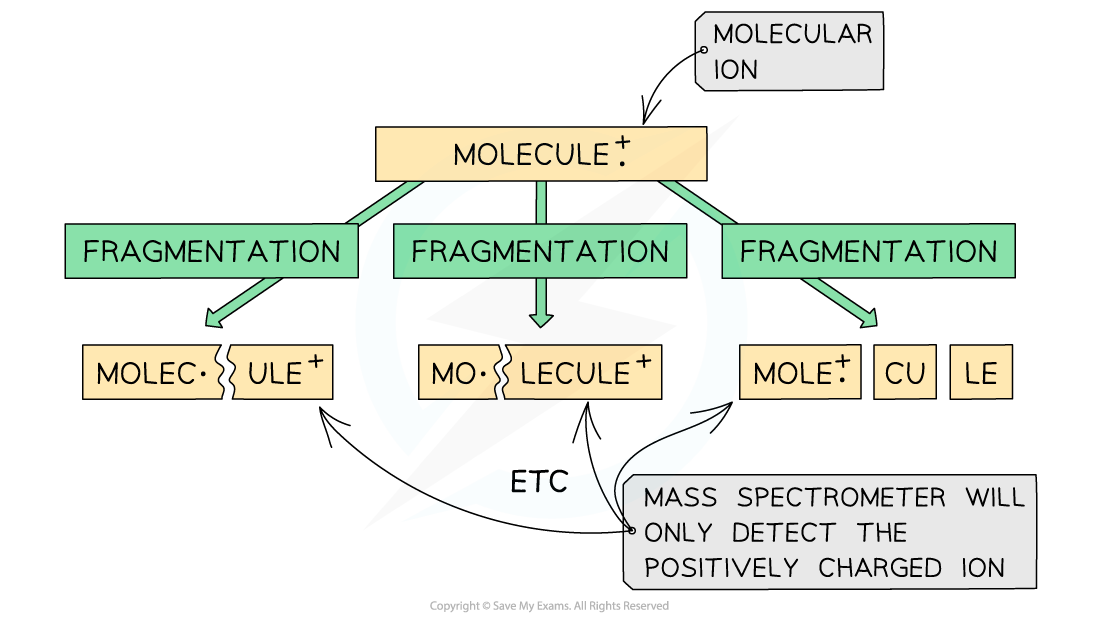
The same molecule can produce several different fragments in mass spectrometry
-
These fragmentation ions are accelerated by an electric field
-
Based on their mass (m) to charge (e) ratio, the fragments of ions are then separated by deflecting them into the detector
- For example, an ion with mass 16 and charge 2+ will have a m/e value of 8
-
In the magnetic field, ions with a smaller m/e value (smaller mass or higher positive charge) are deflected more than ions with a larger m/e value
-
Each fragment corresponds to a specific peak with a particular *m/e *value in the mass spectrum
-
The base peak is the peak corresponding to the most abundant ion
Isotopes
-
Isotopes are different atoms of the same element that contain the same number of protons and electrons but a different number of neutrons.
- These are atoms of the same elements but with different mass number
- For example, Cl-35 and Cl-37 are isotopes as they are both atoms of the same element (chlorine, Cl) but have a different mass number (35 and 37 respectively)
-
Mass spectrometry can be used to find the relative abundance of the isotopes experimentally
-
The relative abundance of an isotope is the proportion of one particular isotope in a mixture of isotopes found in nature
- For example, the relative abundance of Cl-35 and Cl-37 is 75% and 25% respectively
- This means that in nature, 75% of the chlorine atoms is the Cl-35 isotope and 25% is the Cl-37 isotope
-
The heights of the peaks in mass spectrometry show the proportion of each isotope present
Example mass spectrum of boron
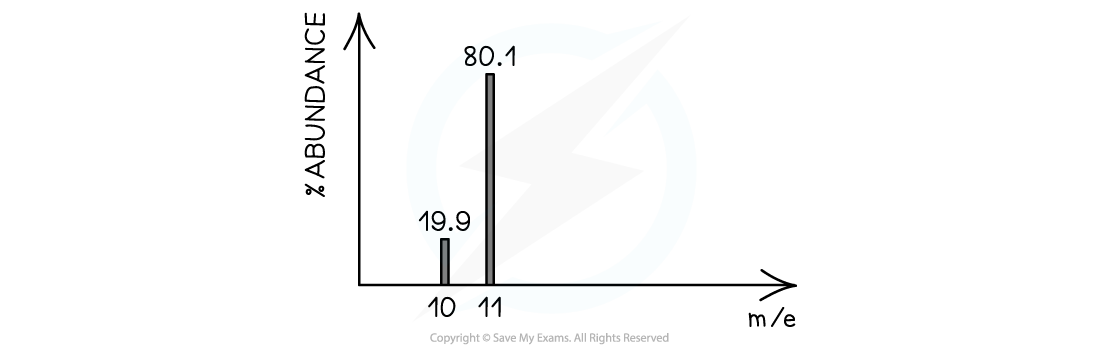
The peak heights show the relative abundance of the boron isotopes: boron-10 has a relative abundance of 19.9% and boron-11 has a relative abundance of 80.1%
Worked Example In a sample of iron, the ions 54Fe2+ and 56Fe3+ are detected.
Calculate the m/e value ratio and determine which ion is deflected more inside the spectrometer.
Answer:
- m/e (54Fe2+) =
- m/e (56Fe3+) =
Exam Hint A small *m/e *value corresponds to fragments that are either small or have a high positive charge or a combination of both
Was this revision note helpful?
Build on this topic