Van der Waals' Forces (Cambridge International A-Level Chemistry)
Van der Waals' Forces & Dipoles
-
Covalent bonds are strong intramolecular forces
-
Molecules also contain weaker intermolecular forces which are forces between molecules
-
These intermolecular forces are called van der Waals’ forces
-
There are two types of van der Waals’ forces:
- Instantaneous(temporary) dipole – induced dipole forces also called London dispersion forces
- Permanent dipole – permanent dipole forces
Intermolecular and intramolecular forces in water
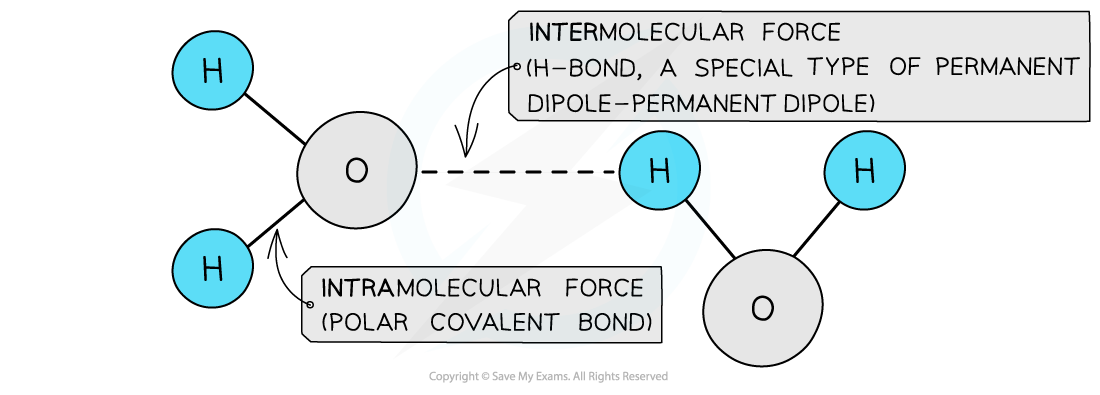
The polar covalent bonds between O and H atoms are intramolecular forces and the permanent dipole – permanent dipole forces between the molecules are intermolecular forces as they are a type of van der Waals’ force
Instantaneous dipole - induced dipole (id - id)
- Instantaneous dipole - induced dipole forces or London dispersion forces exist between all atoms or molecules
- The electron charge cloud in non-polar molecules or atoms are constantly moving
- During this movement, the electron charge cloud can be more on one side of the atom or molecule than the other
- This causes a temporary dipole to arise
- This temporary dipole can induce a dipole on neighbouring molecules
- When this happens, the δ+ end of the dipole in one molecule and the δ- end of the dipole in a neighbouring molecule are attracted towards each other
- Because the electron clouds are moving constantly, the dipoles are only temporary
Instantaneous dipoles
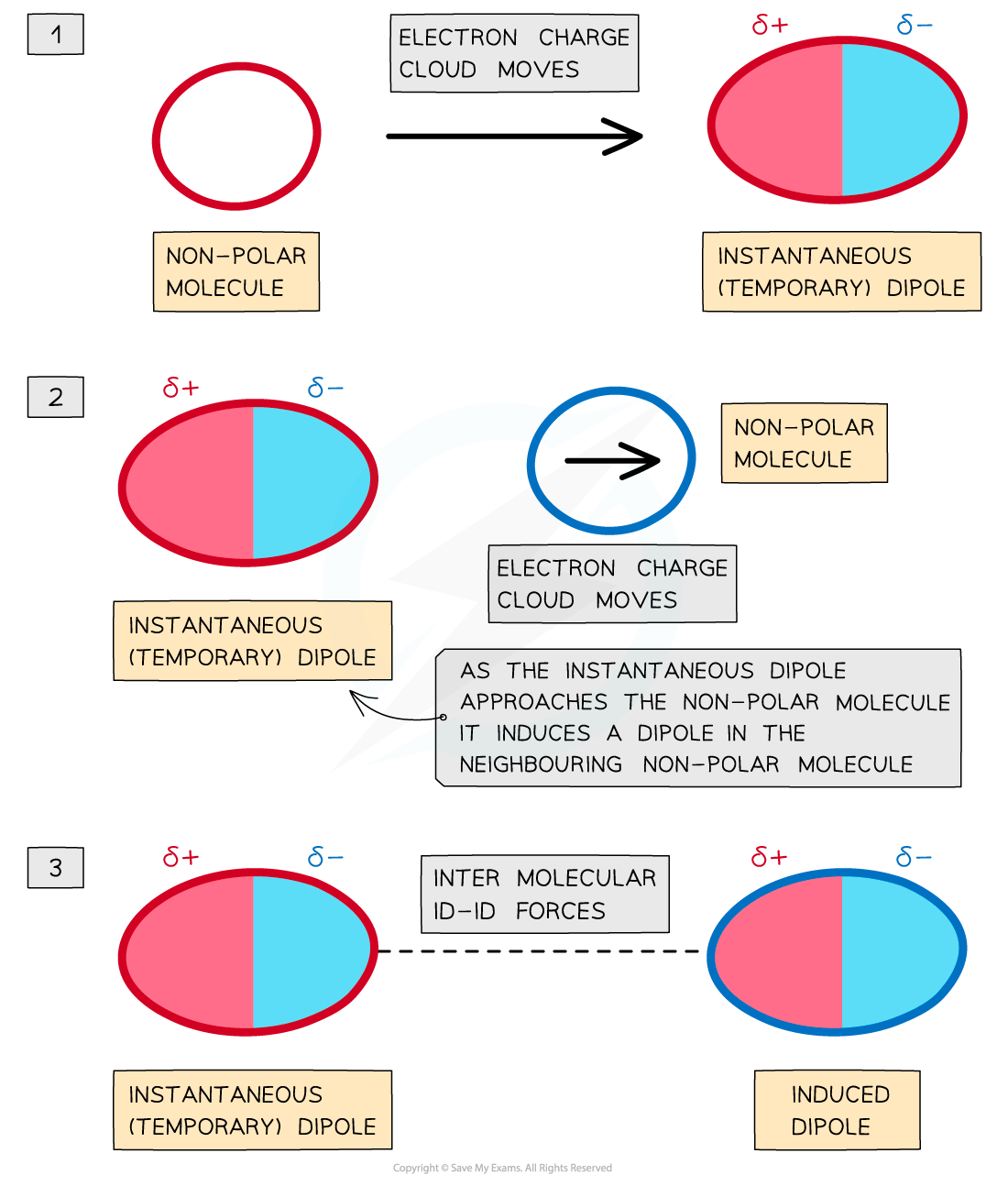
Id-id (London dispersion) forces between two non-polar molecules
-
Id - id forces increase with:
- Increasing number of electrons (and atomic number) in the molecule
- Increasing the places where the molecules come close together
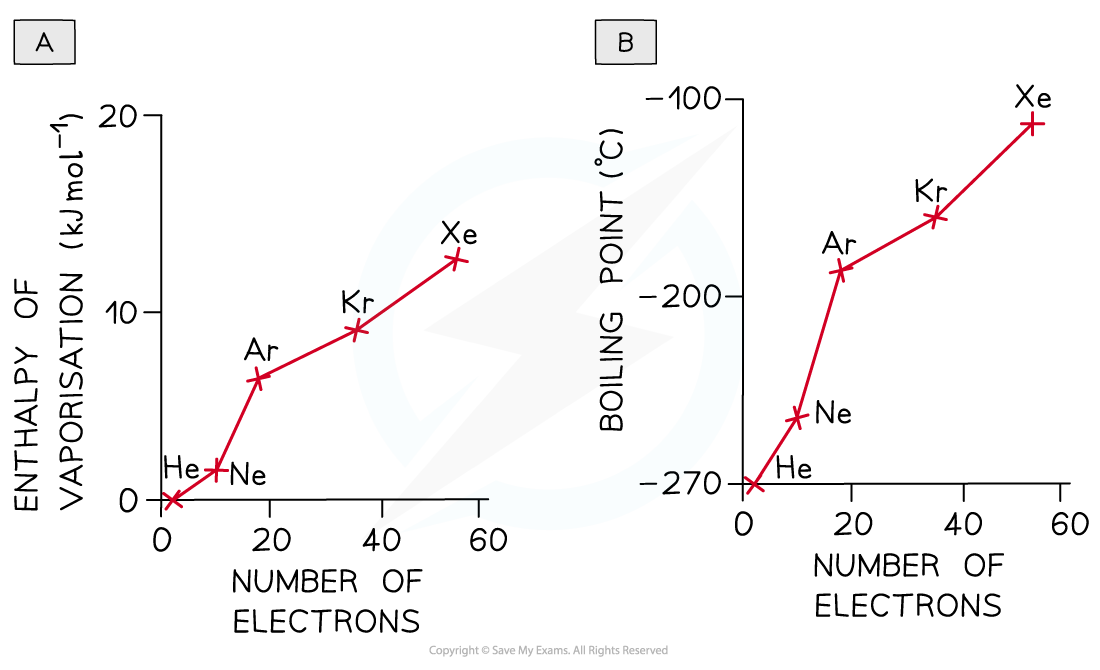
Going down the Group, the id-id forces increase due to the increased number of electrons in the atoms
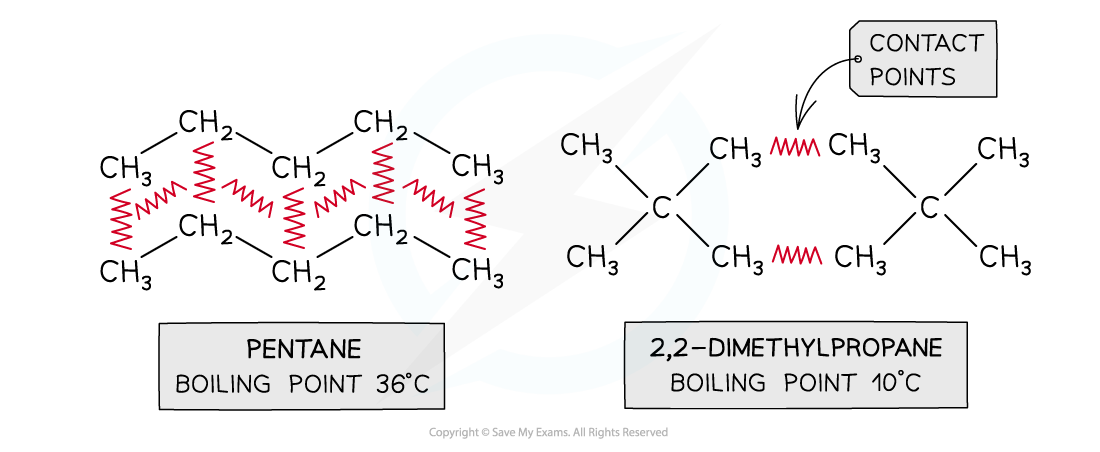
The increased number of contact points in pentane means that it has more id-id forces and therefore a higher boiling point
Permanent dipole - permanent dipole (pd - pd)
- Polar molecules have permanent dipoles
- The molecule will always have a negatively and positively charged end
- Forces between two molecules that have permanent dipoles are called permanent dipole - permanent dipole forces
- The δ+ end of the dipole in one molecule and the δ- end of the dipole in a neighbouring molecule are attracted towards each other
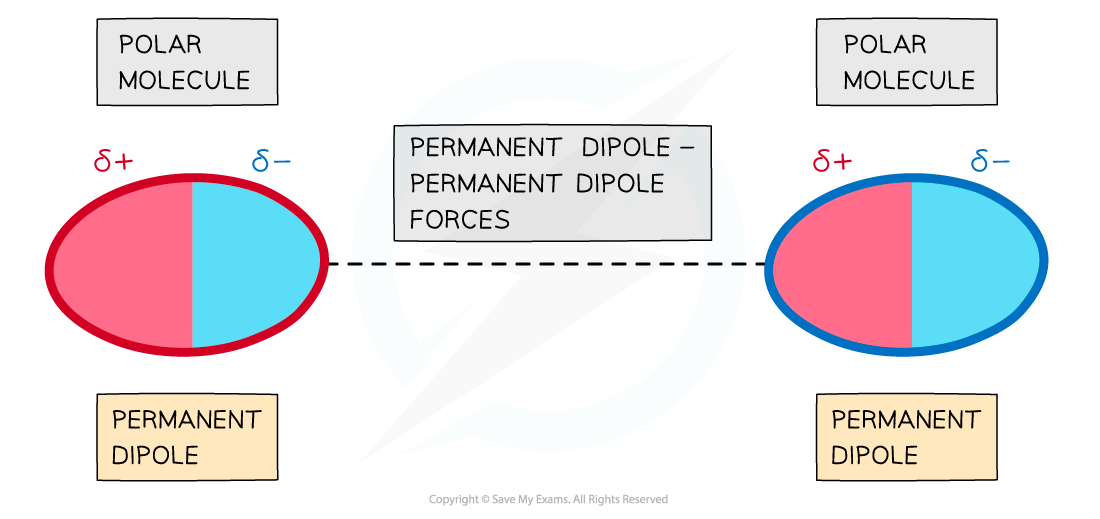
The delta negative end of one polar molecule will be attracted onwards the delta positive end of a neighbouring polar molecule
-
For small molecules with the same number of electrons, pd - pd forces are stronger than id - id
- Butane and propanone have the same number of electrons
- Butane is a nonpolar molecule and will have id - id forces
- Propanone is a polar molecule and will have pd - pd forces
- Therefore, more energy is required to break the intermolecular forces between propanone molecules than between butane molecules
- So, propanone has a higher boiling point than butane
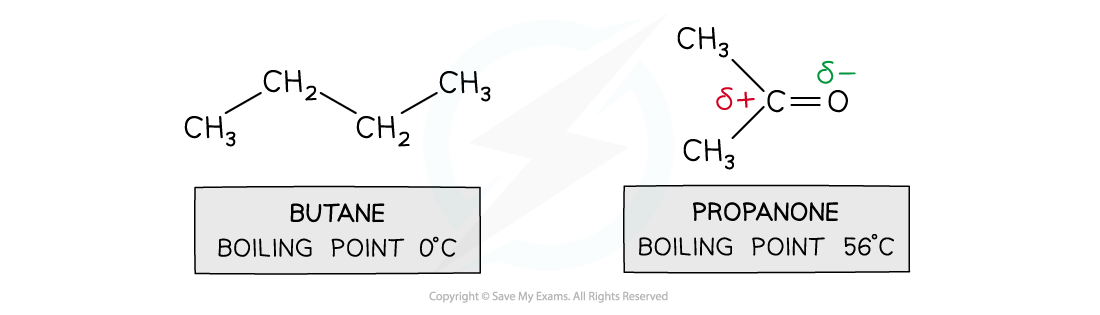
Pd-pd forces are stronger than id-id forces in smaller molecules with an equal number of electrons
Exam Hint Remember this difference: intramolecular forces are forces within a molecule, whereas intermolecular forces are forces between a molecule.
Hydrogen Bonding as a Permanent Dipole
-
Hydrogen bonding is an intermolecular force between molecules with an -OH/-NH group and molecules with an N/O atom
-
Hydrogen bonding is a special case of a permanent dipole - dipole force between molecules
- Hydrogen bonds are stronger forces than pd - pd forces
-
The hydrogen is bonded to an O/N atom which is so electronegative, that almost all the electron density from the covalent bond is drawn towards the O/N atom
-
This leaves the H with a large delta positive and the O/N with a large delta negative charging resulting in the formation of a permanent dipole in the molecule
-
A delta positive H in one molecule is electrostatically attracted to the delta negative O/N in a neighbouring molecule
Hydrogen bonds in water molecules
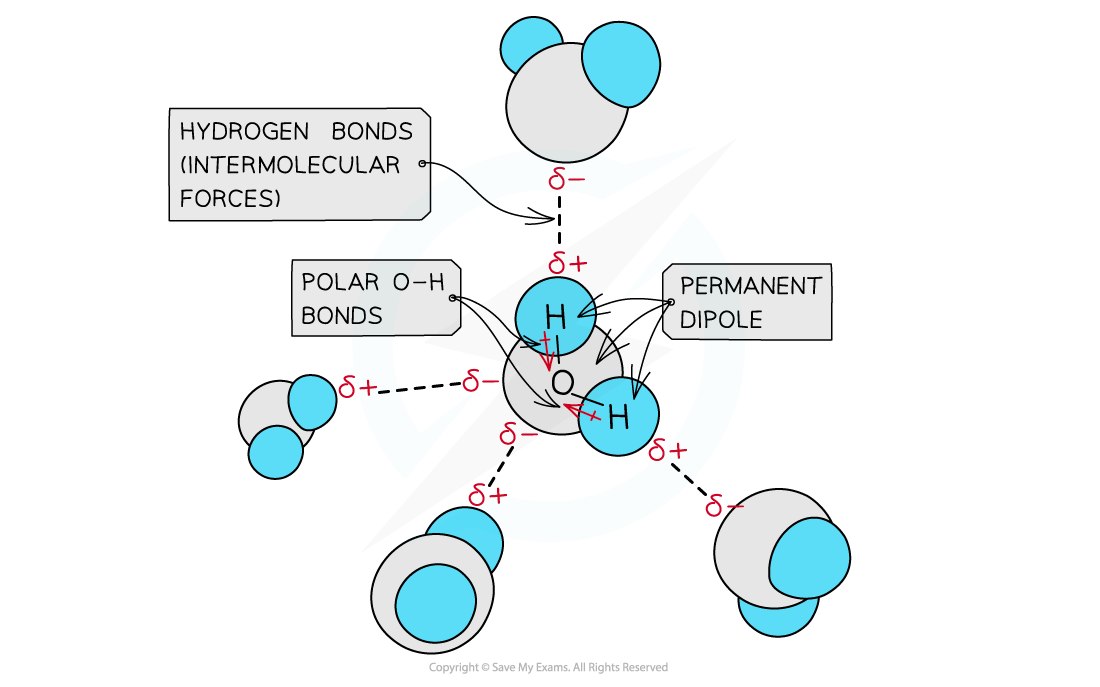
Hydrogen bonding in water occurs between the oxygen lone pair of one water molecule and the δ+ hydrogen atoms of another water molecule
Was this revision note helpful?
Build on this topic