Acid/Base Behaviour of the Period 3 Oxides & Hydroxides (Cambridge International A-Level Chemistry)
Acid / Base Behaviour of Period 3 Oxides & Hydroxides
Period 3 oxides
- Aluminium oxide is amphoteric which means that it can act both as a base (and react with an acid such as HCl) and an acid (and react with a base such as NaOH)
Acidic and basic nature of Period 3 oxides table
| Period 3 oxide | Na2O | MgO | Al2O3 | SiO2 | P4O10 | SO2SO3 |
|---|---|---|---|---|---|---|
| Acid / base nature | Basic | Basic | Amphoteric | Acidic | Acidic | Acidic |
Reaction of Period 3 oxides with acid / base table
| Oxide | Chemical equation | Comment |
|---|---|---|
| Na2O | Na2O (s) + 2HCl (aq) → 2NaCl (aq) + H2O (l) | |
| MgO | MgO (s) + 2HCl (aq) → MgCl2 (aq) + H2O (l) | Used in indigestion remedies by neutralising excess acid in the stomach |
| Al2O3 | Al2O3 (s) + 3H2SO4 (aq) → Al2(SO4)3 (aq) + 3H2O (l) Al2O3 (s) + 2NaOH (aq) + 3H2O (l) → 2NaAl(OH)4 (aq) | Reacts with acid to form salt and water Reacts with hot, concentrated alkali to form salt |
| SiO2 | SiO2 (s) + 2NaOH (aq) → Na2SiO3 (aq) + H2O (l) | |
| P4O10 | P4O10 (s) + 12NaOH (aq) → 4Na3PO4 (aq) + 6H2O (l) | |
| SO2SO3 | SO2 (g) + 2NaOH (aq) → Na2SO3 (aq) + H2O (l) SO3 (g) + 2NaOH (aq) → Na2SO4 (aq) + H2O (l) |
- The acidic and basic nature of the Period 3 elements can be explained by looking at their structure, bonding and the Period 3 elements’ electronegativity
Structure & bonding of the Period 3 oxides table
| Period 3 oxide | Na2O | MgO | Al2O3 | SiO2 | P4O10 | SO2SO3 |
|---|---|---|---|---|---|---|
| Relative melting point | High | High | Very high | Very high | Low | Low |
| Chemical bonding | Ionic | Ionic | Ionic (with some covalent character) | Covalent | Covalent | Covalent |
| Structure | Giant ionic | Giant ionic | Giant ionic | Giant covalent | Simple molecular | Simple molecular |
Electronegativity of Period 3 elements table
| Period 3 element | Na | Mg | Al | Si | P | S | Cl |
|---|---|---|---|---|---|---|---|
| Electronegativity | 0.9 | 1.2 | 1.5 | 1.8 | 2.1 | 2.5 | 3.0 |
- Oxygen has an electronegativity value of 3.5
- Therefore, the difference in electronegativity between oxygen and Na, Mg and Al is the largest
- So, electrons will be transferred to oxygen when forming oxides giving the oxide an ionic binding
- The oxides of Si, P and S will share the electrons with the oxygen to form covalently bonded oxides
- The giant ionic and giant covalent structured oxides will have high melting points as it is difficult to break the structures apart
The structure of some Period 3 oxides
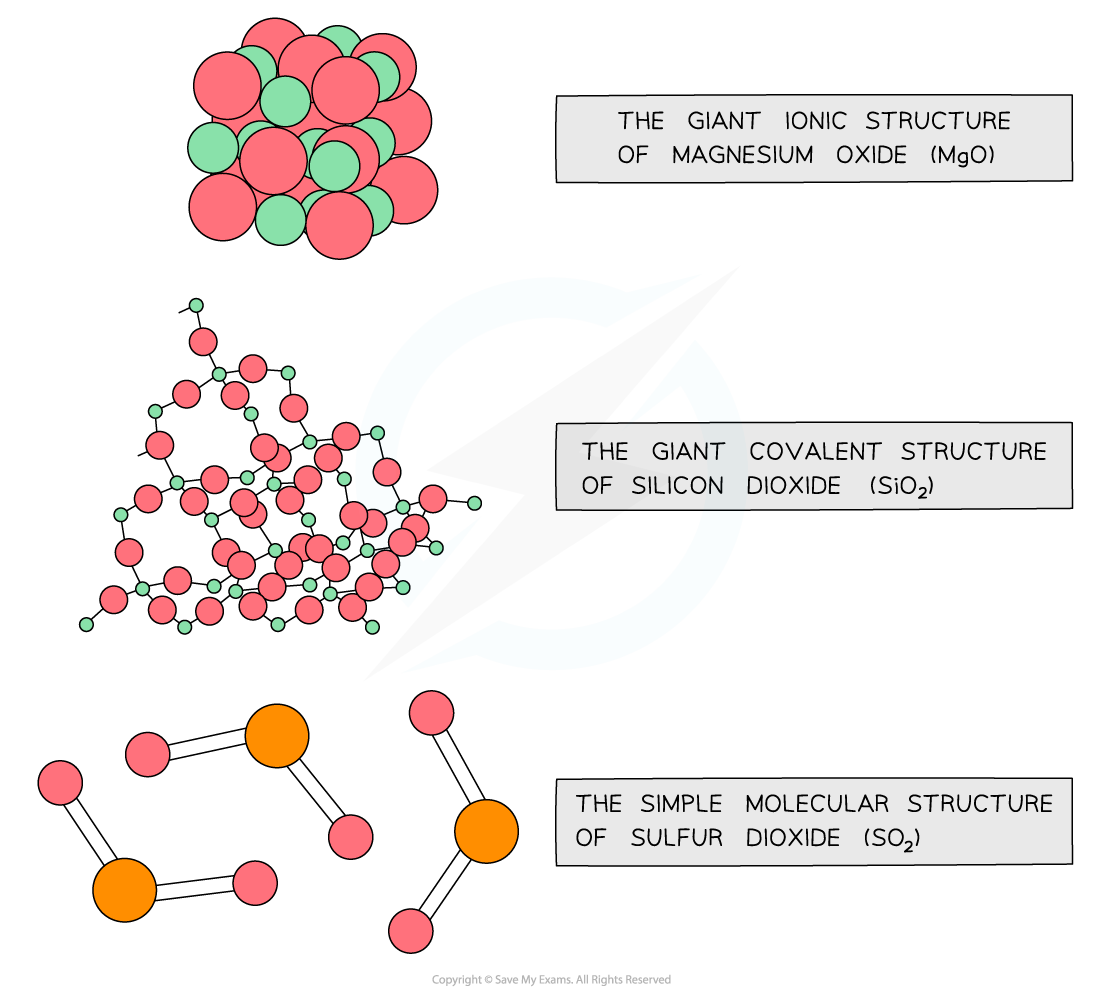
Magnesium oxide is giant ionic, silicon dioxide is giant covalent and sulfur dioxide is simple molecular
- The oxides of Na and Mg which show purely ionic bonding produce alkaline solutions with water as their oxide ions (O2-) become hydroxide ions (OH-):
O2- (aq) + H2O (l) → 2OH- (aq)
-
The oxides of P and S which show purely covalent bonding produce acidic solutions with water because when these oxides react with water, they form an acid which donates H+ ions to water
- Eg. SO3 reacts with water as follows:
SO3 (g) + H2O (l) → H2SO4 (aq)
- The H2SO4 is an acid which will donate a H+ to water:
H2SO4 (aq) + H2O (l) → H3O+(aq) + HSO4- (aq)
-
Al and Si are insoluble and when they react with hot, concentrated alkaline solution they act as an acid and form a salt
- This behaviour is very typical of a covalently bonded oxide
-
Al can also react with acidic solutions to form a salt and water
- This behaviour is very typical of an ionic bonded metal oxide
-
This behaviour of Al proves that the chemical bonding in aluminium oxide is not purely ionic nor covalent: it is amphoteric
Period 3 hydroxides
- NaOH is a strong base and will react with acids to form a salt and water:
NaOH (aq) + HCl (aq) → NaCl (aq) + H2O (l)
- Mg(OH)2 is also a basic compound which is often used in indigestion remedies by neutralising the excess acid in the stomach to relieve pain:
Mg(OH)2 (s) + 2HCl (aq) → MgCl2 (aq) + 2H2O (l)
- Al(OH)3 is amphoteric and can act both as an acid and base:
Al(OH)3 (s) + 3HCl (aq) → AlCl3 (s) + 3H2O (l)
Al(OH)3 (s) + NaOH (aq) → NaAl(OH)4 (aq)
Exam Hint
- Electronegativity is the power of an element to draw the electrons towards itself in a covalent bond.
- For example, in Na2O the oxygen will draw the electrons more strongly towards itself than sodium does.
Was this revision note helpful?
Build on this topic