Measuring the Standard Electrode Potential (Cambridge International A-Level Chemistry)
Spec point —
24.2.3
Measuring the Standard Electrode Potential
-
There are three different types of half-cells that can be connected to a standard hydrogen electrode
- A metal / metal ion half-cell
- A non-metal / non-metal ion half-cell
- An ion / ion half-cell (the ions are in different oxidation states)
-
When a half-cell is connected to a standard hydrogen electrode, or when two half-cells are connected, a salt bridge is required
- A salt bridge has mobile ions that complete the circuit
- A salt bridge is typically a strip of filter paper soaked in a saturated solution of potassium nitrate or potassium chloride as nitrates and chlorides are usually soluble
- This should ensure that no precipitates form which can affect the equilibrium position of the half-cells
Metal / metal ion half-cell
-
An example of a metal / metal ion half-cell is the Ag+/ Ag half-cell
- Ag is the metal
- Ag+ is the metal ion
-
This half-cell is connected to a standard hydrogen electrode and the two half-equations are:
Ag+(aq) + e- ⇌ Ag (s) Eꝋ = + 0.80 V
2H+(aq) + 2e- ⇌ H2(g) E ꝋ = 0.00 V
-
Since the Ag+ / Ag half-cell has a more positive Eꝋ value, this is the positive pole and the H+ / H2 half-cell is the negative pole
-
The standard cell potential (Ecellꝋ) is Ecellꝋ = (+ 0.80) - (0.00) = + 0.80 V*
-
The Ag+ ions are more likely to get reduced than the H+ ions as it has a greater Eꝋ value
- Reduction occurs at the positive pole
- Oxidation occurs at the negative pole
Example of an electrochemical cell containing a metal / metal ion half-cell
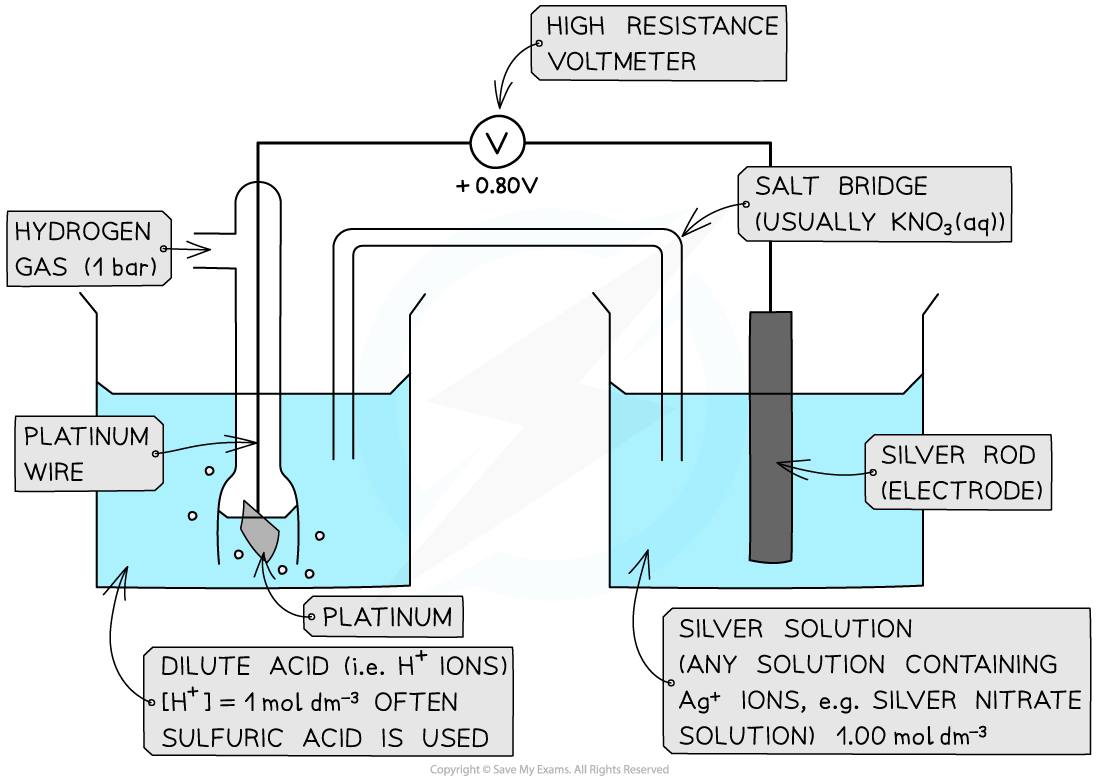
Under standard conditions, a metal / metal ion half-cell is connected to the standard hydrogen electrode to measure the cell potential
Non-metal / non-metal ion half-cell
-
In a non-metal / non-metal ion half-cell platinum wire or foil is used as an electrode to make electrical contact with the solution
- Like graphite, platinum is inert and does not take part in the reaction
- The redox equilibrium is established on the platinum surface
-
An example of a non-metal/non-metal ion is the Br2 / Br- half-cell
- Br is the non-metal
- Br- is the non-metal ion
-
The half-cell is connected to a standard hydrogen electrode and the two half-equations are:
Br2(l) + 2e- ⇌ 2Br-(aq) Eꝋ = +1.09 V
2H+(aq) + 2e- ⇌ H2(g) Eꝋ = 0.00 V
- The Br2 / Br- half-cell is the positive pole and the H+ / H2 is the negative pole
- Ecellꝋ= (+ 1.09) - (0.00) = + 1.09 V
- The Br2 molecules are more likely to get reduced than H+ as they have a greater Eꝋ value
Example of an electrochemical cell containing a non-metal / non-metal ion half-cell
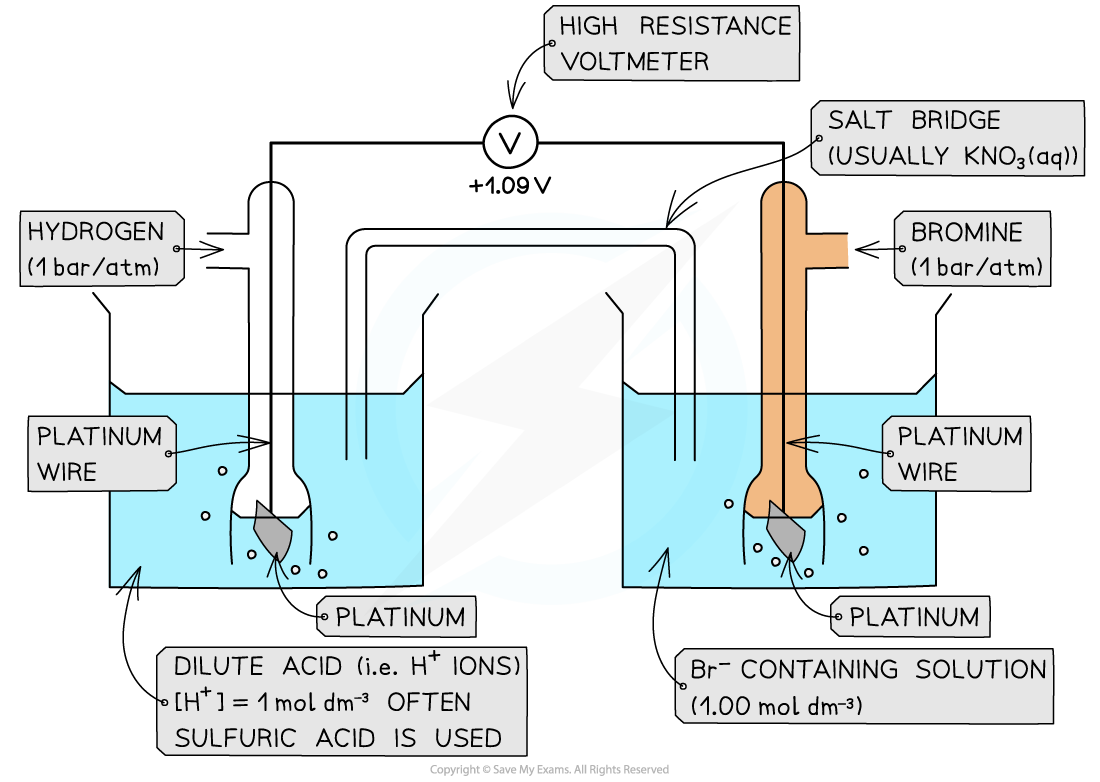
Under standard conditions, a non-metal / non-metal ion half-cell is connected to the standard hydrogen electrode to measure the cell potential
Ion / Ion half-cell
-
A platinum electrode is again used to form a half-cell of ions that are in different oxidation states
-
An example of such a half-cell is the MnO4- / Mn2+ half-cell
- MnO4- is an ion containing Mn with an oxidation number of +7
- The Mn2+ ion contains Mn with an oxidation number of +2
-
This half-cell is connected to a standard hydrogen electrode and the two half-equations are:
MnO4-(aq) + 8H+(aq) + 5e- ⇌ Mn2+(aq) + 4H2O (l) Eꝋ = +1.52 V
2H+(aq) + 2e- ⇌ H2(g) E ꝋ = 0.00 V
- The H+ ions are also present in the half-cell as they are required to convert MnO4- into Mn2+ ions
- The MnO4- / Mn2+ - half-cell is the positive pole and the H+ / H2 is the negative pole
- Ecellꝋ= (+ 1.52) - (0.00) = + 1.52 V
Example of an electrochemical cell containing an ion / ion half-cell
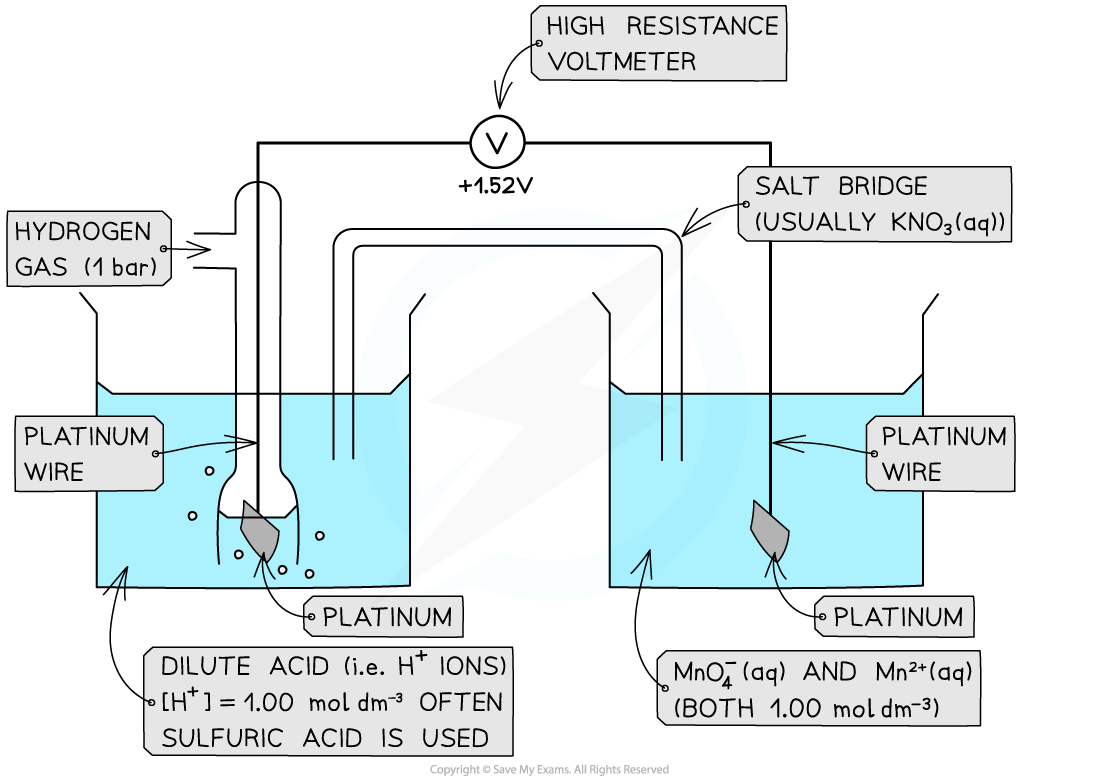
Under standard conditions, an ion / ion half-cell is connected to the standard hydrogen electrode to measure the cell potential
Standard Cell Potential: Direction of Electron Flow & Feasibility
Spec point —
24.2.5
Direction of electron flow
- The direction of electron flow can be determined by comparing the Eꝋ values of two half-cells in an electrochemical cell
Cl2(g) + 2e- ⇌ 2Cl-(aq) Eꝋ = +1.36 V
Cu2+(aq) + 2e- ⇌ Cu (s) Eꝋ = +0.34 V
-
The Cl2 more readily accept electrons from the Cu2+/Cu half-cell
- This is the positive pole
- Cl2 gets more readily reduced
-
The Cu2+ more readily loses electrons to the Cl2/Cl- half-cell
- This is the negative pole
- Cu2+ gets more readily oxidised
-
The electrons flow from the Cu2+/Cu half-cell to the Cl2/Cl- half-cell
-
The flow of electrons is from the negative pole to the positive pole
Flow of electrons through an electrochemical cell
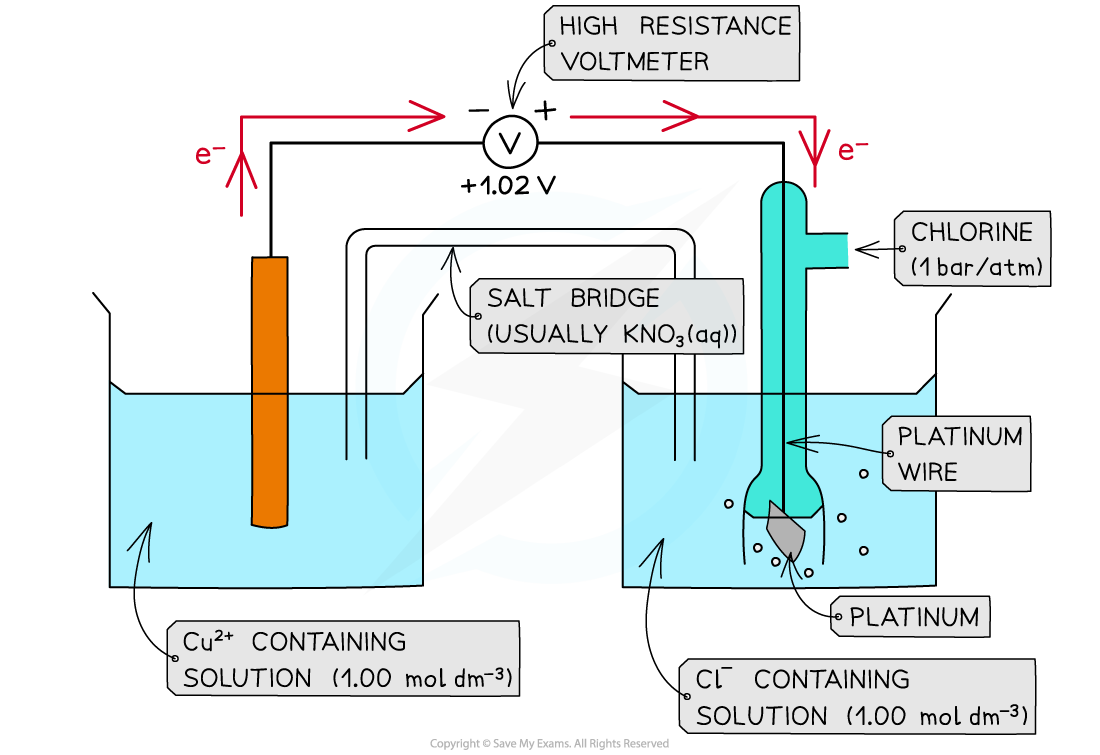
The electrons flow through the wires from the negative pole to the positive pole
Feasibility
-
The Eꝋ values of a species indicate how easily they can get oxidised or reduced
-
The more positive the value, the easier it is to reduce the species on the left of the half-equation
- The reaction will tend to proceed in the forward direction
-
The less positive the value, the easier it is to oxidise the species on the right of the half-equation
- The reaction will tend to proceed in the backward direction
- A reaction is feasible(likely to occur) when the Ecellꝋ is positive
-
For example, two half-cells in the following electrochemical cell are:
Cl2(g) + 2e- ⇌ 2Cl-(aq) Eꝋ = +1.36 V
Cu2+(aq) + 2e- ⇌ Cu (s) Eꝋ = +0.34 V
- Cl2 molecules are reduced as they have a more positive Eꝋ value
- The chemical reaction that occurs in this half-cell is:
Cl2(g) + 2e- → 2Cl-(aq)
- Cu2+ ions are oxidised as they have a less positive Eꝋ value
- The chemical reaction that occurs in this half-cell is:
Cu (s) → Cu2+(aq) + 2e-
- The overall equation of the electrochemical cell is (after cancelling out the electrons):
Cu (s) + Cl2(g) → 2Cl- (aq) + Cu2+(aq)
OR
Cu (s) + Cl2(g) → CuCl2(s)
- The forward reaction is feasible (spontaneous) as it has a positive Eꝋ value of +1.02 V ((+1.36) - (+0.34))
- The backward reaction is not feasible (not spontaneous) as it has a negative Eꝋ value of -1.02 ((+0.34) - (+1.36))
Reaction feasibility and the standard cell potential
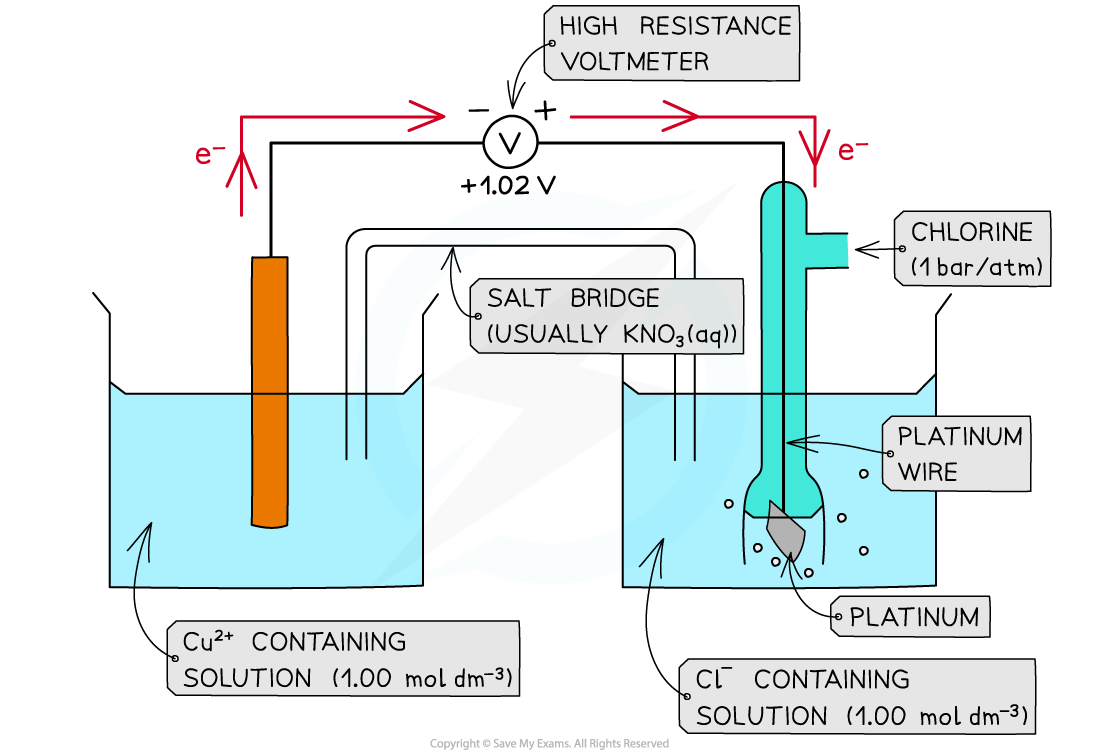
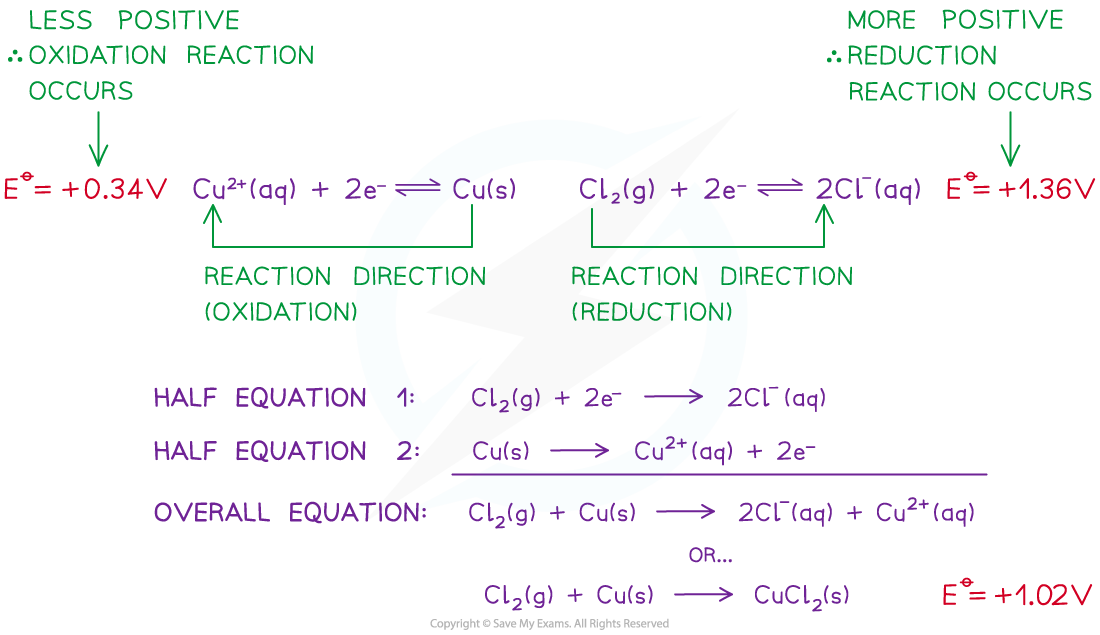
A reaction is feasible when the standard cell potential Eꝋ is positive
Exam Hint Remember that the electrons only move through the wires in the external circuit and not through the electrolyte solution.
Redox Equations
Spec point —
24.2.7
-
The main ways to construct redox equations using the relevant half-equations:
-
Using changes in oxidation numbers to help balance chemical equations
-
Using the number of electrons for each half-cell
- Both of these are discussed in the Redox Reactions topic
-
Interpreting the information given to you and predicting any other chemicals involved in the reaction
-
Worked Example Write the balanced chemical equation for hydrogen iodide reacting with sulfuric acid to form hydrogen sulfide, iodine and one other product
Answer:
There are 2 possible methods:
- Using ionic half-equations
- Interpreting the information and predicting any other chemicals involved
Using ionic half-equations method:
Step 1: Identify possible half-equations from the information
- Iodide → iodine
- Sulfuric acid → hydrogen sulfide
Step 2: Construct the half equations
Iodide → iodine
- I– → I2
- This requires 2 iodide ions and 2 electrons as products to balance the equation
- 2I– → I2 + 2e–
Sulfuric acid → hydrogen sulfide
- H2SO4 → H2S
- The 4 oxygen atoms will form 4 water molecules as products
- H2SO4 → H2S + 4H2O
- The 8 hydrogen atoms in the water molecules will require 8 protons as reactants
- H2SO4 + 8H+ → H2S + 4H2O
- The 8 protons will require 8 electrons to balance the charge
- H2SO4 + 8H+ + 8e– → H2S + 4H2O
Step 3: Combine the half-equations
Iodide → iodine
- 2I– → I2 + 2e–
- The iodide half-equation needs to be multiplied by 4 to have the same number of electrons as the sulfuric acid half-equation
- 8I– → 4I2 + 8e–
Sulfuric acid → hydrogen sulfide
- H2SO4 + 8H+ + 8e– → H2S + 4H2O
Combining the half-equations
- 8I– + H2SO4 + 8H+ + 8e– → 4I2 + 8e– H2S + 4H2O
Cancelling, where appropriate
- The electrons cancel on both sides
- The 8I– and 8H+ can be re-written as 8HI
- 8HI + H2SO4 → 4I2 + H2S + 4H2O
Interpreting and predicting method:
Step 1: Start with what you know:
- HI + H2SO4 → H2S + I2
Step 2: Consider any elements that are not accounted for
- The only element that is not currently considered is oxygen
Step 3: Make a common and appropriate suggestion for the missing product
- Most of these questions are in solution so there is always H2O, H+ and OH- available
- Missing product suggestion = 4H2O
- HI + H2SO4 → H2S + I2 + 4H2O
Step 4: Balance the remaining chemicals
- 8HI + H2SO4 → H2S + 4I2 + 4H2O
Exam Hint
- Similar approaches can be used to balance more complicated ionic half-equations
- In these situations, you will have H2O, H+, OH- and electrons available
Was this revision note helpful?