Synthetic Routes (Cambridge International A-Level Chemistry)
Exam board Cambridge International · A-LevelUpdated 2026-07-02
Analysis of Synthetic Routes
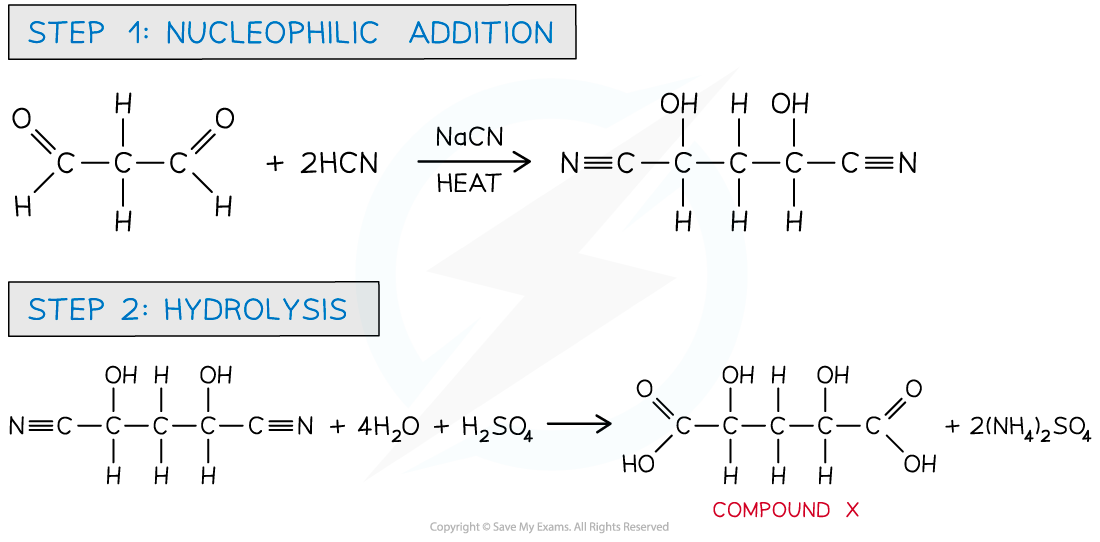
Worked Example The synthesis of compound X takes place in 2 steps:
OHCCH2CHO intermediate HO2CCH(OH)CH2CH(OH)CO2H compound X Which reagents could be used for this synthesis?
Answer:
- The first step involves a nucleophilic addition of CN- using NaCN as catalyst and heat to form a hydroxynitrile
- In the second step, the nitrile is refluxed with dilute aqueous sulfuric acid causing hydrolysis of the nitrile forming a carboxylic acid and ammonium salt
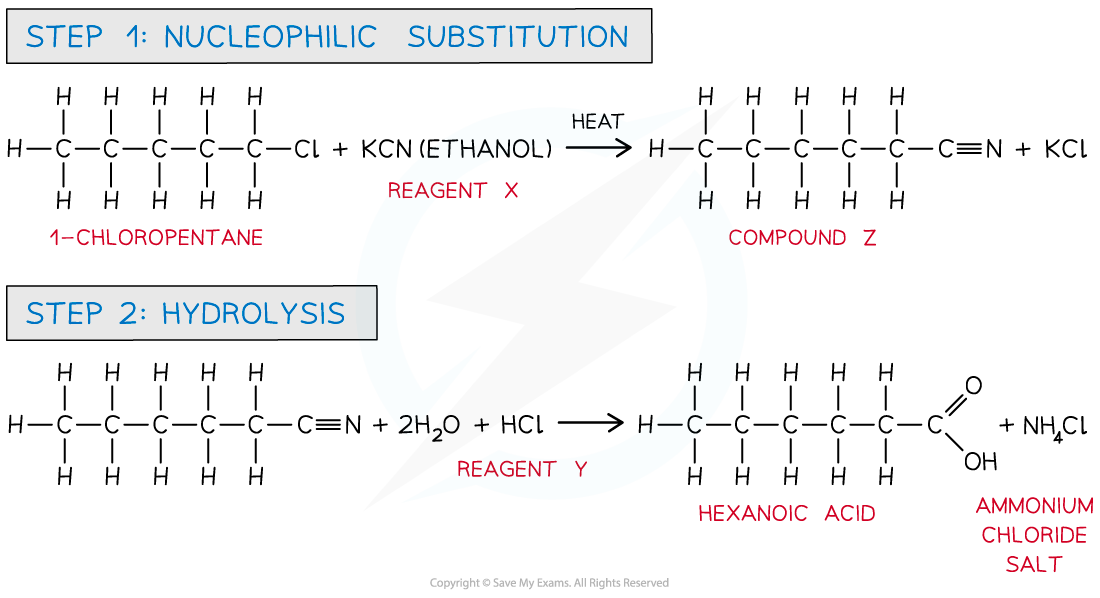
Worked Example The synthesis of hexanoic acid takes place in 2 steps
1-chloropentane compound Z hexanoic acid Which reagents could be used for this synthesis?
Answer:
- Halogenoalkanes can undergo nucleophilic substitution with ethanolic KCN in which the CN- ion acts as a nucleophile and replaces the chlorine atom in 1-chloropentane to form a nitrile.
- The treatment of nitriles with concentrated hydrochloric acid will produce a carboxylic acid and an ammonium salt.
- In this case, hexanoic acid and ammonium chloride will be formed.
Was this revision note helpful?
Build on this topic