Factors Affecting Enthalpy of Hydration (Cambridge International A-Level Chemistry)
Exam board Cambridge International · A-LevelUpdated 2026-07-02
Enthalpy of Hydration: Ionic Charge & Radius
- The standard enthalpy change of hydration (ΔHhydθ) is affected by the amount that the ions are attracted to the water molecules
- The factors which affect this attraction are the ionic charge and radius
Ionic radius
-
The standard enthalpy change of hydration ( ΔHhydθ) becomes more exothermic (more negative) as the ionic radius decreases
-
Smaller ions have a higher charge density, resulting in stronger ion–dipole attractions with water molecules
-
Therefore, more energy is released when these ions are hydrated
-
For example:
- Mg²⁺ in MgSO4 is smaller than Ba²⁺ in BaSO4
- As a result, ΔHhydθof MgSO4is more exothermic than that of BaSO4
Ionic charge
-
The enthalpy of hydration becomes more exothermic as the ionic charge increases
-
Higher charge leads to a greater charge density, strengthening ion–dipole attractions with water molecules
-
This means more energy is released during hydration
-
For example:
- Ca²⁺ and O²⁻ in CaO have higher charges than K⁺ and Cl⁻ in KCl
- Therefore, ΔHhydθof CaO is more exothermic than that of KCl
Comparing enthalpies of hydration
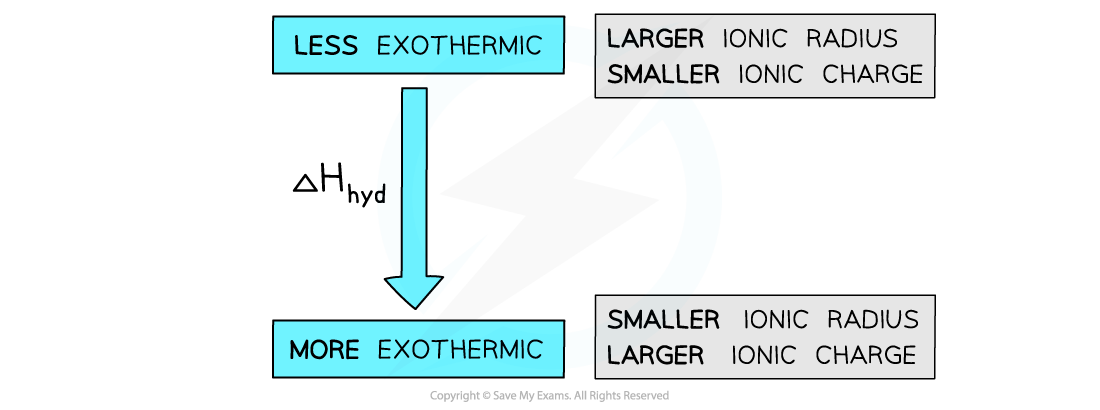
The enthalpy of hydration is more exothermic for smaller ions and ions with a greater ionic charge
Was this revision note helpful?
Build on this topic