Gas/Liquid Chromatography (Cambridge International A-Level Chemistry)
Exam board Cambridge International · A-LevelUpdated 2026-07-02
Gas/Liquid Chromatography Terminology
-
Gas-Liquid Chromatography (GLC) is used for analysing:
- Gases
- Volatile liquids
- Solids in their vapour form
-
The stationary phase:
- This method uses a column for the stationary phase
- A non-polar, long-chain, non-volatile hydrocarbon with a high boiling point is mounted onto a solid support
- Small silica particles can be packed into a glass column to offer a large surface area
- Sample gas particles travel through this phase and are able to separate well due to the large surface area
-
The Mobile phase
- An inert carrier gas (eg. Helium, Nitrogen) moves the sample molecules through the stationary phase
Retention times
-
Once sample molecules reach the detector, their retention times are recorded
- This is the time taken for a component to travel through the column
-
The retention times are recorded on a chromatogram where each peak represents a volatile compound in the analysed sample
-
Retention times are then compared with data book values to identify unknown molecules
An example gas chromatogram
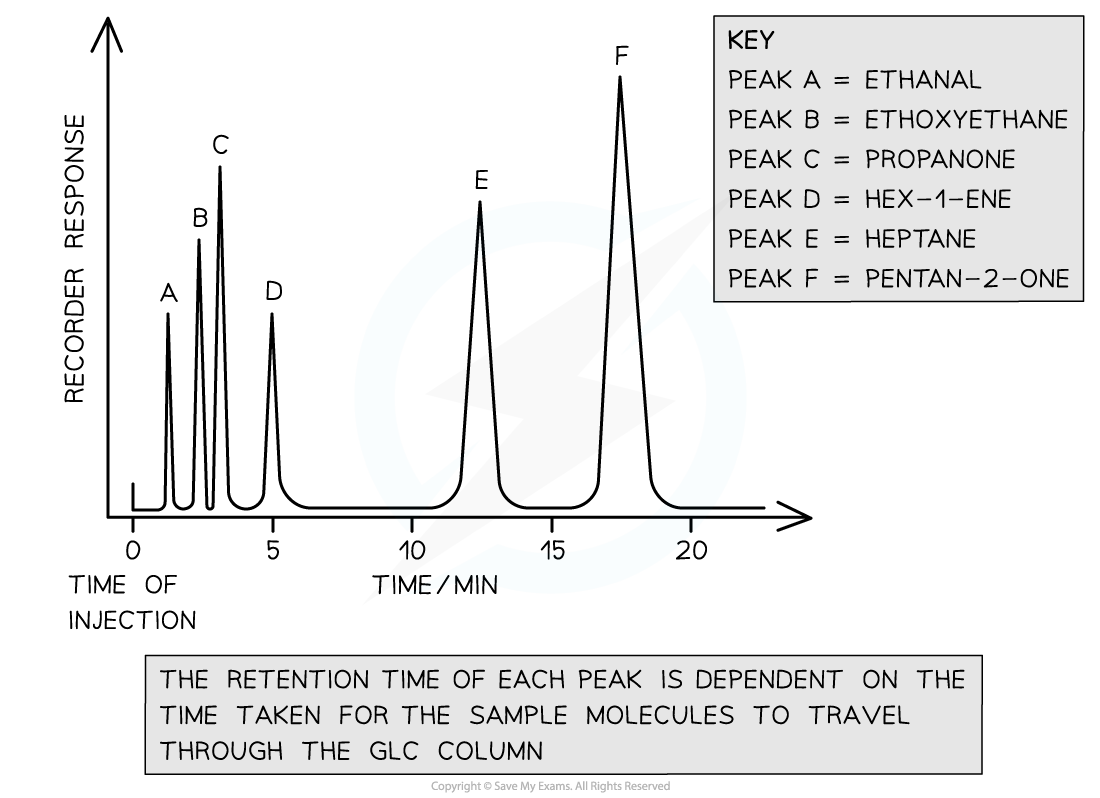
A gas chromatogram of a volatile sample compound has six peaks. Depending on each molecule’s interaction with the stationary phase, each peak has its own retention time
Was this revision note helpful?
Build on this topic