Determining Electronic Configuration (Cambridge International A-Level Chemistry)
Determining Electronic Configurations
-
Electron configuration shows how electrons are arranged in shells, subshells, and orbitals.
-
There are two formats:
- Full configuration; lists all electrons from 1s onward
- Shorthand configuration; uses the symbol of the nearest noble gas in brackets to represent inner electrons (e.g. [Ar])
-
Ions form when atoms gain or lose electrons:
- Anions (negative) form by adding electrons to the outer shell
- Cations (positive) form by removing electrons from the outer shell
-
Transition metals:
- Fill the 4s before 3d when neutral
- Lose electrons from 4s first, not 3d, when forming ions
-
In the Periodic Table the elements are grouped into blocks based on their valence subshell:
- s-block: valence electrons in an s orbital
- p-block: valence electrons in a p orbital
- d-block: valence electrons in a d orbital
- f-block: valence electrons in an f orbital
The blocks of the Periodic Table
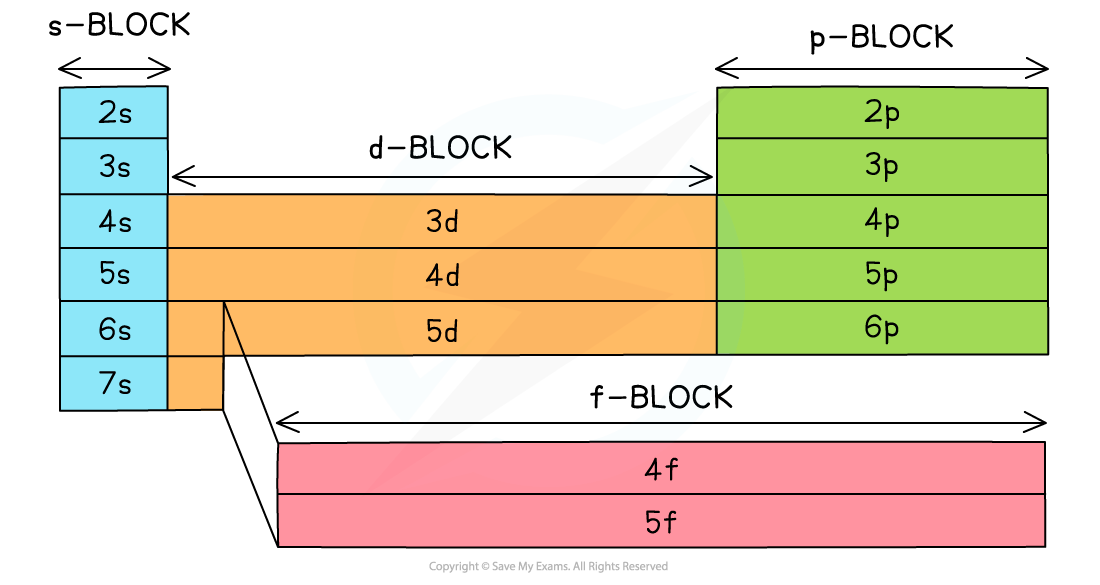
The elements can be divided into the s, p, d or f block, according to their outer shell electron configuration
Examples
-
Electronic configuration of Fe
- Atomic number = 26 so there are 26 electrons
- Full configuration: 1s2 2s2 2p6 3s2 3p6 4s2 3d6
- Shorthand: [Ar] 4s2 3d6
-
Electronic configuration of Fe2+
- Atomic number = 26 so there are 26 electrons, but the Fe2+ ion only has 24 electrons
- Electrons are removed from the 4s orbital before the 3d
- Full configuration: 1s2 2s2 2p6 3s2 3p6 3d6
- Shorthand: [Ar] 3d6
Exceptions to the Aufbau principle
-
Chromium and copper have the following electron configurations:
- Cr is [Ar] 3d5 4s1 not [Ar] 3d4 4s2
- Cu is [Ar] 3d10 4s1 not [Ar] 3d9 4s2
-
This is because the [Ar] 3d5 4s1 and [Ar] 3d10 4s1 configurations are energetically favourable
-
By promoting an electron from 4s to 3d, these atoms achieve a half full or full d-subshell, respectively
Worked Example
Write down the full and shorthand electron configuration of the following elements: Answer:
Potassium
Calcium
Gallium
Ca2+
Potassium
- Electrons: 19
- Full configuration: 1s2 2s2 2p6 3s2 3p6 4s¹
- Shorthand: [Ar] 4s¹
- Note: Argon (Ar) has 18 electrons and is the previous noble gas
Calcium
- Electrons: 20
- Full configuration: 1s2 2s2 2p63s2 3p6 4s2
- Shorthand: [Ar] 4s²
- Note: 4s is filled before 3d because it is lower in energy
Gallium
- Electrons: 31
- Full configuration: 1s2 2s2 2p6 3s2 3p6 3d10 4s2 4p1
- Shorthand: [Ar] 3d10 4s2 4p1
- Note: Includes filled 3d subshell after argon
Calcium 2+ ion
- Electrons: 18 (after losing two 4s electrons)
- Full configuration: 1s2 2s2 2p6 3s2 3p6
- Shorthand: [Ar]
- Note: Ca²⁺ has the same configuration as argon
Was this revision note helpful?
Build on this topic