Calculations using Born-Haber Cycles (Cambridge International A-Level Chemistry)
Born-Haber Cycles Calculations
Calculations Using Born-Haber Cycles
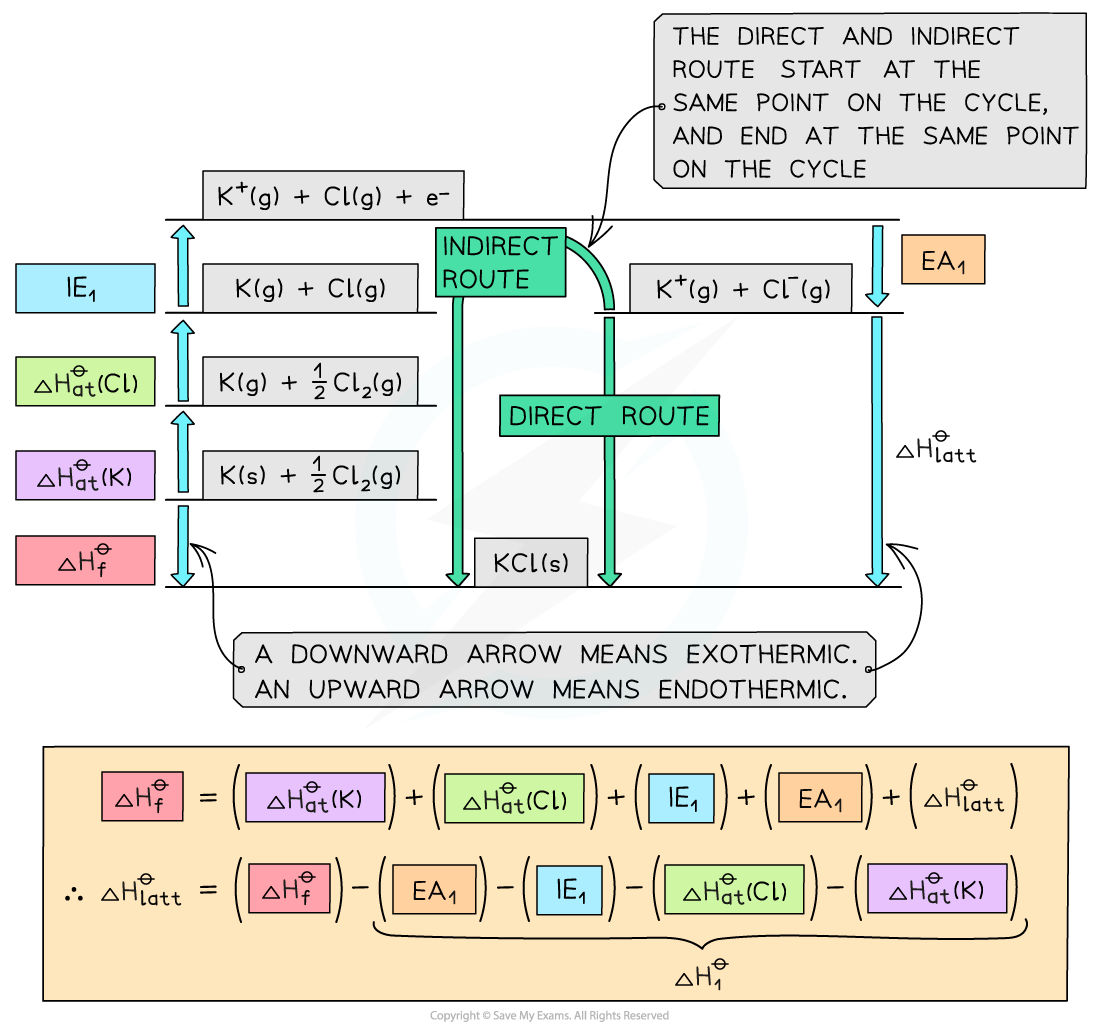
- Once a Born-Haber cycle has been constructed, it is possible to calculate the lattice energy (ΔHlattꝋ) by applying Hess’s law and rearranging:
ΔH fθ = ΔHatθ + ΔH atθ + IE + EA + ΔHlattθ
If we simplify this into three terms, this makes the equation easier to see:
- ΔHlattθ
- ΔHfθ
- ΔH1θ (the sum of all of the various enthalpy changes necessary to convert the elements in their standard states to gaseous ions)
- The simplified equation becomes
ΔH fθ = ΔH1θ + ΔHlattθ
So, if we rearrange to calculate the lattice energy, the equation becomes
ΔH lattθ = ΔHfθ - ΔH1θ
-
When calculating the ΔHlattθ, all other necessary values will be given in the question
-
A Born-Haber cycle could be used to calculate any stage in the cycle
- For example, you could be given the lattice energy and asked to calculate the enthalpy change of formation of the ionic compound
- The principle would be exactly the same
- Work out the direct and indirect route of the cycle (the stage that you are being asked to calculate will always be the direct route)
- Write out the equation in terms of enthalpy changes and rearrange if necessary to calculate the required value
-
Remember: sometimes a value may need to be doubled or halved, depending on the ionic solid involved
- For example, with MgCl2 the value for the first electron affinity of chlorine would need to be doubled in the calculation, because there are two moles of chlorine atoms
- Therefore, you are adding 2 moles of electrons to 2 moles of chlorine atoms, to form 2 moles of Cl- ions
Worked Example Using the data below, calculate the ΔHlattθ of potassium chloride, KCl.
ΔH atθ / kJ mol–1 ** IE / EA** / kJ mol –1 ** K +90 +418 Cl +122 -349 ΔH**fθ / kJ mol–1 KCl -437 Answer:
- **Step 1: **The corresponding Born-Haber cycle is:
**Step 2: **Applying Hess’ law, the lattice energy of KCl is:
- ΔH**lattθ** = ΔHfθ**- **ΔH1θ
- ΔHlattθ = ΔHfθ - [(ΔHatθ K) + (ΔHatθ Cl) + (IE1 K) + (EA1 Cl)]
- Step 3: Substitute in the numbers:
- ΔHlattθ = (-437) - [(+90) + (+122) + (+418) + (-349)] = –718 kJ mol-1–1
Worked Example Using the data below, calculate the ΔHlatt**θ **of magnesium oxide, MgO.
ΔH**atθ** / kJ mol –1 ** IE1** / EA 1 / kJ mol –1 ** IE2** / EA 2 / kJ mol –1 ** Mg +148 +736 +1450 O +248 –142 +770 ΔH**fθ/ kJ mol–1 MgO –602 Answer:
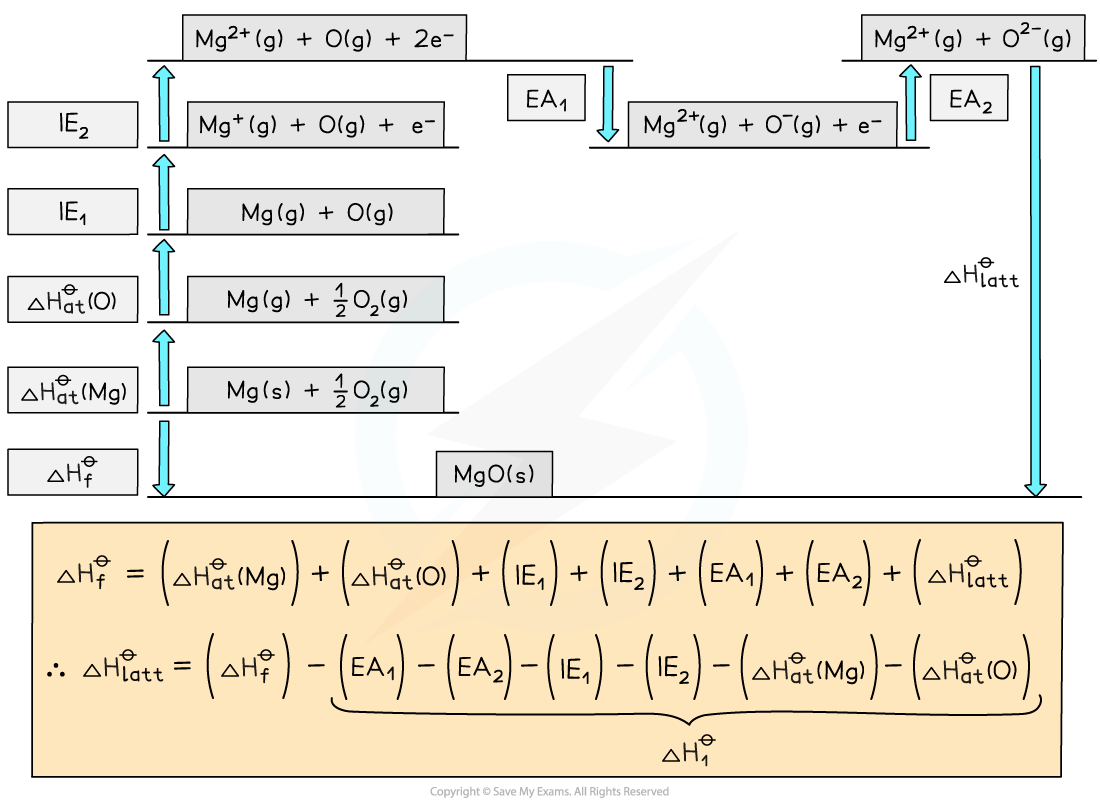
- **Step 1: **The corresponding Born-Haber cycle is:
**Step 2: **Applying Hess’ law, the lattice energy of MgO is:
- ΔH**lattθ** = ΔHfθ****- ΔH 1θ **
- ΔH**lattθ = ΔH fθ - [(ΔHatθ Mg) + (ΔH atθ O) + (IE1 Mg) + (IE 2 Mg) + (EA 1 O) + (EA 2 O)]**
- **Step 3: **Substitute in the numbers:
- ΔH**lattθ** = (-602) - [(+148) + (+248) + (+736) + (+1450) + (-142) + (+770)]**
Exam Hint Make sure you use brackets when carrying out calculations using Born-Haber cycles as you may forget a +/- sign which will affect your final answer!
Was this revision note helpful?
Build on this topic