Standard Cell Potential: Calculations, Electron Flow & Feasibility (Cambridge International A-Level Chemistry)
Standard Cell Potential Calculations
-
Once the Eꝋ of a half-cell is known, the potential difference or voltage or emf of an electrochemical cell made up of any two half-cells can be calculated
- These could be any half-cells and neither have to be a standard hydrogen electrode
-
The standard cell potential ( E*cellꝋ) can be calculated by subtracting the less positive Eꝋ from the more positive E*ꝋ value
- The half-cell with the more positive Eꝋ value will be the positive pole
- By convention this is shown on the right-hand side in a conventional cell diagram, so is termed **Erightꝋ
-
The half-cell with the less positive Eꝋ value will be the** negative pole
- By convention this is shown on the left-hand side in a conventional cell diagram, so is termed Eleftꝋ
Ecellꝋ= Eright ꝋ - Eleftꝋ
- Since oxidation is always on the left and reduction on the right, you can also use this version
Ecellꝋ= Ereduction ꝋ - Eoxidationꝋ
Worked Example Calculating the standard cell potential
Calculate the standard cell potential for the electrochemical cell below and explain why the Cu2+ / Cu half-cell is the positive pole. The half-equations are as follows:
Cu2+ (aq) + 2e**- ⇌ Cu (s) Eꝋ = +0.34 V
Zn2+ (aq) + 2e**- ⇌ Zn (s) Eꝋ = −0.76 V
Answer
- Step 1: Calculate the standard cell potential. The copper is more positive so must be the right hand side.
Ecellꝋ = Erightꝋ - Eleftꝋ
Ecellꝋ = (+0.34) - (-0.76) = +1.10 V
- Step 2: Determine the positive and negative poles
- The Cu2+ / Cu half-cell is the positive pole as its Eꝋ is more positive than the Eꝋ value of the Zn2+ / Zn half-cell
Exam Hint
- Students often confuse the redox process that take place in voltaic cells and electrolytic cells.
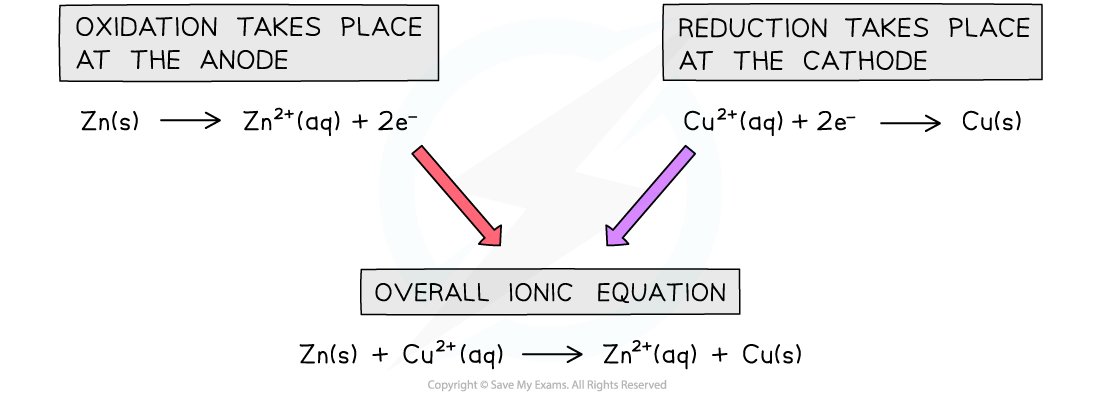
- An easy way to remember is the phrase RED CATS: REDuction takes place at the CAThode. OR AN OX. OXidation takes place at the ANode
Electrochemical Series
-
The Eꝋ values of a species indicate how easily they can get oxidised or reduced
-
In other words, they indicate the relative reactivity of elements, compounds and ions as oxidising agents or reducing agents
-
The electrochemical series is a list of various redox equilibria in order of decreasing Eꝋ values
-
More positive(less negative) Eꝋ values indicate that:
- The species is easily reduced
- The species is a better oxidising agent
-
Less positive(more negative) Eꝋ values indicate that:
- The species is easily oxidised
- The species is a better reducing agent
An example electrochemical series
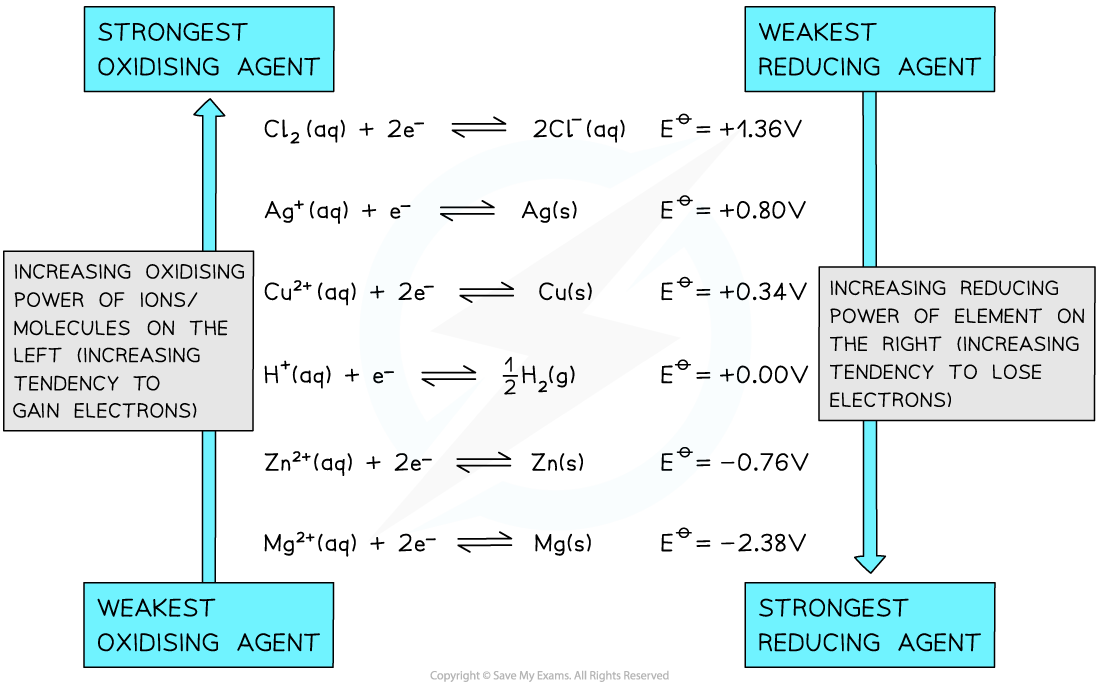
In this example electrochemical series the equilibria are arranged in order of decreasing Eꝋ values. These values can then be used to identify the strongest and weakest reducing / oxidising agents.
Was this revision note helpful?
Build on this topic