Redox Reactions (Cambridge International A-Level Chemistry)
Balancing Redox Reactions
-
Oxidation numbers can be used to balance chemical equations
-
Go through these steps to balance a redox equation:
- Write the unbalanced equation and identify the atoms which change in ox. no.
- Deduce the oxidation number changes
- Balance the oxidation number changes
- Balance the charges
- Balance the atoms
Worked Example Writing overall redox reactions
Manganate(VII) ions, MnO4–, react with Fe2+ ions in the presence of acid, H+, to form Mn2+ ions, Fe3+ ions and water.
Write the overall redox equation for this reaction.
Answer
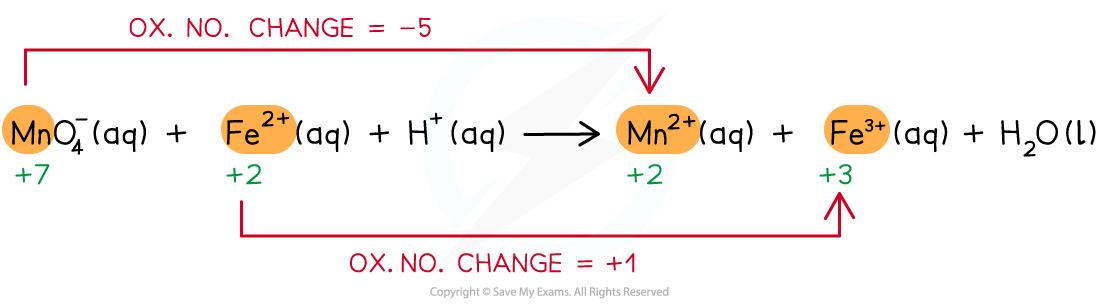
- Step 1: Write the unbalanced equation and identify the atoms which change in oxidation number:
- Step 2: Deduce the oxidation number changes:
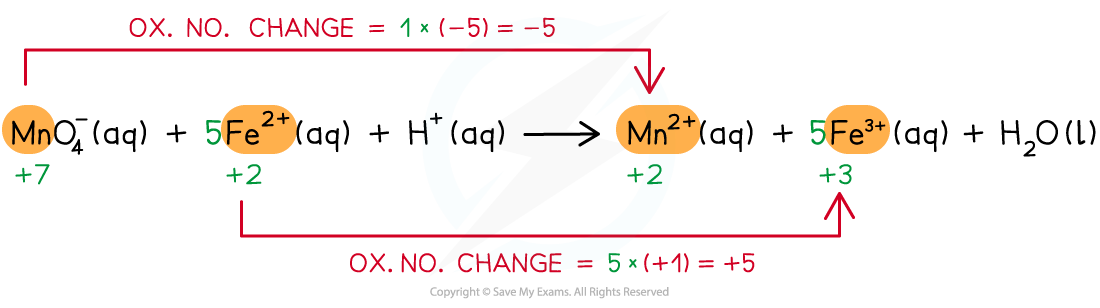
- Step 3: Balance the oxidation number changes:
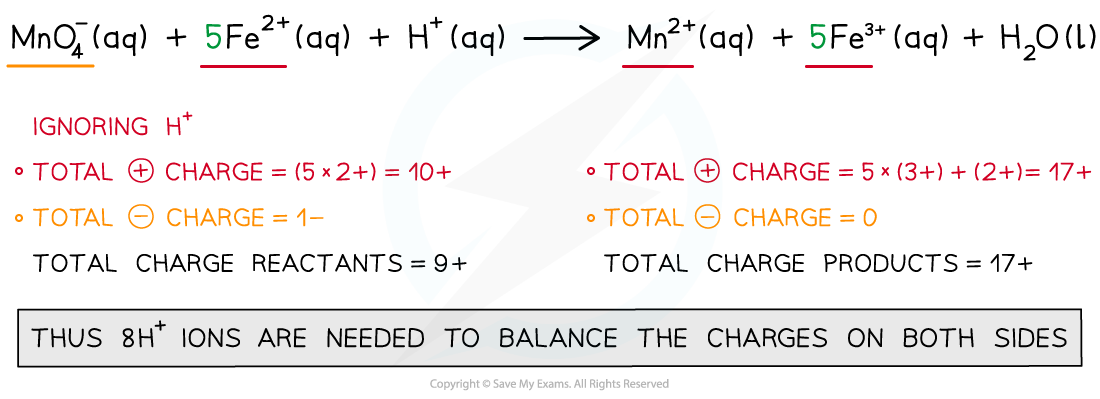
- Step 4: Balance the charges:
- Step 5: Balance the atoms:


Redox & Disproportionation Reactions
Oxidation
-
Oxidation is the gain of oxygen, e.g.:
- Cu + H2O → CuO + H2
- Cu has gained an oxygen and is oxidised
-
Oxidation is also the loss of a hydrogen, e.g.:
- 2NH3+ 3Br2→ N2+ 6HBr
- N has lost a hydrogen and is oxidised
-
Oxidation is also the loss of electrons, e.g.:
- Cu2++ Mg → Mg2++ Cu
- Mg has lost two electrons and is oxidised
-
Oxidation causes an increase in oxidation number, e.g:
- Cu2++ Mg → Mg2++ Cu
- The oxidation number of Mg changes from 0 to +2, thus Mg is oxidised
Reduction
-
Reduction is the loss of oxygen, e.g.:
- Cu+ H2O → 2CuO + H2
- H has been reduced
-
Reduction is also the gain of a hydrogen, e.g.:
- 2NH3+ 3Br2→ N2+ 6HBr
- Br has been reduced
-
Reduction is also the gain of electrons, e.g.:
- Cu2++ Mg → Mg2++ Cu
- Cu has been reduced
-
Reduction causes a decrease in oxidation number, e.g.:
- Cu2++ Mg → Mg2++ Cu
- The oxidation number of Cu changes from +2 to 0, thus Cu is reduced
OIL RIG acronym
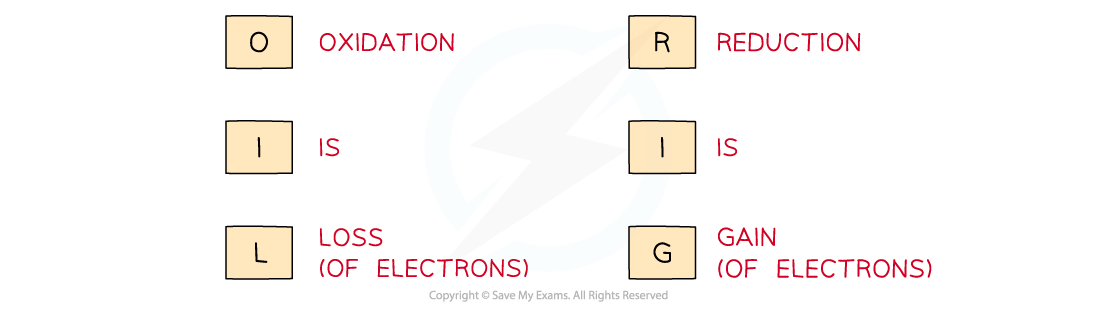
Use the acronym "Oil Rig" to help you remember the definitions of oxidation and reduction
Redox reactions
-
Redox reactions are reactions in which oxidation and reduction take place together
- While one species is oxidising, another is reducing in the same reaction
-
For example:
Cu2++ Mg → Mg2++ Cu
- Cu has been reduced from +2 to 0
- Mg has been oxidised from 0 to +2
Worked Example Oxidation and reduction
In each of the following equations, state which reactant has been oxidised and which has been reduced.
- 2Na + Cl2 → 2NaCl
- Mg + Fe2+ → Mg2+ + Fe
- CO + Ag2O → 2Ag + CO2
Answer
Answer 1:
- Oxidised: Na as the oxidation number has increased from 0 to +1
- Reduced: Cl2 as the oxidation number has decreased from 0 to –1
Answer 2:
- Oxidised: Mg as the oxidation number has increased by 2
- Reduced: Fe2+ as the oxidation number has decreased by 2
Answer 3:
- Oxidised: C as it has gained oxygen
- Reduced: Ag as it has lost oxygen
Disproportionation reactions
- A disproportionation reaction is a reaction in which the same species is both oxidised and reduced at the same time
Example disproportion reaction

Worked Example Balancing disproportionation reactions
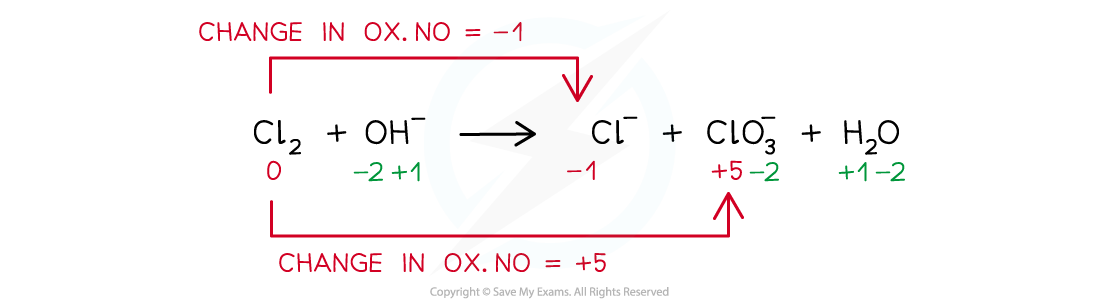
Balance the disproportionation reaction which takes place when chlorine is added to hot concentrated aqueous sodium hydroxide.
The products are Cl– ions, ClO3– ions and water.
Answer
- Step 1: Write the unbalanced equation and identify the atoms that change in oxidation number:
- Step 2: Deduce the oxidation number changes:
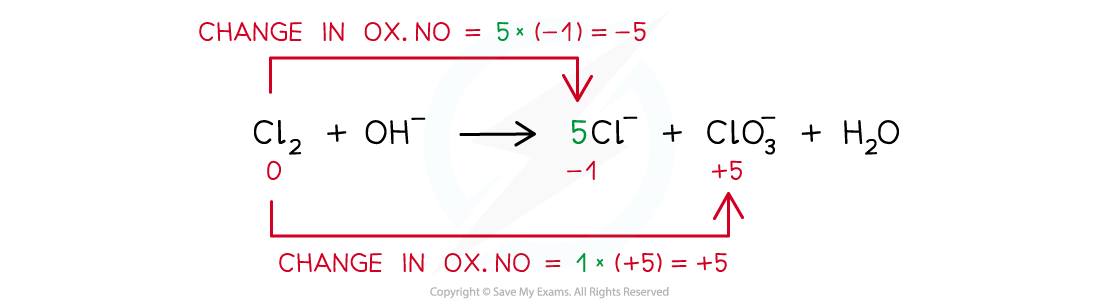
- Step 3: Balance the oxidation number changes:
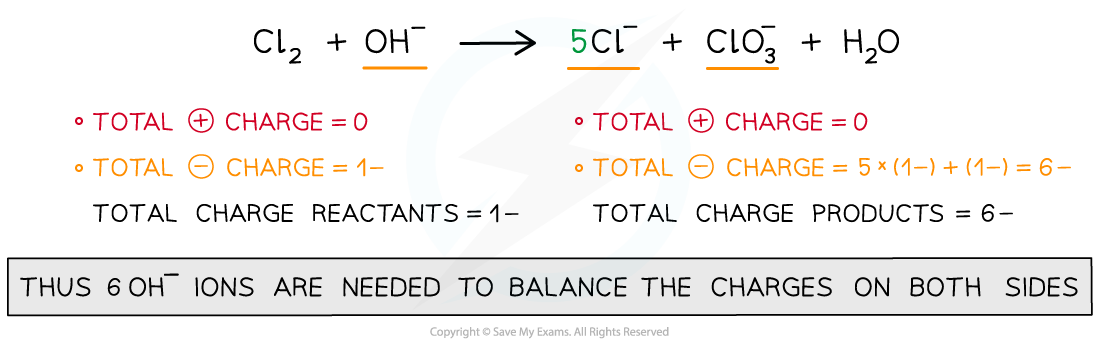
- Step 4: Balance the charges:
- Step 5: Balance the atoms:

Was this revision note helpful?
Build on this topic