Electronegativity & Bonding (Cambridge International A-Level Chemistry)
Using Electronegativity to Predict Bond Formation
- The differences in Pauling electronegativity values can be used to predict whether a bond is covalent or ionic in character
Electronegativity & covalent bonds
-
Single covalent bonds are formed by sharing a pair of electrons between two atoms
-
In diatomic molecules, the electron density is shared equally between the two atoms
- Eg. H2, O2 and Cl2
-
Both atoms will have the same electronegativity value and have an equal attraction for the bonding pair of electrons leading to the formation of a covalent bond
-
The equal distribution leads to a non-polar molecule
Electronegativity and non-polar molecules
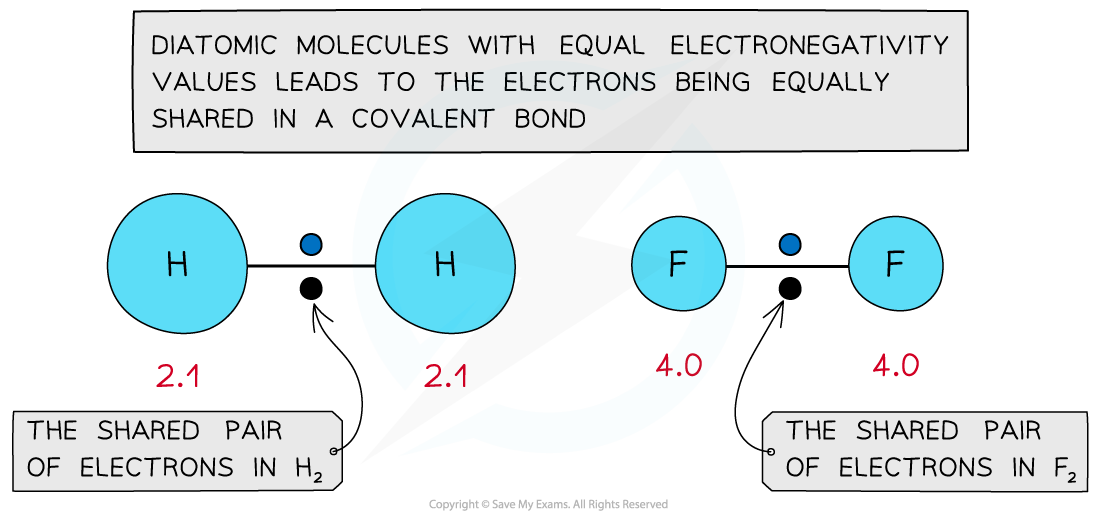
The electronegativity values are equal resulting in the formation of a nonpolar covalent bond
Electronegativity & polar covalent bonds
- When atoms of different electronegativities form a molecule, the shared electrons are not equally distributed in the bond
- The more electronegative atom (the atom with the higher value on the Pauling scale) will draw the bonding pair of electrons towards itself
- A molecule with partial charges forms as a result
- The more electronegative atom will have a partial negative charge (delta negative, δ-)
- The less electronegative atom will have a partial positive charge (delta positive, δ+)
- This leads to a polar covalent molecule
Electronegativity and polar covalent molecules
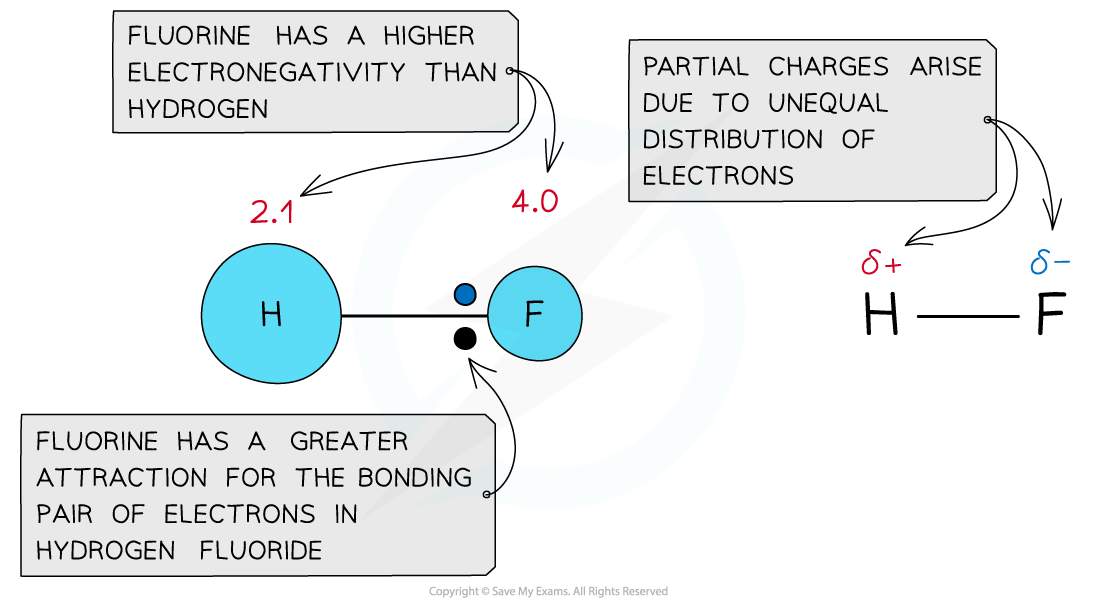
The electronegativity values are not equal so a polar bond forms
-
If there is a large difference in electronegativity of the two atoms in a molecule, the least electronegative atom’s electron will transfer to the other atom
-
This in turn leads to an ionic bond – one atom transfers its electron and the other gains that electron
- The cation is a positively charged species which has lost(an) electron(s)
- The anion is a negatively charged species which has gained(an) electron(s)
Electronegativity and ionic bonding
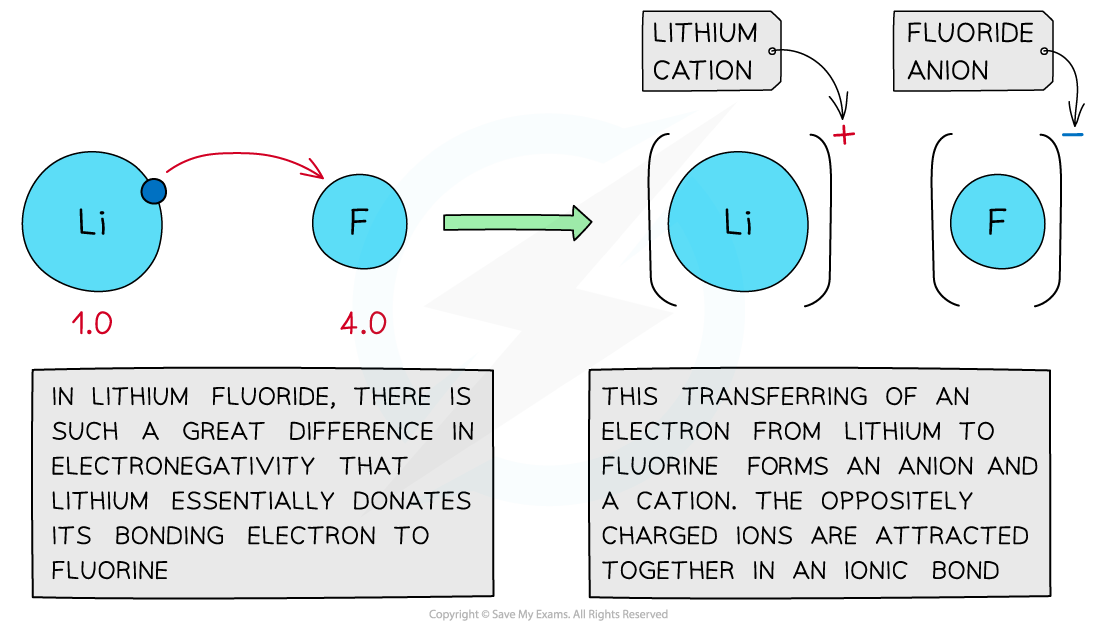
Large differences in electronegativity values lead to the formation of ionic bonds
Exam Hint Electronegativity difference (ΔEN) gives a guide to how polar a bond is (it’s a continuum, not a strict rule):
- ΔEN ≈ 0.0–0.4 means non-polar covalent
- ΔEN ≈ 0.4–1.7 means polar covalent
- ΔEN ≳ 1.7 means mostly ionic
Remember: a polar* bond *doesn’t always mean a polar molecule, the shape of the molecule determines whether bond dipoles cancel out.
Was this revision note helpful?