Factors Affecting Lattice Energy (Cambridge International A-Level Chemistry)
Exam board Cambridge International · A-LevelUpdated 2026-07-02
Lattice Energy: Ionic Charge & Radius
- The two key factors which affect lattice energy, ΔHlattꝋ, are the charge and radius of the ions that make up the crystalline lattice
Ionic radius
-
The lattice energy becomes less exothermic (numerically less negative) as the ionic radius increases
- In larger ions, the charge is spread over a greater volume, so charge density is lower
- The ions are also further apart in the lattice, increasing the distance between their centres
- As a result, the electrostatic attraction between oppositely charged ions is weaker, and less energy is released when the lattice forms
-
For example:
- Both CsF and KF contain F⁻ ions
- Cs⁺ is larger than K⁺, so the lattice energy of CsF is less exothermic than that of KF
Trends in the lattice energy of different metal halides
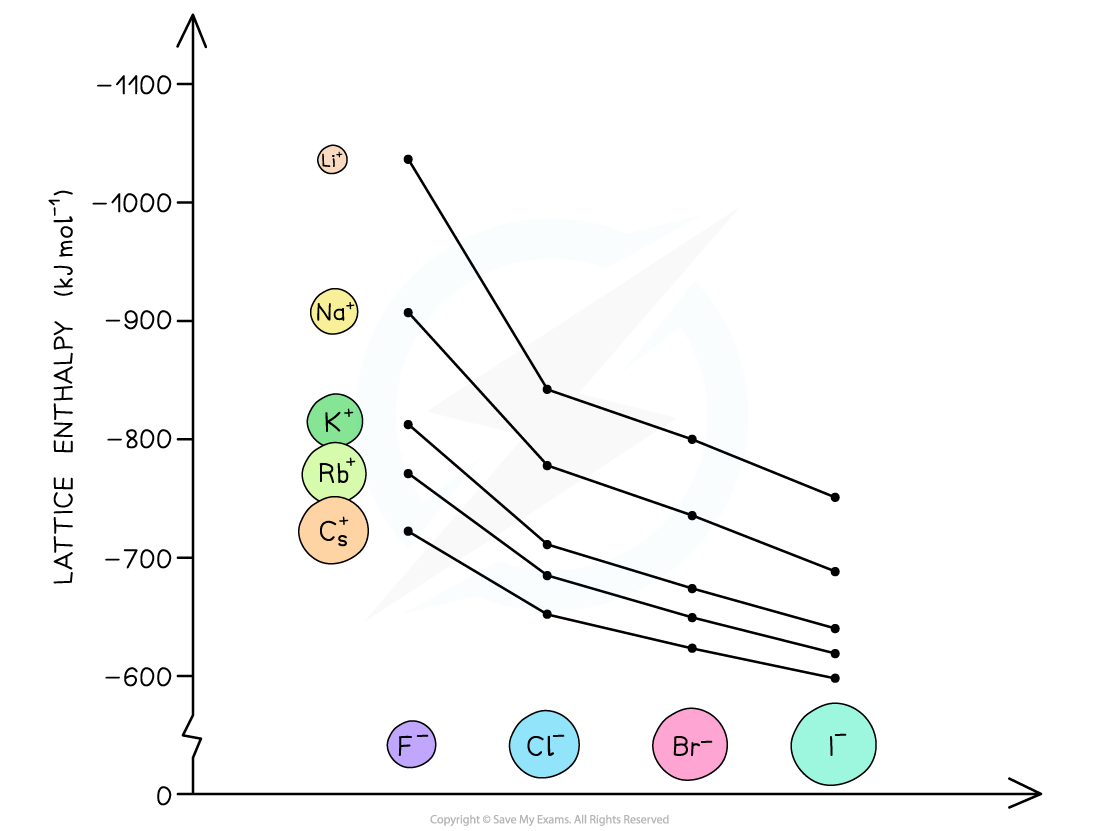
The lattice energies get less exothermic as the ionic radius of the ions increases
Ionic charge
The lattice energy becomes more exothermic (more negative) as the ionic charge increases.
-
Higher ionic charge leads to higher charge density
-
This results in stronger electrostatic attractions between oppositely charged ions
-
Consequently, more energy is released when the lattice is formed
-
For example:
- CaO is composed of Ca²⁺ and O²⁻ ions, while KCl contains K⁺ and Cl⁻ ions
- The ions in CaO have higher charges, so the electrostatic forces are stronger
- Therefore, the lattice energy of CaO is more exothermic than that of KCl
- Additionally, Ca²⁺ and O²⁻ ions are smaller than K⁺ and Cl⁻, further increasing the exothermic value
Was this revision note helpful?
Build on this topic