Nitration & Bromination of Phenol (Cambridge International A-Level Chemistry)
Spec point —
32.2.5
Nitration & Bromination of Phenol
- Compared to benzene, phenol reacts more readily with electrophiles
- This is because one of the lone pairs of electrons on the oxygen atom in phenol overlaps with the π bonding system of the benzene ring
- As a result, there is now an increased electron density in the ring
- The electron-donating-OH group in phenol, therefore, activates the benzene ring and directs incoming electrophiles to the 2, 4, and 6 positions
- The increased reactivity of phenol means that different reagents and conditions are used for electrophilic substitution reactions of phenols compared to benzene
Nitration
-
Nitration is an example of an electrophilic substitution reaction
-
The nitration of benzene requires a mixture of concentrated nitric acid (HNO2) and sulfuric acid (H2SO4) refluxed with benzene between 25oC and 60oC
-
Since phenol is more reactive, nitration can occur under milder conditions by reacting it with dilute nitric acid at room temperature
- If concentrated nitric acid is used, 2,4,6-trinitrophenol is formed
Bromination
- Bromination is another example of an electrophilic substitution reaction
- Benzene will undergo bromination only when reacted with pure bromine (not a solution) and in the presence of an anhydrous aluminium bromide (AlBr3) catalyst at room temperature
- Phenol on the other hand readily reacts with bromine water in the absence of a catalyst
Reagents & conditions for nitration and bromination of phenol & benzene table
| Reaction | Benzene | Phenol |
|---|---|---|
| Nitration | Concentrated nitric acid and concentrated sulfuric acid Reflux between 25 oC and 60 oC | Dilute nitric acid Room temperature |
| Bromination | Pure bromine Aluminium bromide (AlBr3) catalyst | Bromine water Room temperature |
Directing Effects of Hydroxyl Group on Phenol
Spec point —
32.2.5
-
Phenols consist of a hydroxyl (-OH) group attached to a benzene ring
-
The oxygen atom in this hydroxyl group donates electron density into the ring
-
One of the lone pairs of the oxygen atom overlaps with the π system of the benzene ring and becomes delocalised causing an increased electron density in the aromatic ring
-
Due to the increased electron density, the benzene ring is now more likely to undergo electrophilic attack and becomes activated
-
The hydroxyl group of the phenol directs the incoming electrophiles to the 2, 4, and 6 positions
-
An example is the bromination of phenol
- The bromine acts as an electrophile and substitutes a hydrogen atom in the benzene ring
- The substitution of the hydrogen atom can occur on the 2, 4, or 6 positions
Bromination of phenol
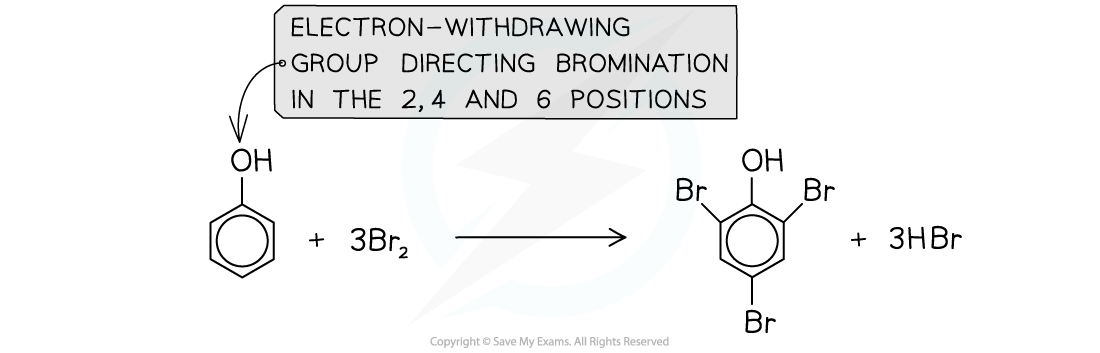
The hydroxyl group in phenol directs bromination in the 2, 4 and 6 positions
Was this revision note helpful?
Build on this topic