Transition Metal Complexes (Cambridge International A-Level Chemistry)
Complex Formation
What is a complex?
-
A complex is a molecule or ion formed by a central metal atom or ion surrounded by one or more ligands
-
A ligand is a species with a lone pair of electrons that can be donated to the metal ion
- Ligands form dative covalent bonds with the metal by donating their lone pair of electrons
-
For example, [Al(H2O)6]3+ (aq):

Al(III) is the central metal ion with 6 water ligands, each donating a lone pair
Transition metal complex formation
-
Transition metal ions readily form complexes with ligands
-
Copper(II) and cobalt(II) ions will be used as examples of the central metal ions, in the complexes with:
- Water (H2O)
- Ammonia (NH3)
- Hydroxide (OH-)
- Chloride (Cl-)
Co(II) and Cu(II) complexes with water & ammonia
-
Water and ammonia are neutral ligands
- Water donates a lone pair from the oxygen atom
- Ammonia donates a lone pair from the nitrogen atom
-
Water and ammonia are small ligands
- Up to 6 water or ammonia ligands can fit around a central metal ion
- This results in 6 dative covalent bonds
-
6 dative covalent bonds give:
-
An octahedral shape
-
A coordination number of 6
- The coordination number of a complex is the number of dative covalent bonds formed between the central metal ion and the ligands
-
Cobalt(II) and copper(II) complexes with water and ammonia
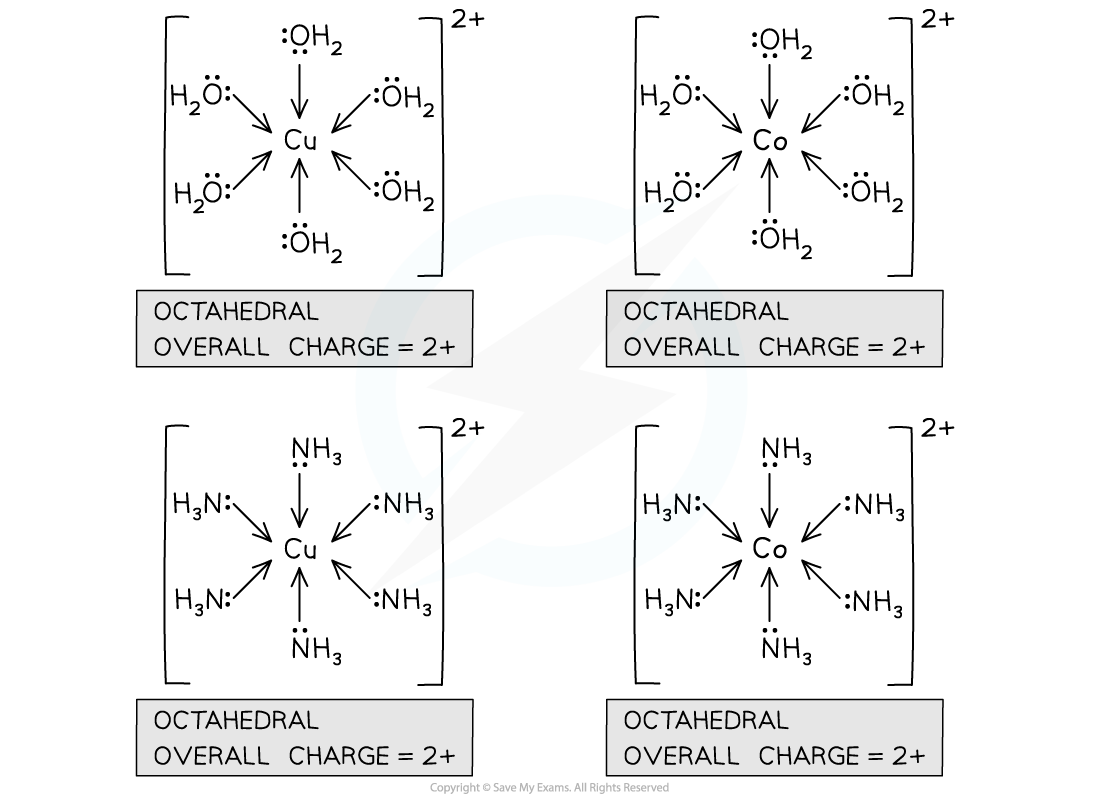
Cobalt(II) and copper(II) form octahedral complexes with ammonia and water ligands
-
The overall charge of a complex is the sum of the charge on the central metal ion, and the charges on each of the ligands
-
For a cobalt(II) or copper(II) complex with 6 water or ammonia ligands:
- The central metal ion has a charge of 2+
- The ligands have a charge of 0
- So, the overall charge of the complex is (2+) + (6 x 0) = 2+
Complexes with hydroxide & chloride ions
-
Hydroxide ions, OH-, and chloride ions, Cl-, are negatively charged ligands
- Each donates a lone pair of electrons to form a dative covalent bond with the central metal ion
Hydroxide complexes
-
Hydroxide ions are small ligands
-
Up to 6 hydroxide ions can fit around a central metal ion
-
This results in:
- 6 dative covalent bonds
- An octahedral shape
- A coordination number of 6
-
Exam Hint Although up to 6 hydroxide ions can fit around a central metal ion, in many examples only 2 hydroxide ions are present alongside 4 water ligands
Chloride complexes
-
Chloride ions are large ligands
- Up to 4 chloride ligands can fit around a central metal ion
- This results in 4 dative covalent bonds
-
4 dative covalent bonds give:
- A tetrahedral shape
- A coordination number of 4
Charges of Co(II) complexes with hydroxide and chloride ligands
-
Co(II) ions commonly form complexes with 2 hydroxide ion ligands
- The remaining ligands are water
-
For this cobalt(II) complex:
- The central metal ion has a charge of 2+
- The water ligands have a charge of 0
- The 2 hydroxide ligands have a charge of 2 x (-1) = -2
- So, the overall charge of the complex is (2+) + (4 x 0) + (-2) = 0
[Co(H2O)4(OH)2]
-
Co(II) ions commonly form complexes with 4 chloride ion ligands
-
For this cobalt(II) complex:
- The central metal ion has a charge of 2+
- The 4 chloride ligands have a charge of 4 x (-1) = -4
- So, the overall charge of the complex is (2+) + (-4) = -2
[CoCl4]2-
Charges of Cu(II) complexes with hydroxide and chloride ligands
-
Cu(II) ions commonly form complexes with 2 hydroxide ion ligands
- The remaining ligands are water
-
For this copper(II) complex:
- The central metal ion has a charge of 2+
- The water ligands have a charge of 0
- The 2 hydroxide ligands have a charge of 2 x (-1) = -2
- So, the overall charge of the complex is (2+) + (4 x 0) + (-2) = 0
[Cu(H2O)4(OH)2]
-
Cu(II) ions commonly form complexes with 4 chloride ion ligands
-
For this copper(II) complex:
- The central metal ion has a charge of 2+
- The 4 chloride ligands have a charge of 4 x (-1) = -4
- So, the overall charge of the complex is (2+) + (-4) = -2
[CuCl4]2-
Comparing copper(II) and cobalt(II) complexes with chloride and water / hydroxide ions
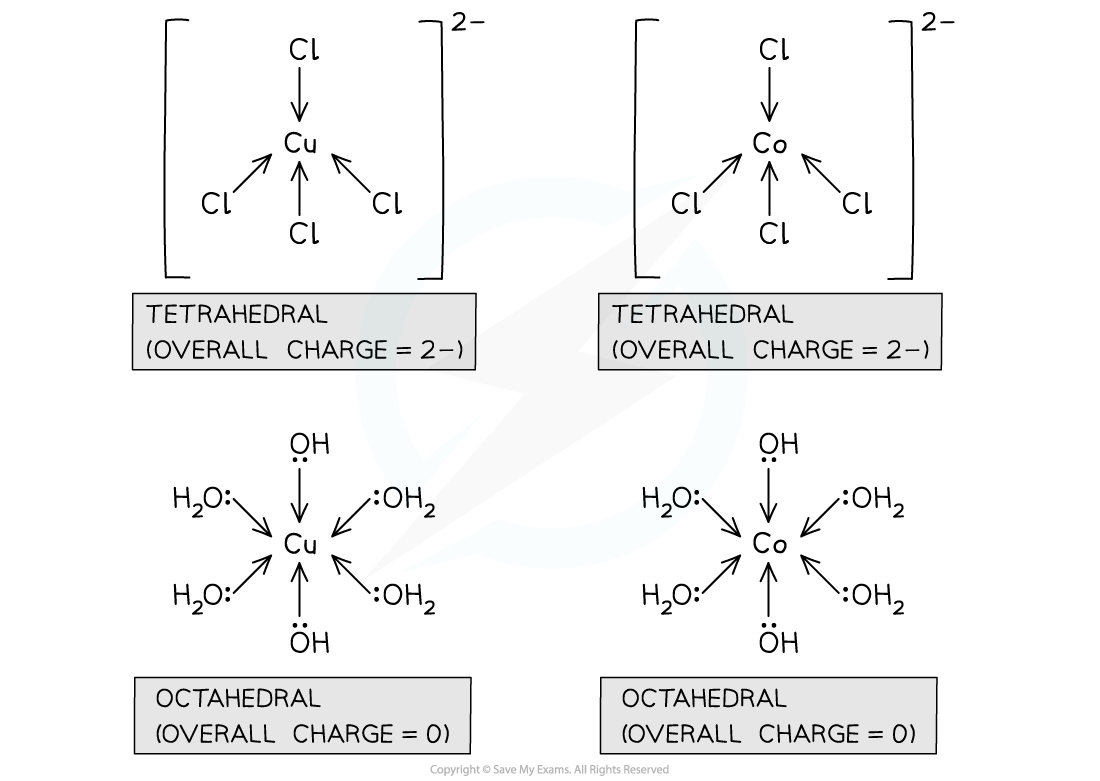
Cobalt(II) and copper(II) form tetrahedral complexes with chloride and octahedral complexes with water and hydroxide ligands
Was this revision note helpful?
Build on this topic