Atomic Structure & Subatomic Particles (Cambridge International A-Level Chemistry)
Structure of the Atom
-
All matter is composed of atoms, which are the smallest parts of an element that can take place in chemical reactions
-
Atoms are mostly made up of empty space around a very small, dense nucleus that contains protons and neutrons
-
The nucleus has an overall positive charge
- The protons have a positive charge and the neutrons have a neutral charge
-
Negatively charged electrons are arranged in shells (also known as energy levels) that surround the nucleus
The structure of an atom
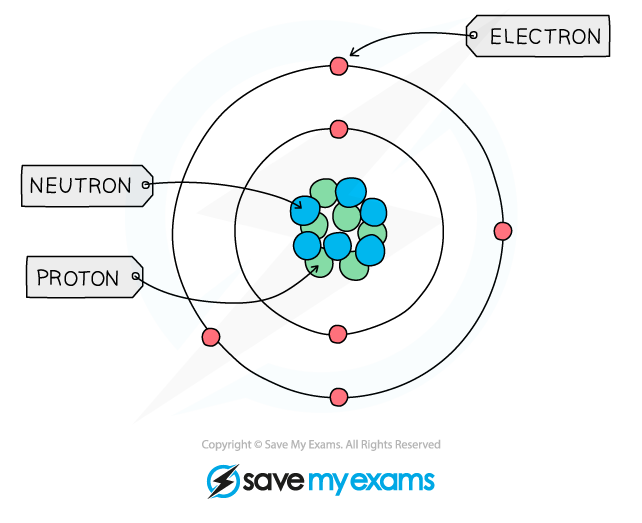
Atoms contains protons, neutrons and electrons
Mass & Charge of Subatomic Particles
-
Atoms are made up of protons, neutrons, and electrons, collectively known as subatomic particles.
- These particles are very small, so their actual masses and charges cannot be measured easily in standard units like grams or coulombs
- Instead, chemists use relative masses and relative charges, comparing each particle to the others
- These are not absolute values, but scaled values used for easier comparison.
- Protons and neutrons have almost the same mass, so each is assigned a relative mass of 1
- Electrons are about the mass of a proton or neutron, so their mass is considered negligible in most calculations
-
The relative mass and charge of the subatomic particles are:
-
Proton
- Relative charge: +1
- Relative mass: 1
-
Neutron
- Relative charge: 0
- Relative mass: 1
-
Electron
- Relative charge: -1
- Relative mass:
-
-
The mass of an atom is concentrated in the nucleus, which contains the heavier subatomic particles: protons and neutrons
-
The mass of an electron is negligible in comparison
-
The nucleus is positively charged, due to the presence of protons
-
Electrons orbit the nucleus in energy levels, forming a cloud of negative charge around it
-
The atom is held together by the electrostatic attraction between the positively charged nucleus and the negatively charged electrons
The distribution of mass in an atom
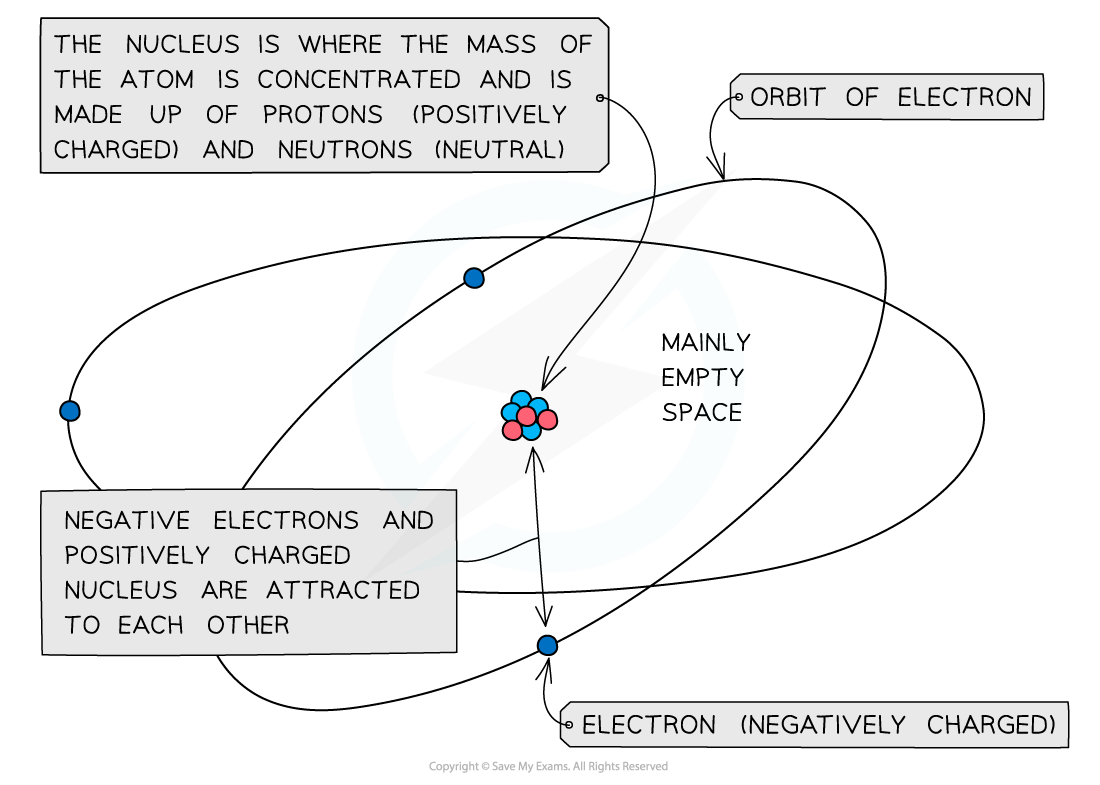
The mass of the atom is concentrated in the positively charged nucleus which is attracted to the negatively charged electrons orbiting around it
Exam Hint
- You can see from the table how the relative mass of an electron is almost negligible
- The charge of a single electron is -1.602 x 10⁻¹⁹ coulombs, whereas the charge of a proton is +1.602 x 10⁻¹⁹ coulombs
- So, relative to each other, their charges are -1 and +1 respectively
Behaviour of Subatomic Particles in an Electric Field
-
When protons, neutrons, and electrons travel at the same velocity through an electric field, they behave differently due to differences in charge and mass
-
A beam of electrons is deflected strongly toward the positive plate
- This shows that electrons are negatively charged, since they are repelled by the negative plate and attracted to the positive one
- The large deflection also indicates that electrons have a very small mass.
-
A beam of protons is deflected slightly toward the negative plate
- This observation confirms that protons carry a positive charge, as they are attracted to the negative plate
- The smaller deflection (compared to electrons) shows that protons are much heavier
-
A beam of neutrons passes through without deflection
- This confirms that neutrons are neutral, they have no charge and are unaffected by the electric field
-
Subatomic particles passing through an electric field
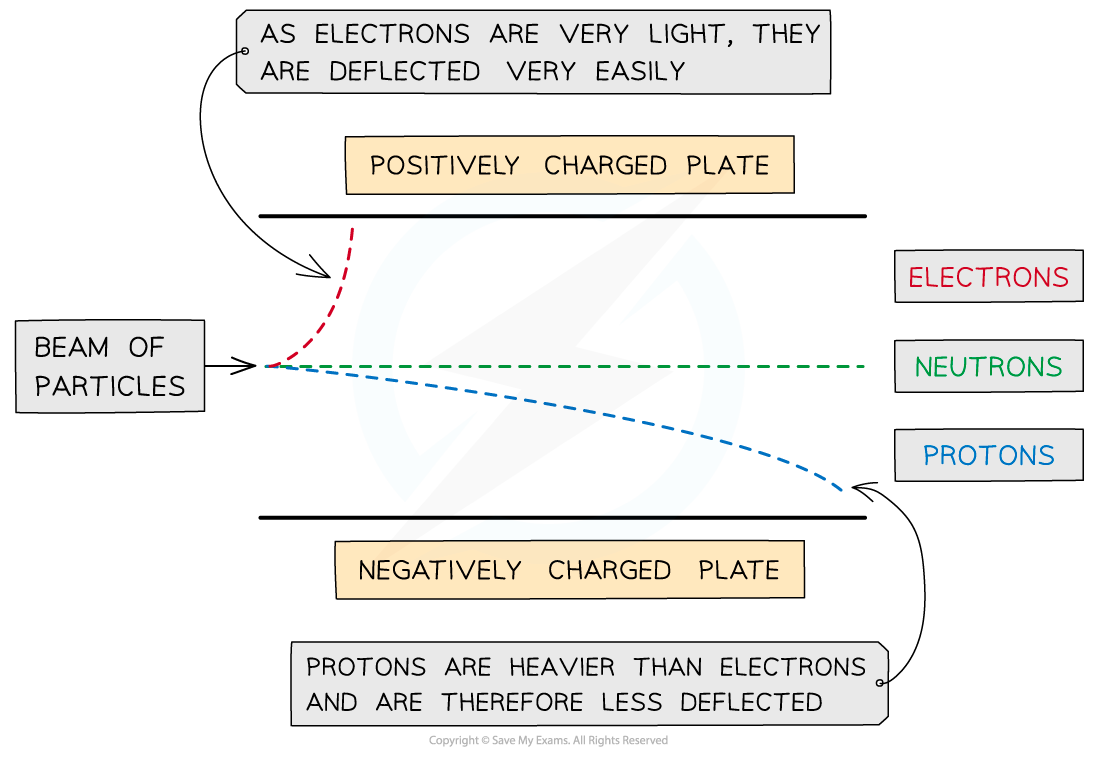
The lighter electrons undergo much more deflection than the protons
Was this revision note helpful?
Build on this topic