Physical & Chemical Trends in Group 2 (Cambridge International A-Level Chemistry)
Physical & Chemical Trends in Group 2
Chemical trends
- All elements in Group 2 (also called alkali earth metals) have the two electrons in their outermost principal quantum shell
- All Group 2 metals can form ionic compounds in which they donate these two outermost electrons(so they act as reducing agents) to become an ion with +2 charge (so they themselves become oxidised)
- Going down the group, the metals become more reactive
- This can be explained by looking at the Group 2 ionisation energies:
Graph of the first and second ionisation energies of the Group 2 elements
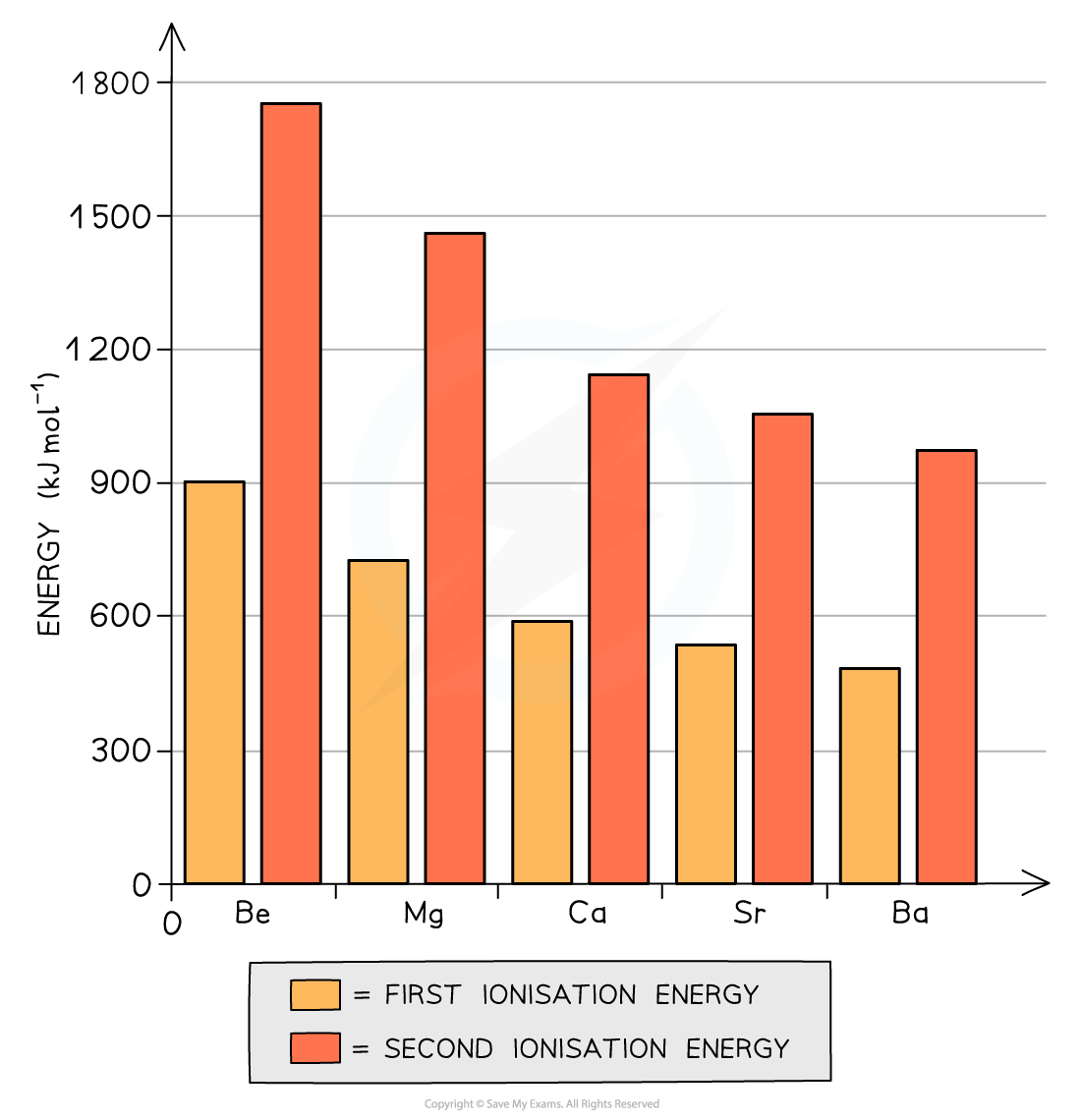
The graph shows that both the first and second ionisation energies decrease going down the table
-
The first ionisation energy is the energy needed to remove the first outer electron of an atom
-
The second ionisation energy is the energy needed to remove the second outer electron of an atom
-
The graph above shows that going down the group, it becomes easier to remove the outer two electrons of the metals
-
Though the nuclear charge on the nucleus increases going down the group (because there are more protons);
- Factors such as an increased shielding effect and a larger distance between the outermost electrons and the nucleus outweigh the attraction of the higher nuclear charge
-
The elements become more reactive going down the group as it gets easier for the atoms to lose two electrons and become 2+ ions
-
This trend is shown by looking at the reactions of the Group 2 metals:
-
With dilute hydrochloric acid;
- Bubbles of hydrogen gas are given off much faster indicating that the reactions become more vigorous
-
With oxygen;
- The metals get more reactive with oxygen down the group (Ba is so reactive, that it must be stored in oil to prevent it from reacting with oxygen in air)
-
Physical trends
- Going down the group, the elements become larger as the outer two electrons occupy a new principal quantum shell which is further away from the nucleus
The atomic radius of the Group 2 elements
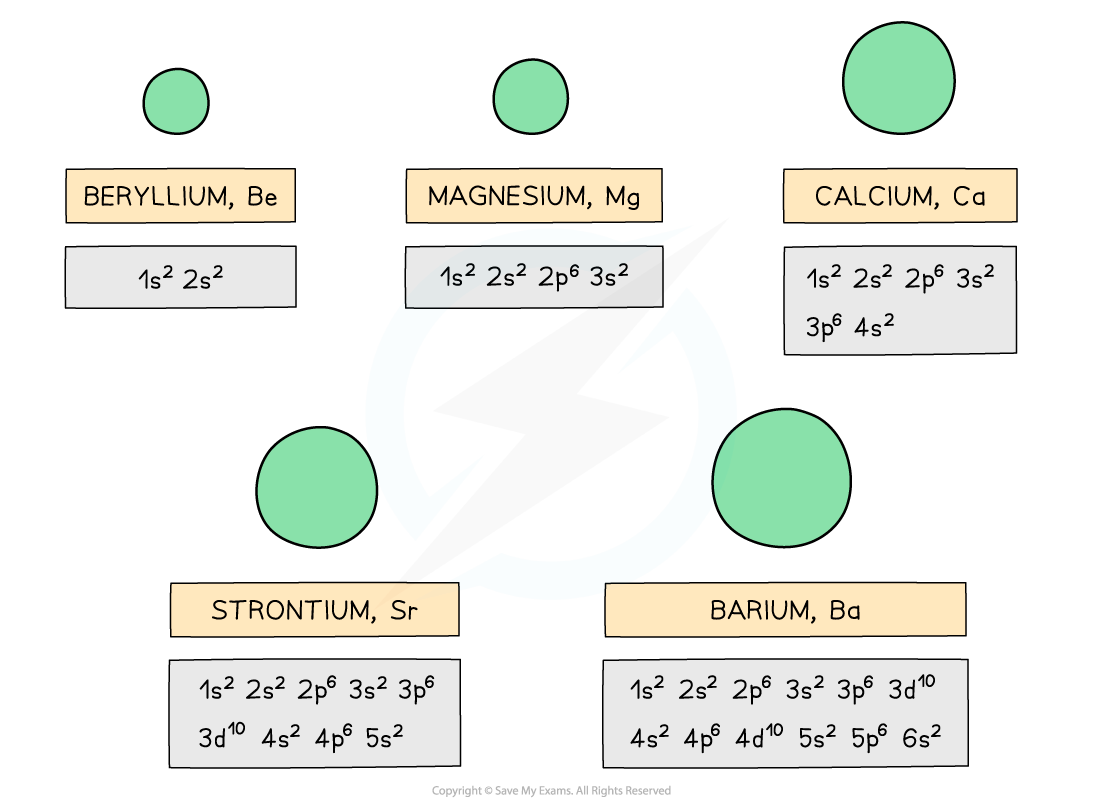
The atomic radius of the Group 2 elements increases going down the group due to the addition of an extra principal quantum shell
Graph of the atomic radius descending Group 2
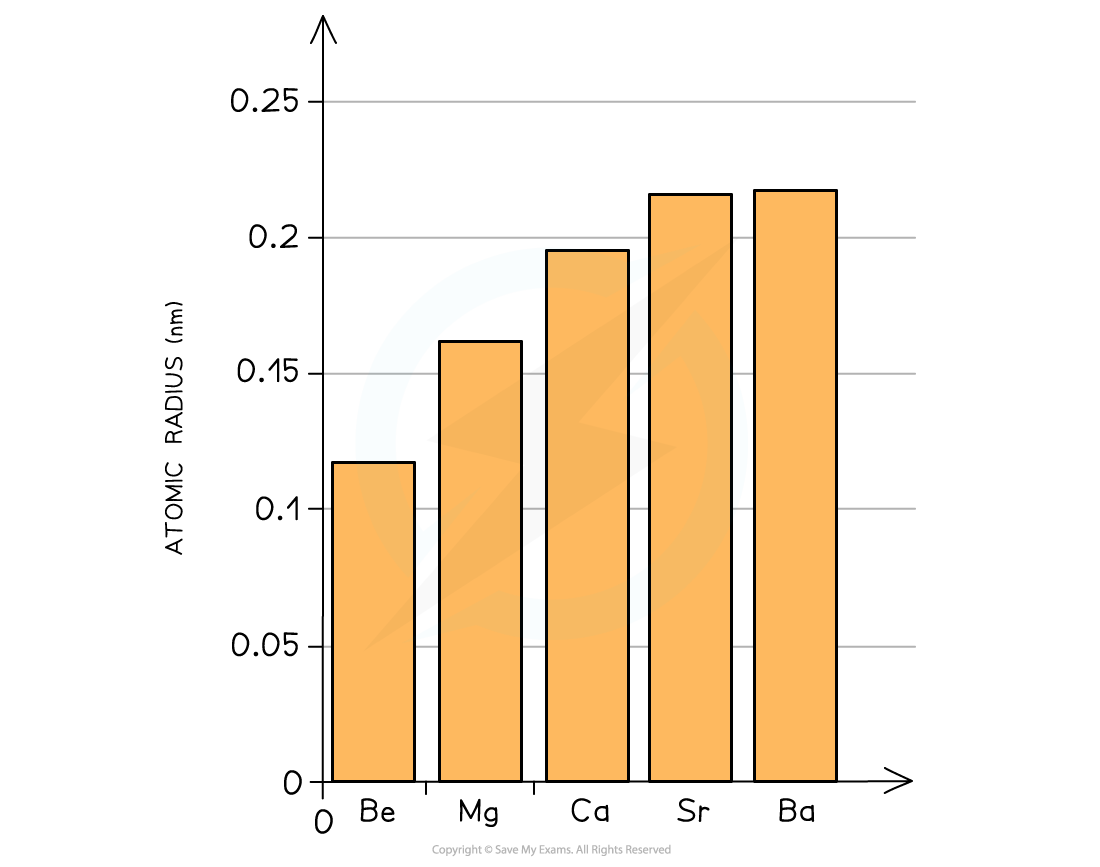
The graph shows an increase in atomic radius going down the group
- The melting point of the elements decreases going down the group as the outer electrons get further away from the nucleus
- This means that the attraction between the nucleus and the bonding electrons decreases causing a decrease in melting point
Graph of the melting points descending Group 2
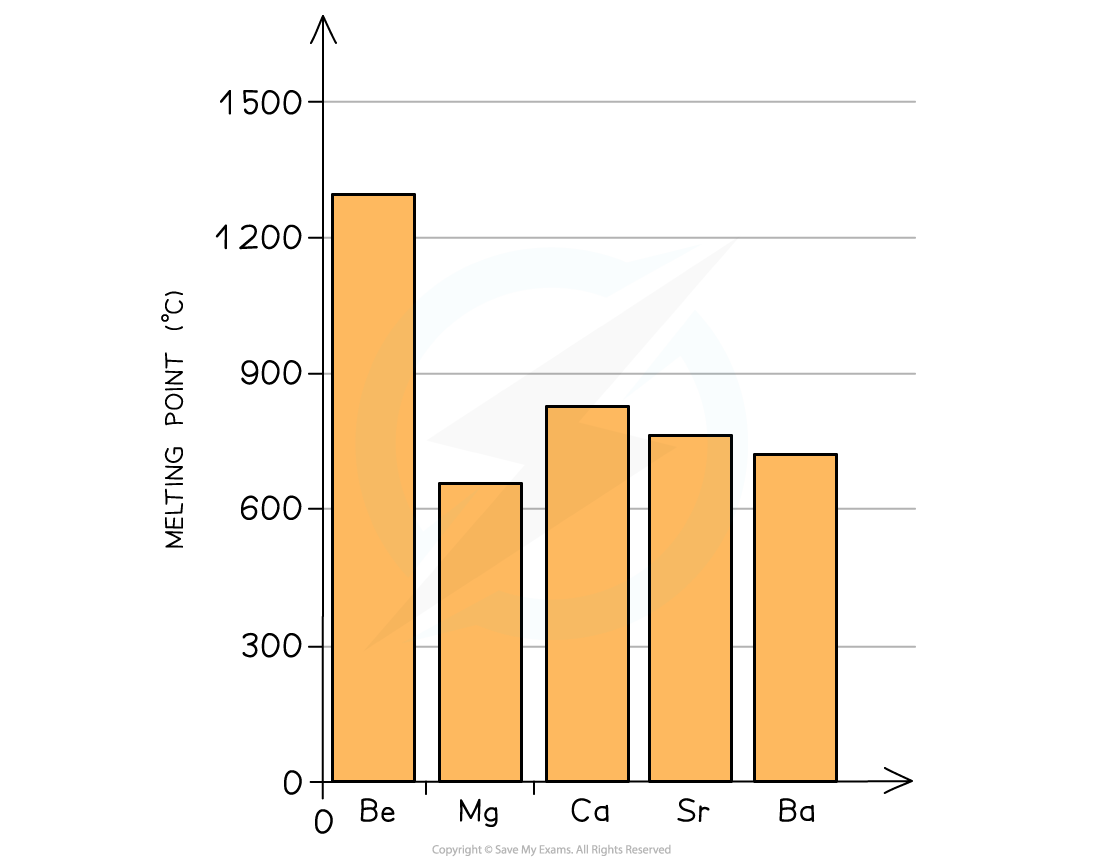
The graph shows a general decrease in melting point going down the group
- As you go down the group, the density of the alkali earth metals increases
Graph of the density descending Group 2
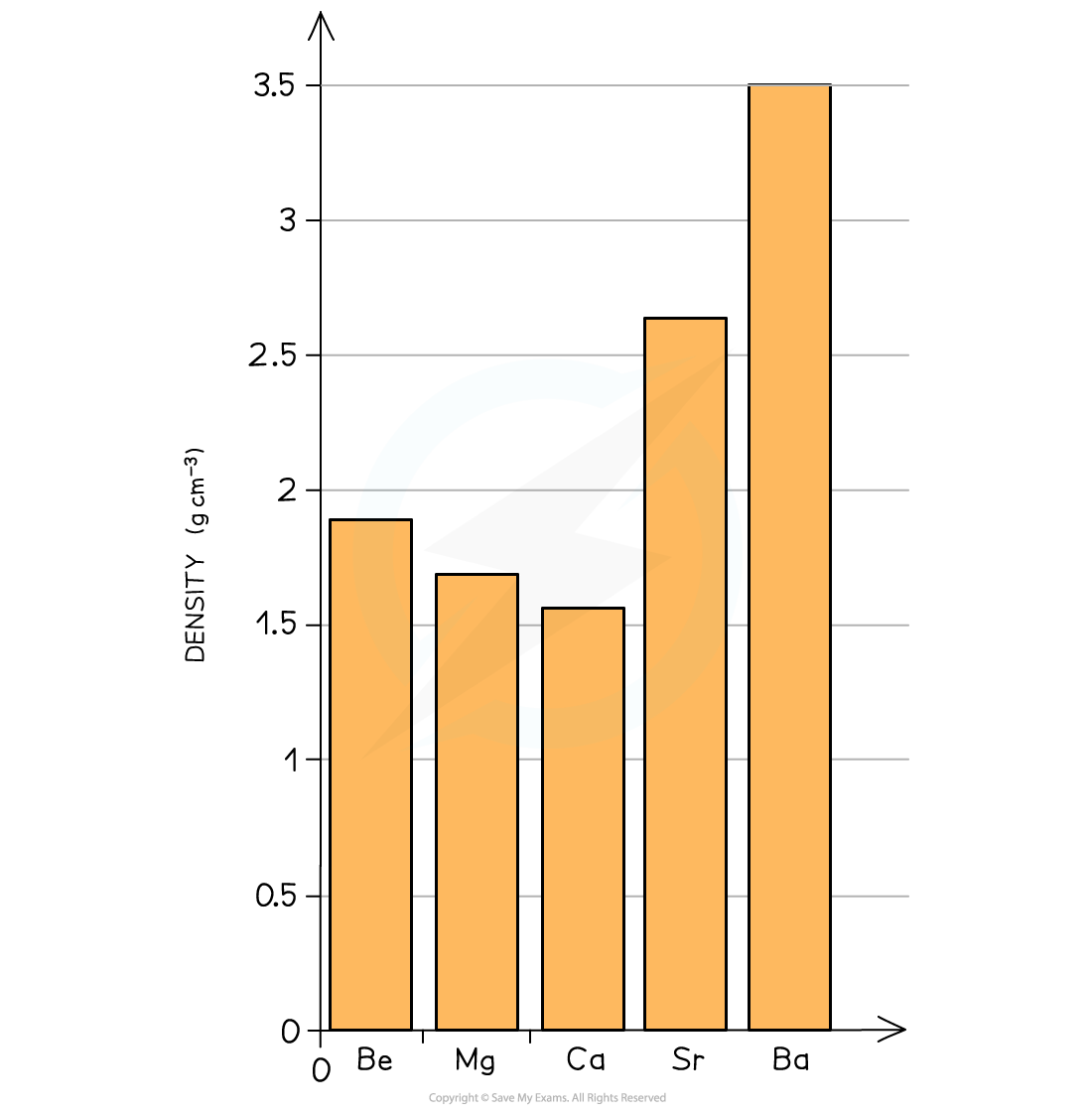
The graph shows an overall increase in density going down the group
Worked Example Predicting properties of radium
Radium, Ra, is a radioactive element found below barium, at the bottom of Group 2.
Applying your knowledge of the Group 2 elements, predict:
- The formula of the ion formed by radium.
- The formula radium's oxide and hydroxide.
- The first ionisation energy of radium.
- The reactivity of radium compared to barium.
- The relative pH of a saturated radium hydroxide solution compared with a saturated calcium hydroxide solution.
- The solubility of radium sulfate compared with strontium sulfate.
- The equation for the reaction of solid radium oxide with dilute hydrochloric acid.
- What you would expect to see if you mixed radium hydroxide solution with dilute sulfuric acid.
Answer
Answer 1:
- Since Ra is in Group 2, it will form an ion with a +2 charge to give Ra2+
Answer 2:
- The Group 2 oxides and hydroxides have the general formula XO and X(OH)2 respectively, where X is the Group 2 element
- Therefore, radium oxide is RaO and radium hydroxide is Ra(OH)2
Answer 3:
- Radium is below barium, so its atomic radius is larger than the atomic radius of barium.
- This means that radium’s outermost electrons are even further away and are therefore even more easily removed than barium’s outermost electron pair.
- The first ionisation energy is between 450 - 480 kJ mol-1
Answer 4:
- Radium’s outermost electrons are even further away than in barium and are therefore more easily removed, making radium more reactive than barium
Answer 5:
- The Group 2 hydroxides become more soluble going down the group
- Radium hydroxide will therefore be more soluble than calcium hydroxide
Answer 6:
- The Group 2 sulfates become less soluble going down the group
- Radium sulfate will therefore be less soluble than strontium sulfate
Answer 7:
- The general equation for the reaction of Group 2 oxides with dilute hydrochloric acid is:
XO (s) + 2HCl (aq) → XCl2 (aq) + H2O (l)
where X is the Group 2 element
- The reaction of radium oxide with dilute hydrochloric acid is therefore:
RaO (s) + 2HCl (aq) → RaCl2 (aq) + H2O (l)
Answer 8:
- Radium sulfate will be formed in this reaction
- However, the solubility of Group 2 sulfates decreases going down the group
- Therefore, a white precipitate of radium sulfate will be formed in this reaction
Was this revision note helpful?
Build on this topic