Trends in Electronegativity (Cambridge International A-Level Chemistry)
Exam board Cambridge International · A-LevelUpdated 2026-07-02
Spec point —
3.1.3
Trends in Electronegativity
- Electronegativity varies across Periods and down the Groups of the Periodic Table
Down a group
- There is a decrease in electronegativity going down the Group
- The nuclear charge increases as more protons are being added to the nucleus
- However, each element has an extra filled electron shell, which increases the shielding
- The addition of the extra shells increases the distance between the nucleus and the outer electrons resulting in larger atomic radii
- Overall, there is a decrease in attraction between the nucleus and outer bonding electrons
Why electronegativity decreases down a group
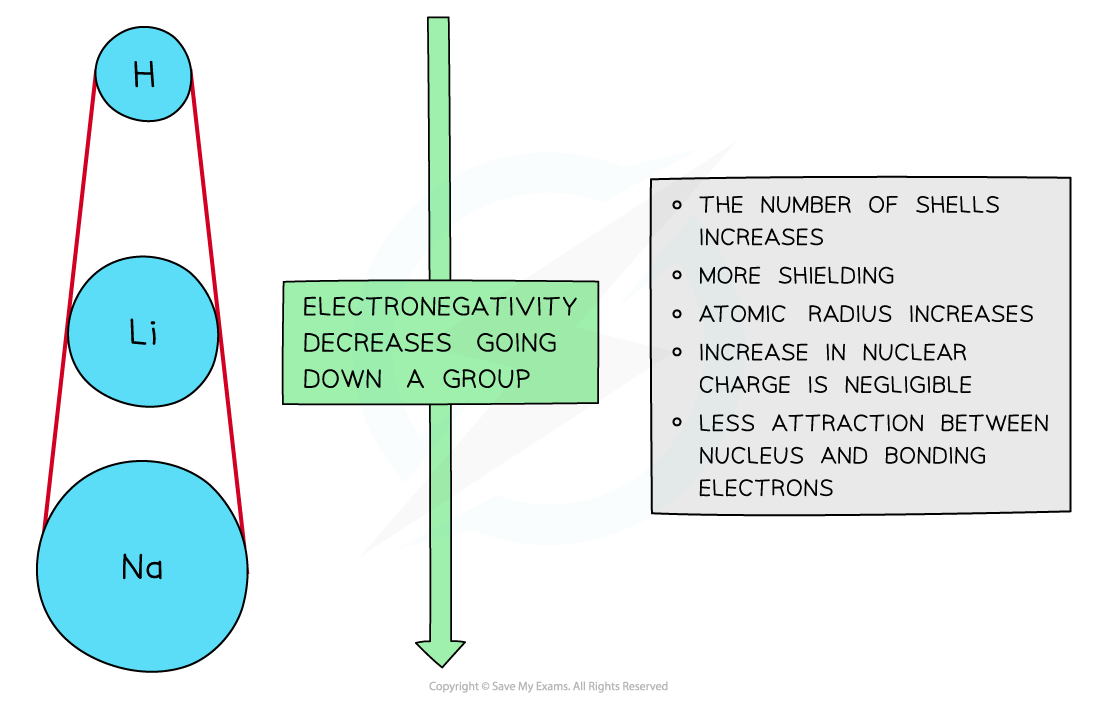
Electronegativity decreases going down the groups of the Periodic Table
Across a period
- Electronegativity increases across a Period
- The nuclear charge increases with the addition of protons to the nucleus
- Shielding remains reasonably the same across the Period as no new shells are being added to the atoms
- The nucleus has an increasingly strong attraction for the bonding pair of electrons of atoms across the Period of the Periodic Table
- This results in smaller atomic radii
Why electronegativity increases across a period
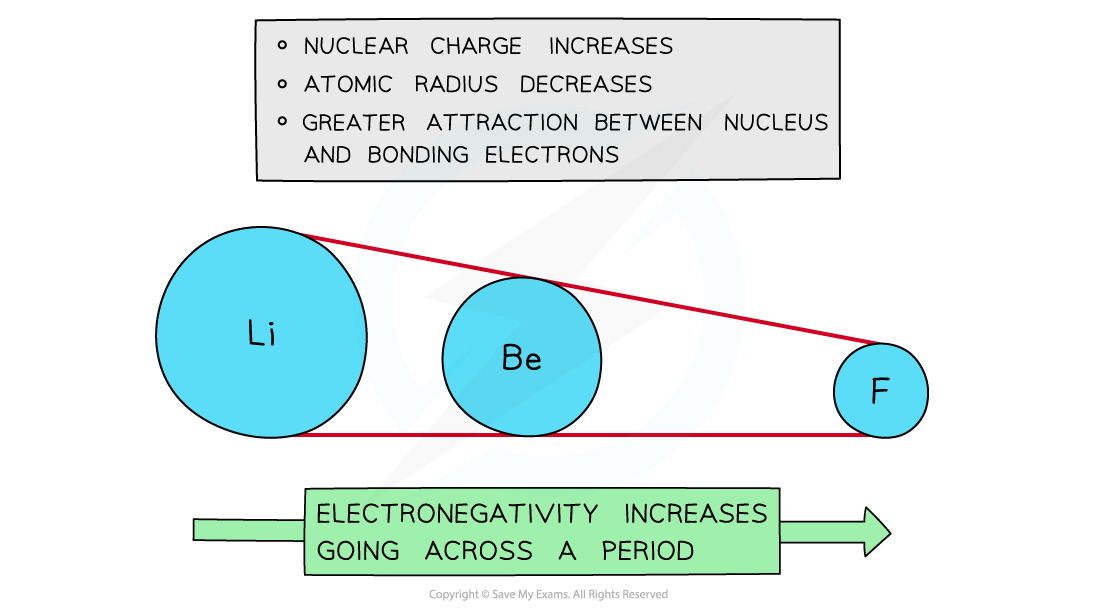
Electronegativity increases going across the periods of the Periodic Table
Trends down a group & across a period
-
Nuclear charge
- Increases down a group
- Increases across a period
-
Shielding
- Increases down a group
- Reasonably constant across a period
-
Atomic radius
- Increases down a group
- Decreases across a period
-
Electronegativity
- Decreases down a group
- Increases across a period
Exam Hint
- Remember the general trend is an increase in electronegativity towards the top right of the Periodic Table.
- Fluorine is the most electronegative element in the Periodic Table.
Was this revision note helpful?