Combustion of Alkanes (Cambridge International A-Level Chemistry)
Combustion of Alkanes & the Environment
- Cars’ exhaust fumes include toxic gases such as carbon monoxide(CO), oxides of nitrogen(NO/NO2) and volatile organic compounds(VOCs)
- When released into the atmosphere, these pollutants have drastic environmental consequences damaging nature and health
Carbon monoxide
- When oxygen supply is limited, carbon monoxide (CO) forms instead of carbon dioxide:
fuel + oxygen → carbon monoxide + water
- For example, Incomplete combustion of propane:
propane + oxygen → carbon monoxide + water
C3H8(l) + 3½O2(g) → 3CO (g) + 4H2O (l)
-
Carbon monoxide is extremely dangerous because it is:
- Colourless and odourless (can’t be seen or smelled)
- Hard to detect without a sensor
-
It is a toxic and poisonous gas that binds irreversibly to haemoglobin in the blood.
- This prevents haemoglobin from carrying oxygen.
-
Lack of oxygen transport leads to:
- Dizziness
- Loss of consciousness
- Potentially death if not treated
The effect of carbon monoxide on haemoglobin
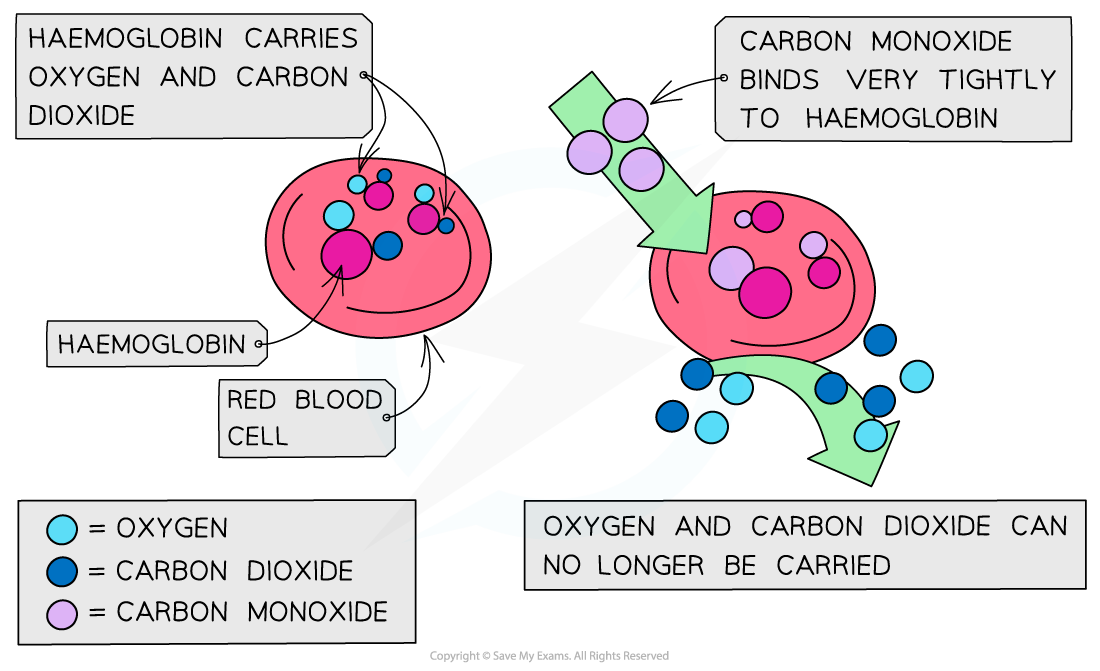
The high affinity of CO to haemoglobin prevents it from binding to O2 and CO2
Oxides of nitrogen
- Normally, nitrogen is too unreactive to react with oxygen in air
- In a car’s engine, high temperatures and pressures are reached, causing the oxidation of nitrogen to take place:
N2 (g) + O2 (g) → 2NO (g)
N2 (g) + 2O2 (g) → 2NO2 (g)
-
The oxides of nitrogen are then released in the car’s exhaust fumes into the atmosphere
-
Car exhaust fumes also contain unburnt hydrocarbons from fuels and their oxides (VOCs)
-
In the air, the nitrogen oxides can react with these VOCs to form peroxyacetyl nitrate (PAN) which is the main pollutant found in photochemical smog
- PAN is also harmful to the lungs, eyes and plant life
-
Nitrogen oxides can also dissolve and react in water with oxygen to form nitric acid which is a cause of acid rain
- Acid rain can cause corrosion of buildings, endanger plant and aquatic life (as lakes and rivers become too acidic) and directly damage human health
Catalytic removal
-
To reduce the amount of pollutants released in cars’ exhaust fumes, many cars are now fitted with catalytic converters
-
Precious metals (such as platinum) are coated on a honeycomb to provide a large surface area
-
The reactions that take place in the catalytic converter include:
- Oxidation of CO to CO2:
2CO + O2→ 2CO2
or
2CO + 2NO → 2CO2+ N2
- Reduction of NO/NO2 to N2:
2CO + 2NO → 2CO2+ N2
- Oxidation of unburnt hydrocarbons:
CnH2n+2+ (3n+1)[O] → nCO2+ (n+1)H2O
Pollutants, their effect & removal summary
-
Carbon Monoxide (CO)
-
Formation:
- Incomplete combustion of alkanes in car engines
-
Environmental consequence:
- Toxic gas
-
Catalytic removal:
- Oxidised to carbon dioxide (CO2):
-
2CO + O2→ 2CO2
2CO + 2NO → 2CO2+ N2
-
Oxides of Nitrogen (NO, NO2etc.)
-
Formation:
- Oxidation of nitrogen in car engines (due to high temperatures)
-
Environmental consequence:
- Dissolve in water and react with oxygen to form acid rain
-
Catalytic removal:
- Reduced to nitrogen gas:
-
2CO + 2NO → 2CO2+ N2
-
Volatile Organic Compounds (VOCs)
-
Formation:
- Unburnt hydrocarbons from fuels
- Oxides of these hydrocarbons formed in car engines
-
Environmental consequence:
- React with oxides of nitrogen in the atmosphere to form PAN
-
Catalytic removal:
- Oxidised to CO2 and H2O
- General formula reaction:
-
CnH2n+2+ (3n + 1)[O] → nCO2+ (n + 1)H₂O
-
PAN (peroxyacyl nitrate)
-
Formation:
- From the photochemical reaction of VOCs and nitrogen oxides in the atmosphere
-
Environmental consequence:
- Contributes to photochemical smog
-
Catalytic removal:
- Oxidise unburnt hydrocarbons
- Reduce nitrogen oxides to prevent PAN formation
-
Exam Hint Although CO2 is not a toxic gas, it is still a pollutant causing global warming and climate change
Was this revision note helpful?
Build on this topic