Geometry of Complexes (Cambridge International A-Level Chemistry)
Geometry of the Transition Element Complexes
-
Depending on the size of the ligands and the number of dative bonds to the central metal ion, transition element complexes have different geometries
- Dative bonds can also be referred to as coordinate bonds, especially when discussing the geometry of a complex
Linear
- Central metal atoms or ions with two coordinate bonds form linear complexes
- The bond angles in these complexes are 180o
- The most common examples are a copper (I) ion, (Cu+), or a silver (I) ion, (Ag+), as the central metal ion with two coordinate bonds formed to two ammonia ligands
Examples of a linear complex

A linear complex has a bond angle of 180o
Tetrahedral
-
When there are four coordinate bonds the complexes often have a tetrahedral shape
- Complexes with four chloride ions most commonly adopt this geometry
- Chloride ligands are large, so only four will fit around the central metal ion
-
The bond angles in tetrahedral complexes are 109.5o
Example of a tetrahedral complex

Tetrahedral complexes have a bond angle of 109.5o
Square planar
-
Sometimes, complexes with four coordinate bonds may adopt a square planar geometry instead of a tetrahedral one
- Cyanide ions (CN-) are the most common ligands to adopt this geometry
- An example of a square planar complex is cisplatin
-
The bond angles in a square planar complex are 90o
Example of a square planar complex

Cisplatin is an example of a square planar complex with a bond angle of 90o
Octahedral
-
Octahedral complexes are formed when a central metal atom or ion forms six coordinate bonds
-
This could be six coordinate bonds with six small, monodentate ligands
- Examples of such ligands are water and ammonia molecules and hydroxide and thiocyanate ions
-
It could be six coordinate bonds with three bidentate ligands
- Each bidentate ligand will form two coordinate bonds, meaning six coordinate bonds in total
- Examples of these ligands are 1,2-diaminoethane and the ethanedioate ion
-
It could be six coordinate bonds with one polydentate ligand
- The polydentate ligand, for example EDTA4-, forms all six coordinate bonds
-
The bond angles in an octahedral complex are 90o
Examples of octahedral complexes
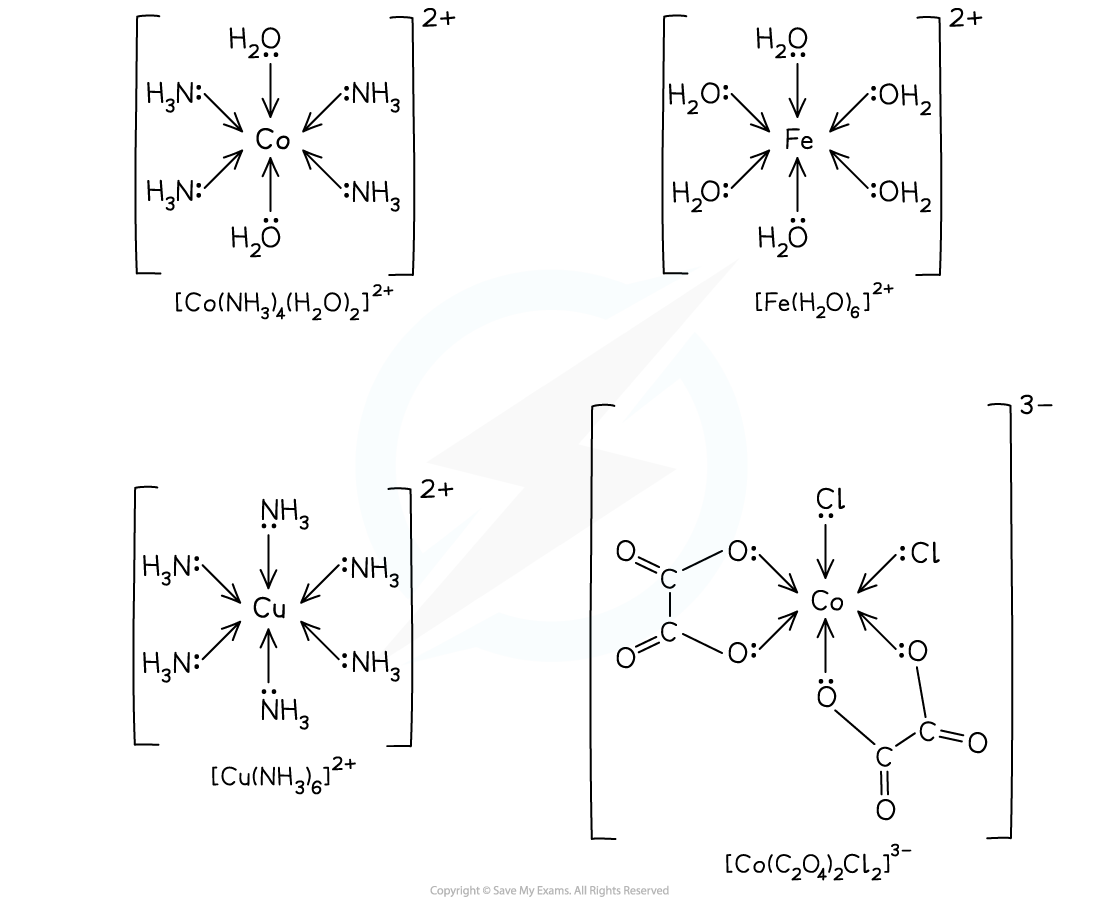
Octahedral complexes have bond angles of 90o
Types of ligands table
| Geometry | Number of coordinate bonds | Bond angle (o) | Ligand(s) involved |
|---|---|---|---|
| Linear | 2 | 180 | Ammonia, NH3 |
| Tetrahedral | 4 | 109.5 | Chloride ion, Cl– |
| Square planar | 4 | 90 | Cyanide ion, CN– |
| Octahedral | 6 | 90 | Water, H2O Ammonia, NH3 Hydroxide ion, OH– Thiocyanate ion, SCN– Ethanedioate ion, C2O42- 1,2-diaminoethane, NH2CH2CH2NH2 EDTA4- |
Coordination Number & Predicting Complex Ion Formula & Charge
Coordination Number & Predicting Complex Ion Formula & Charge
- The coordination number of a complex is the number of coordinate bonds that are formed between the ligand(s) and the central metal atom or ion
- Some ligands can form only one coordinate bond with the central metal ion (monodentate ligands), whereas others can form two (bidentate ligands ) or more (polydentate ligands)
- It is not the number of ligands which determines the coordination number, it is the number of coordinate (dative) bonds
Predicting complex ion formula & charge
-
The formula and charge of a complex ion can be predicted if the following are known:
- The central metal ion and its charge/oxidation state
- The ligands
- The coordination number/geometry
Was this revision note helpful?
Build on this topic