Production & Reactions of Phenylamine (Cambridge International A-Level Chemistry)
Preparation of Phenylamine
Spec point —
34.2.1
-
Phenylamine is an organic compound consisting of a benzene ring and an amine (NH2) functional group
-
It can be produced in a three-step synthesis reaction followed by the separation of phenylamine from the reaction mixture
-
Step 1 - Nitration
- Benzene undergoes nitration with concentrated nitric acid (HNO3) and concentrated sulfuric acid (H2SO4) at 25 to 60 oC to form nitrobenzene
-
Nitration of benzene
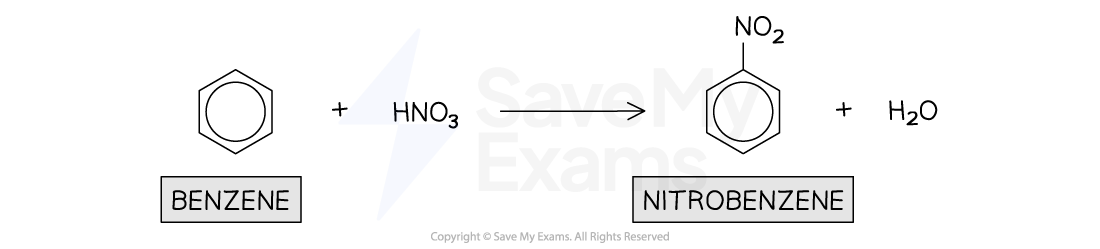
Benzene forms nitrobenzene by reacting with the NO2+electrophile formed by concentrated nitric acid and concentrated sulfuric acid
-
Step 2 - Reduction
- Nitrobenzene is reduced with hot tin(Sn) and concentrated hydrochloric acid (HCl) under reflux to form an acidic mixture that contains the organic product C6H5N+H3
Reduction of nitrobenzene
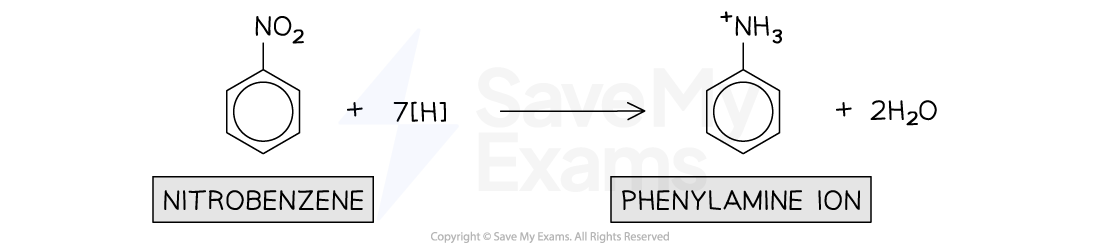
Refluxing nitrobenzene with hot tin and concentrated hydrochloric acid forms the phenylamine ion
-
Step 3 - Deprotonation
- Sodium hydroxide (NaOH) is added to the acidic reaction mixture to deprotonate the phenylamine ion to phenylamine
Deprotonation of the phenylamine ion
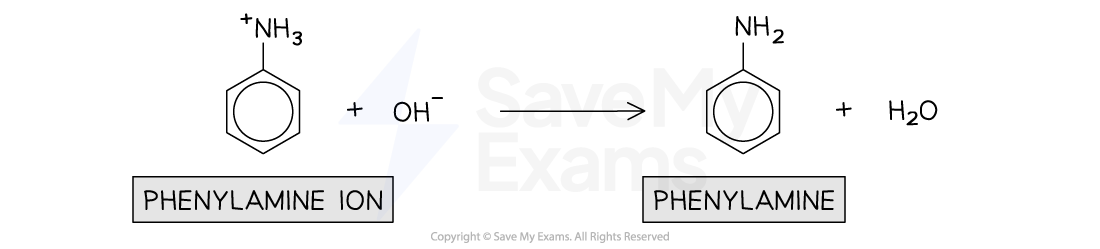
The hydroxide ion from sodium hydroxide deprotonates the phenylamine ion, forming the desired phenylamine
-
Separation / purification
- The phenylamine is then separated from the reaction mixture by steam distillation
Separation of phenylamine
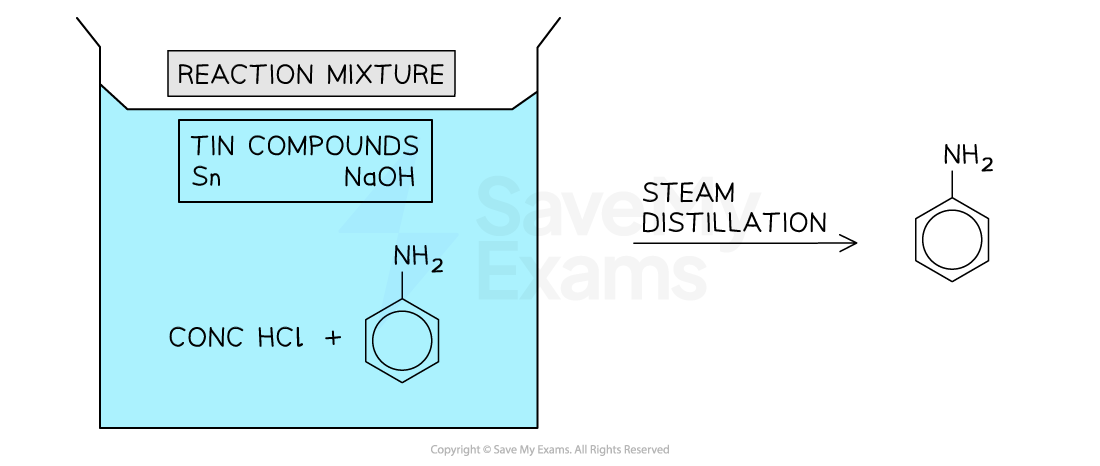
Steam distillation is used to separate the phenylamine from the reaction mixture
The overall reaction forming phenylamine from benzene
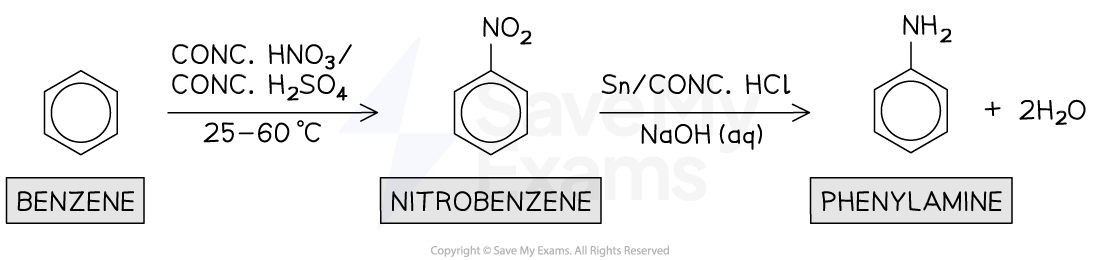
The first reaction step is nitration and the second reaction step is reduction followed by deprotonation
Reactions of Phenylamine
Spec point —
34.2.2
-
Both the benzene ring as well as the -NH2 group in phenylamine can take part in chemical reactions
-
These reactions include
- The bromination of phenylamine
- Formation of a diazonium salt
Bromination of phenylamine
-
Phenylamines react in electrophilic substitution reactions in a similar way as phenols
-
The lone pair of electrons on the nitrogen atom in phenylamines donate electron density into the benzene ring
- In phenols, the oxygen atom donates its lone pair of electrons instead
-
The delocalisation of the electrons causes an increased electron density in the benzene ring
-
The benzene ring, therefore, becomes activated and becomes more readily attacked by electrophiles
-
The incoming electrophiles are directed to the 2,4 and 6 positions
-
Phenylamines, therefore, react under milder conditions with aqueous bromine at room temperature to form 2,4,6-tribromophenylamine
Bromination of phenylamine
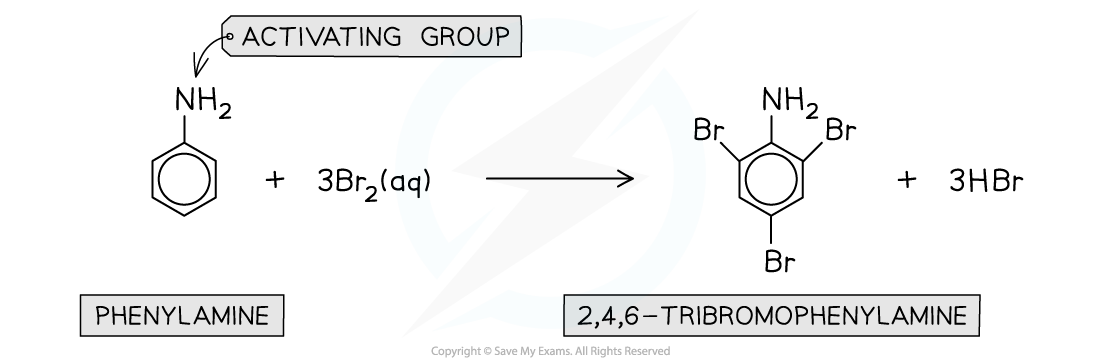
The bromination of phenylamine produces 2,4,6-tribromophenylamine
Formation of diazonium salt
-
Diazonium compounds are very reactive compounds containing an -N2+ group
-
The amine (-NH2) group of phenylamines will react with nitrous acid(HNO2) at a temperature below 10 °C to form diazonium salts
- Since nitric(III) acid is unstable, it has to be made in the test-tube by reacting sodium nitrite (NaNO2) and dilute acid(such as HCl)
-
These diazonium salts are so unstable that they will, upon further warming with water, form phenol
Reacting nitrous acid with phenylamine to form a diazonium salt
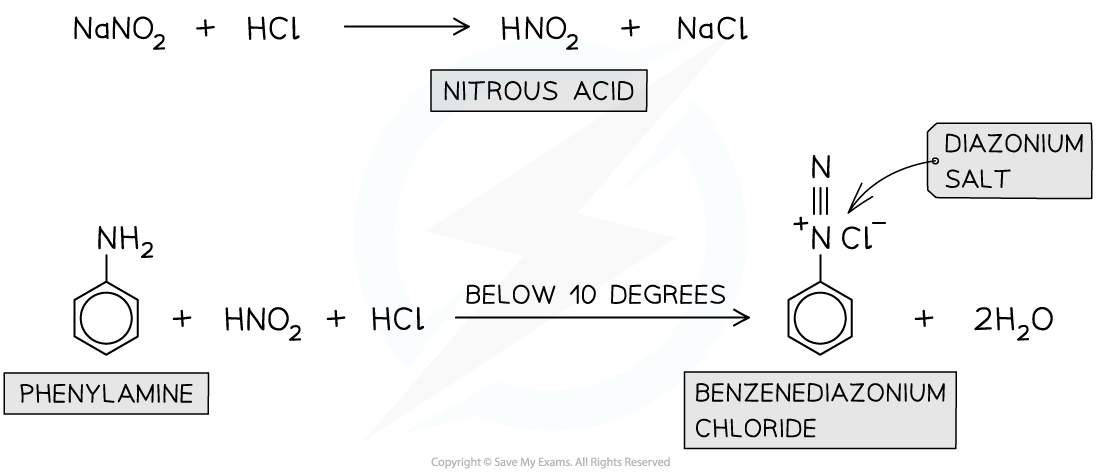
The diazonium salt formed from phenylamine is unstable and decomposes upon warming to form phenol.
Was this revision note helpful?