Organic Chemistry Terminology (Cambridge International A-Level Chemistry)
Organic Chemistry Terminology
-
Organic reactions are often associated with terminology students should be familiar with
-
Two of these important terms include:
- Electrophilic substitution
- Addition-elimination
Electrophilic substitution
-
Electrophiles are species that are electron deficient and can act as an electron pair acceptor
- Electrophiles are ‘electron loving’ species
-
Substitution reactions are reactions that involve the replacement of one atom or group of atoms by another
-
Electrophilic substitution reactions are therefore reactions in which an atom or group of atoms are replaced by an electrophile after an initial attack by the electron-deficient species
-
An example of an electrophilic substitution reaction is the reaction of benzene with bromine in the presence of anhydrous aluminium bromide catalysts
- The bromine acts as an electrophile and attacks the electron-rich benzene ring
- A hydrogen atom is substituted by a bromine atom to form bromobenzene and hydrogen bromide
-
Benzene undergoes substitution reactions rather than addition reactions because of the stability of the benzene ring
Electrophilic substitution of benzene by bromine

A hydrogen atom in benzene is substituted by a bromine atom, which acts as an electrophile
Addition-elimination
-
Acyl chlorides are reactive organic compounds that undergo many reactions such as nucleophilic addition-elimination reactions
-
In nucleophilic addition-elimination reactions, the nucleophilic addition of a small molecule across the C=O bond takes place followed by elimination of a small molecule
-
Examples of these nucleophilic addition-elimination reactions include:
- Hydrolysis
- Reaction with alcohols to form esters
- Reaction with ammonia and primary amines to form amides
Hydrolysis
-
The hydrolysis of acyl chlorides results in the formation of a carboxylic acid and HCl **molecule
-
This is a** nucleophilic addition-elimination reaction
- A water molecule adds across the C=O bond
- A hydrochloric acid (HCl) molecule is eliminated
Hydrolysis of propanoyl chloride to form propanoic acid and HCl
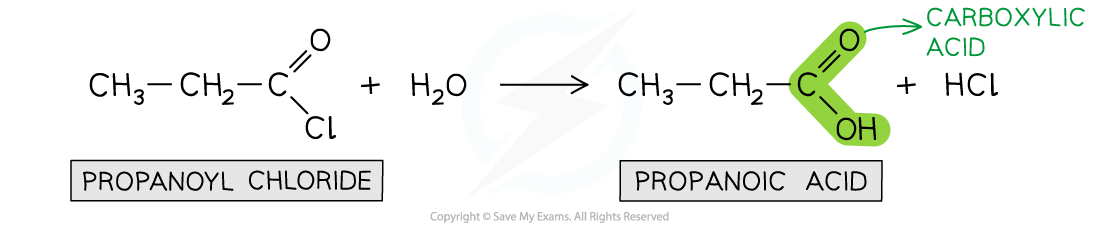
Acyl chlorides are hydrolysed to carboxylic acids via nucleophilic addition-elimination
Formation of esters
-
Acyl chlorides can react with alcohols to form esters
-
The esterification of acyl chlorides is also a nucleophilic addition-elimination reaction
- The alcohol adds across the C=O bond
- A HCl molecule is eliminated
Esterification of propanoyl chloride to form ethyl propanoate and HCl
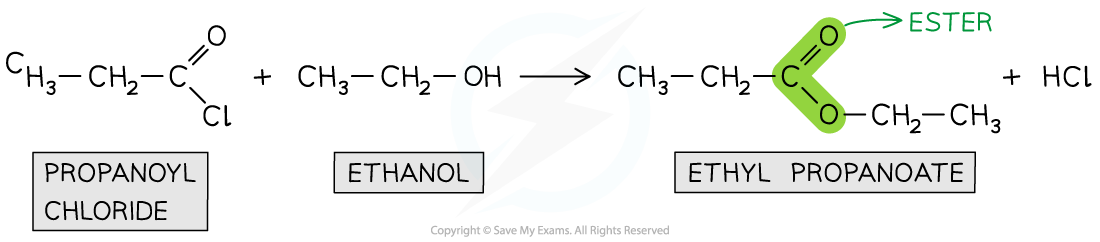
Acyl chlorides are esterified with alcohols to form esters via nucleophilic addition-elimination
Formation of amides
-
Acyl chlorides can form amides with primary **amines **and concentrated ammonia
-
The nitrogen atom in ammonia and primary amine has a lone pair of electrons which can be used to attack the carbonyl carbon atom in the acyl chlorides
-
The product is an** amide (when reacted with ammonia) or N-** substituted **amide (when reacted with primary amines)
-
This is also an example of a** nucleophilic addition-elimination reaction as
- The amine or ammonia molecule adds across the C=O bond
- A HCl molecule is eliminated
Forming amides from propanoyl chloride
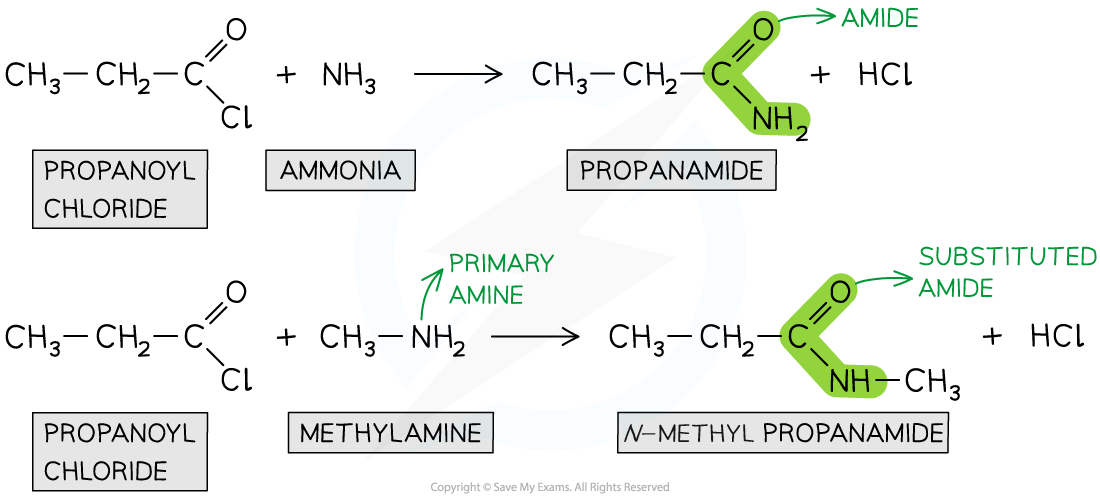
Acyl chlorides undergo reactions with ammonia and primary amines to form amides via nucleophilic addition-elimination
Was this revision note helpful?
Build on this topic