Bond Energy & Length (Cambridge International A-Level Chemistry)
Energy & Length of Covalent Bonds
Bond energy
-
The bond energy is the energy required to break one mole of a particular covalent bond in the gaseous states
- Bond energy has units of kJ mol-1
-
The larger the bond energy, the stronger the covalent bond is
Bond length
-
The bond length is internuclear distance of two covalently bonded atoms
- It is the distance from the nucleus of one atom to another atom which forms the covalent bond
-
The greater the forces of attraction between electrons and nuclei, the more the atoms are pulled closer to each other
-
This decreases the bond length of a molecule and increases the strength of the covalent bond
-
Triple bonds are the shortest and strongest covalent bonds due to the large electron density between the nuclei of the two atoms
-
This increases the forces of attraction between the electrons and nuclei of the atoms
-
As a result of this, the atoms are pulled closer together causing a shorter bond length
-
The increased forces of attraction also mean that the covalent bond is stronger
Comparing the length of carbon-carbon covalent bonds
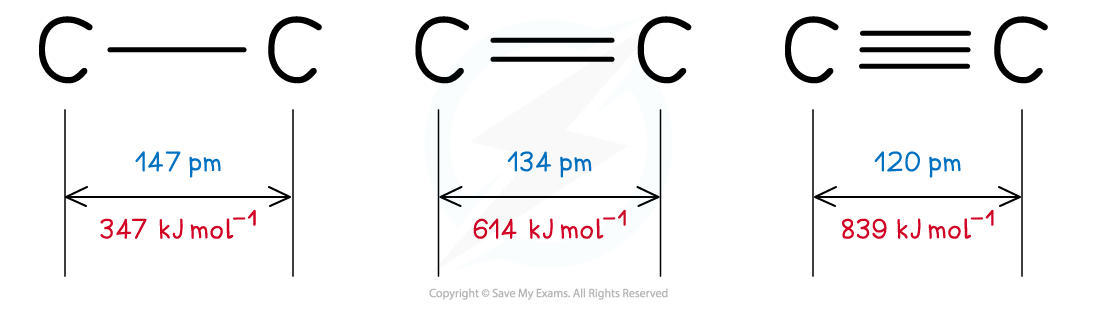
Triple bonds are the shortest covalent bonds and therefore the strongest ones
Reactivity of covalent molecules
-
The reactivity of a covalent bond is greatly influenced by:
- The bond polarity
- The bond strength
- The bond type(σ/π)
Worked Example Bond lengths & bond energies
Bond lengths and bond energy for various hydrogen halides is shown in the table below.
Hydrogen halide Bond length (nm) Bond energy (kJ mol-1) HCl 0.127 431 HBr 0.141 366 HI 0.161 299
- Suggest why the bond energy values of hydrogen halides decrease in the order HCl > HBr > HI.
- Suggest a value for the bond length in HF.
- Suggest which hydrogen halide is the most reactive.
Answer 1:
- Going down the halogen group, the atoms are bigger
- This means that the attractive force between the bonding electrons and the nucleus gets smaller
- So, less energy is needed to break the bond
Answer 2:
- Going down the group the increase in bond length is approximately 0.014 - 0.020 nm
- Fluorine is smaller than chlorine, so a value between 0.09 and 0.11 nm is acceptable for the bond length
Answer 3:
- The hydrogen halide with the longest bond length and therefore smallest bond energy is the most reactive, as it takes the least energy to break the bond between the hydrogen and halide atoms
- Therefore, HI is the most reactive hydrogen halide
Was this revision note helpful?
Build on this topic