Reactions of Aldehydes & Ketones with HCN (Cambridge International A-Level Chemistry)
Exam board Cambridge International · A-LevelUpdated 2026-07-02
Reaction of Hydrogen Cyanide with Aldehydes & Ketones
- The carbonyl group -C=O, in aldehydes and ketones is polarised
- The oxygen atom is more electronegative than carbon drawing electron density towards itself
- This leaves the carbon atom slightly positively charged and the oxygen atom slightly negatively charged
- The carbonyl carbon is therefore susceptible to attack by a nucleophile, such as the cyanide ion
Nucleophilic addition
- The nucleophilic addition of hydrogen cyanide to carbonyl compounds is a two-step process
- In step 1 the cyanide ion attacks the carbonyl carbon to form a negatively charged intermediate
- In step 2 the negatively charged oxygen atom in the reactive intermediate quickly reacts with aqueous H+ (either from HCN, water or dilute acid) to form 2-hydroxynitrile
The nucleophilic addition of HCN mechanism
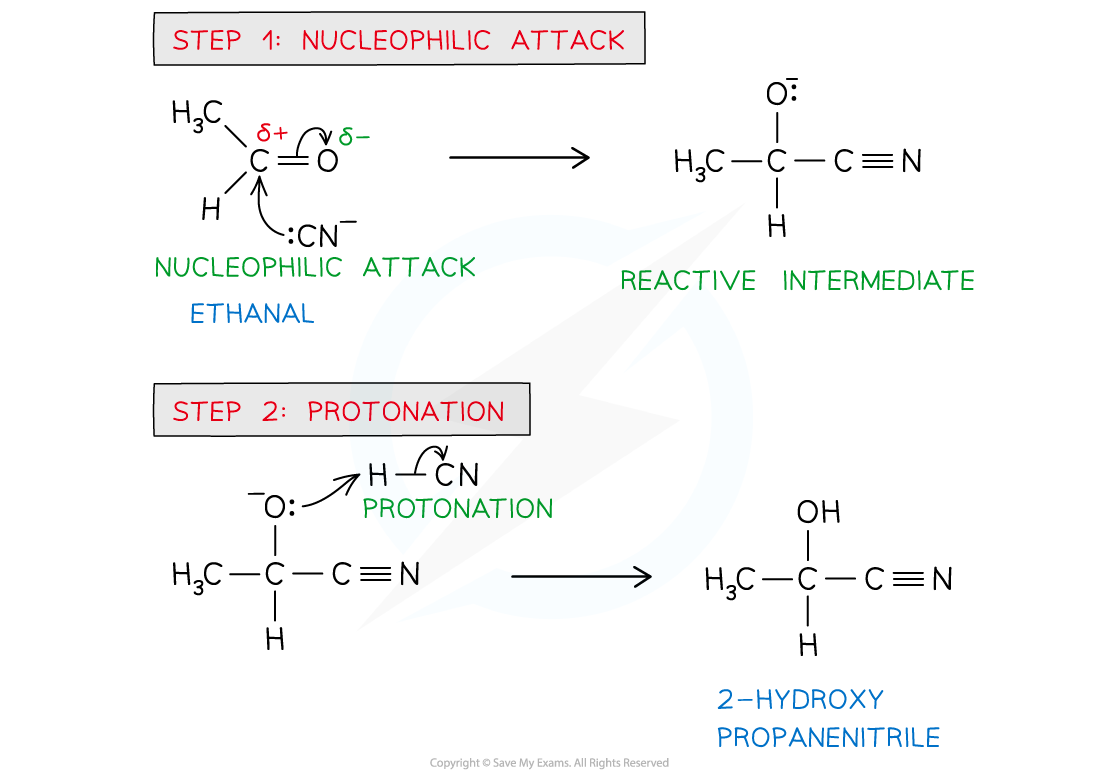
The cyanide ion attacks the carbonyl carbon to form a negatively charged intermediate which quickly reacts with a proton to form a 2-hydroxynitrile compound
Exam Hint The actual negative charge on the cyanide ion is on the carbon atom and not on the nitrogen atom
Was this revision note helpful?
Build on this topic