Half-Life (Cambridge International A-Level Chemistry)
First Order Reaction Half-life
-
The half-life of a first-order reaction is independent of the concentration of reactants
- This means that despite the concentrations of the reactants decreasing during the reaction
- The amount of time taken for the concentrations of the reactants to halve will remain the same throughout the reaction
- The concentration-time graph for a first-order reaction is a downward curve with a constant half-life.
-
The rearrangement of the methyl group(CH3) in ethanenitrile (CH3CN) is an example of a first-order reaction with rate equation rate = k [CH3CN]
Rearrangement of the CH3 group in CH3CN

CH3CN (g) → CH3NC (g)
-
Experimental data on the changes in concentration over time suggests that the half-life is constant
- Even if the half-lives are slightly different from each other, they can still be considered to remain constant
-
This means that no matter what the original concentration of the CH3CN is, the half-life will always be around 10.0 minutes
Half-life table
| Change in [CH3CN] (mol dm-3) | Half-life (minutes) |
|---|---|
| 8.00 - 4.00 | 10.0 |
| 4.00 - 2.00 | 9.50 |
| 2.00 - 1.00 | 9.25 |
Graph of [CH3CN] over time
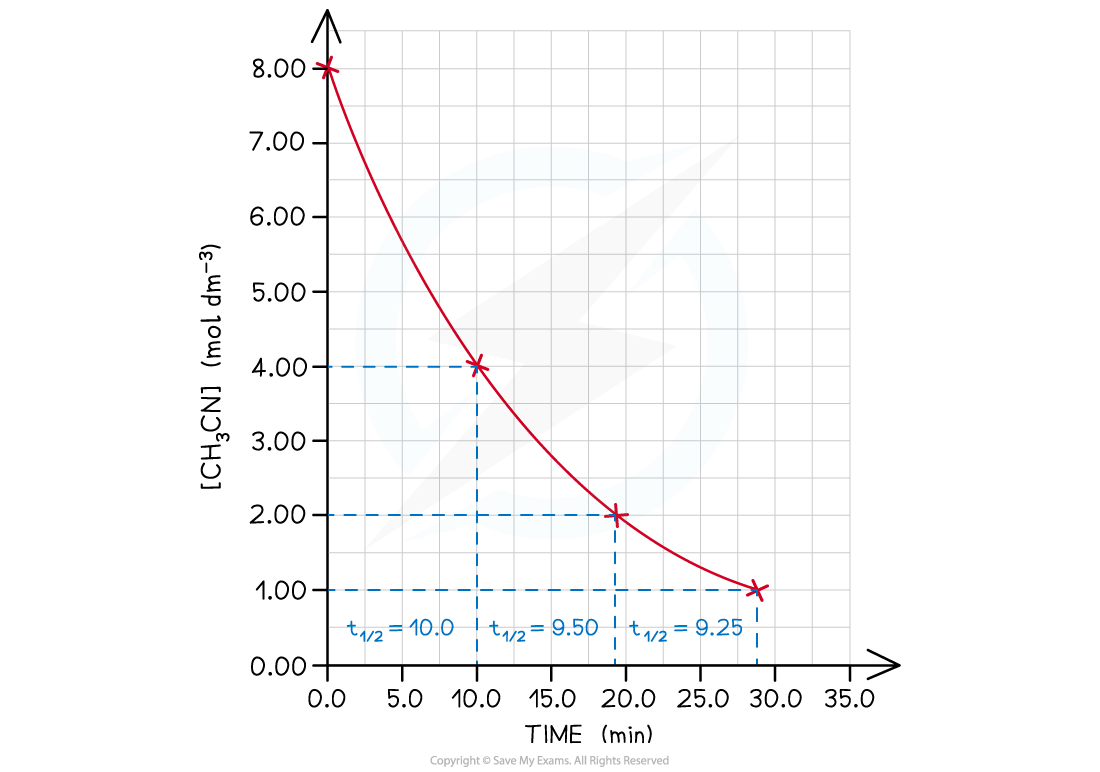
Since this is a first-order reaction, the time taken for the concentration to halve remains constant
Worked Example Using the half-life of first-order reactions in calculations
The change in concentration of a reactant over time is recorded in the following table:
**Time **(s) 0 200 400 600 800 1000 1200 1400 1600 [reactant] x10-4(mol dm-3) 5.8 4.4 3.2 2.5 1.7 1.2 0.8 0.5 0.3
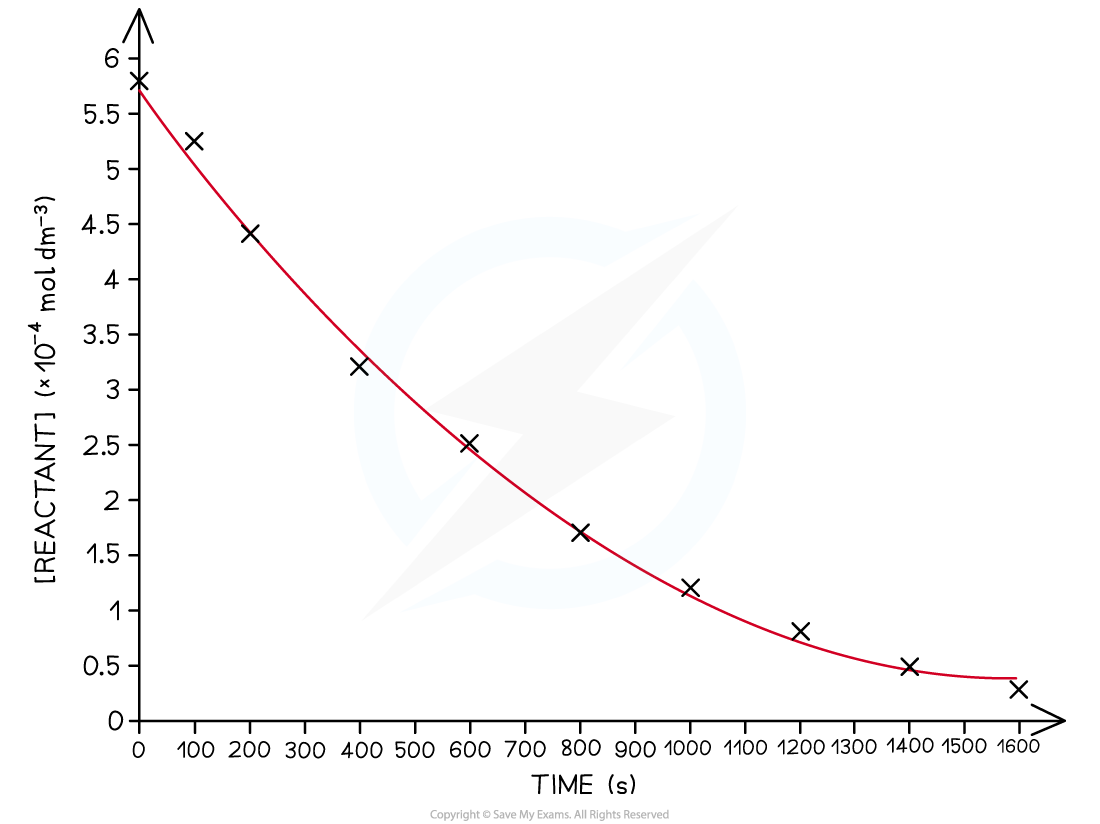
- Draw a graph of concentration against time for these results.
- Determine the first and second half-lives and hence determine the order of the reaction.
Answer
Draw a graph of concentration against time for these results.
Determine the first and second half-lives and hence determine the order of the reaction.
- Find the first and second half-lives by determining when the concentrations halve using the graph:
Change in [reactant] (x10-4mol dm-3) Half-life (s) First half-life 5.80 - 2.90 470 - 0 = 470 Second half-life 2.90 - 1.45 920 - 470 = 450
Determine the reaction order
- It is a first-order reaction
- The successive half-lives remain reasonably constant (around 450 seconds) throughout the reaction
Was this revision note helpful?
Build on this topic