Selecting Sources of Finance (Cambridge International A-Level Business)
Factors affecting the choice of sources of finance
-
Managers must consider a range of factors before deciding upon the type and source of finance required
- They may need to use more than one source of finance at the same time
Factors affecting the choice of finance
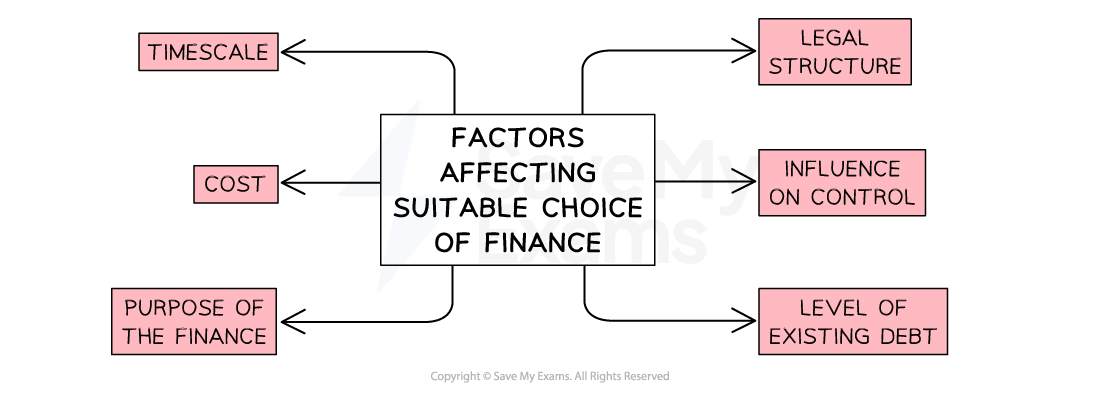
The level of existing debt may be so high that a business will rather sell shares than borrow more
| Factor | Explanation |
|---|---|
| What is the purpose of the finance? | - Fixed assets are most likely to need a long-term source of finance, such as a bank loan - Day-to-day costs such as rent and wages could be covered by a short-term overdraft |
| How long is the finance required for and when can it be paid back? | - Overdrafts are a short term option to help a firm who needs a smaller amount of finance urgently - Mortgages can be paid back over many years |
| How much finance is needed? | - Large amounts of capital can be raised through the issue of shares to family and friends, or through a flotation on a stock exchange - Smaller sums may be accessed through business credit cards or overdrafts |
| What is the legal structure of the business? | - Businesses which are already Public Limited Companies can issue shares or debentures - Sole traders often rely on owners' capital |
| How much risk is involved? | - Businesses with existing loans may have high gearing and pay high rates of interest as they are seen as risky - Leasing involves little risk as assets can be returned if finance costs are not paid |
| How much control and ownership does the company want to keep? | - If limited companies issue too many shares, the current owners may lose some control of the business - Borrowing retains control, though interest is payable |
Reducing the risk of being unable to raise finance
-
The risk of not being able to raise the finance can be reduced in several ways
-
Bank loans will most likely be approved when
- A business presents a convincing business plan, including a cash-flow statement, and income statement for the last time period
- Existing sources of external finance are minimal and being managed effectively
- A business has collateral to reduce risk to the bank
-
Investment from shareholders will most likely happen when
- The share price is improving
- Dividends are generous
- The company has good profit potential and is planning to grow
- Alternative investments are less attractive
Choosing suitable sources of finance
- Finance managers frequently have to make recommendations to their CEOs about the most suitable sources of finance to use
Example 1: Private Limited Company
Case Study Oaky-Cokey Ltd is a very successful private limited company that manufactures and sells wooden educational toys. It has been running for 15 years and has an excellent reputation
Oaky-Cokey has previously reinvested profits to fund expansion but now needs more financing to fund growth into new markets
Key considerations
- Oaky-Cokey is a limited company, so selling shares to family and friends is an option to raise a **limited amount **
- With 15 years of success, it is** less of a risk **than a new start-up, so a bank loan could be obtained
- The scenario indicates that reinvesting profits will not be enough to finance growth plans
Recommendation
A **bank loan **could be easy to obtain due to business success over the last 15 years
- Repayments are spread over several years, and interest must be paid
The business could** issue new shares to existing shareholders**, who may increase their investment due to business success
- Family and friends may want to be part of its exciting growth plans
The decision will depend upon** how much control and ownership the business owner may lose** by issuing more shares
Most finance managers would recommend obtaining a bank loan, as this is often preferable to losing ownership and a share of future profits
Example 2: Sole trader
Case Study Hoopla is a Warsaw-based retail store selling fashion trainers
It has sold large quantities of stock since an influencer promoted the store on TikTok and Instagram. It needs to quickly replenish its stock
Its sole trader owner, Tobias, is considering using his existing overdraft or trade credit
Key considerations
- New stock is needed quickly so the existing overdraft facility on his bank account could be an instant source of finance
- Trade credit means he would not have to pay for stock straight away, which would avoid cashflow problems as stock can be sold before payment to the supplier is due
Recommendation
- An overdraft is a short-term source of finance and Tobias will have to pay interest on the amount that he uses
- Trade credit would ease financial pressure as stock is replenished and he may receive a discount when he sets up the agreement
- Most finance managers would recommend to Tobias that he first seek trade credit
- If he is unable to secure that, then he should consider using his overdraft facility
Was this revision note helpful?
Build on this topic