Internal Sources of Finance (Cambridge International A-Level Business)
An introduction to sources of finance
-
Businesses have different sources of finance available to them
- When the finance comes from inside the business, it is called an internal source of finance
- When the finance comes from outside the business, it is called an external source of finance
Internal and external sources of finance
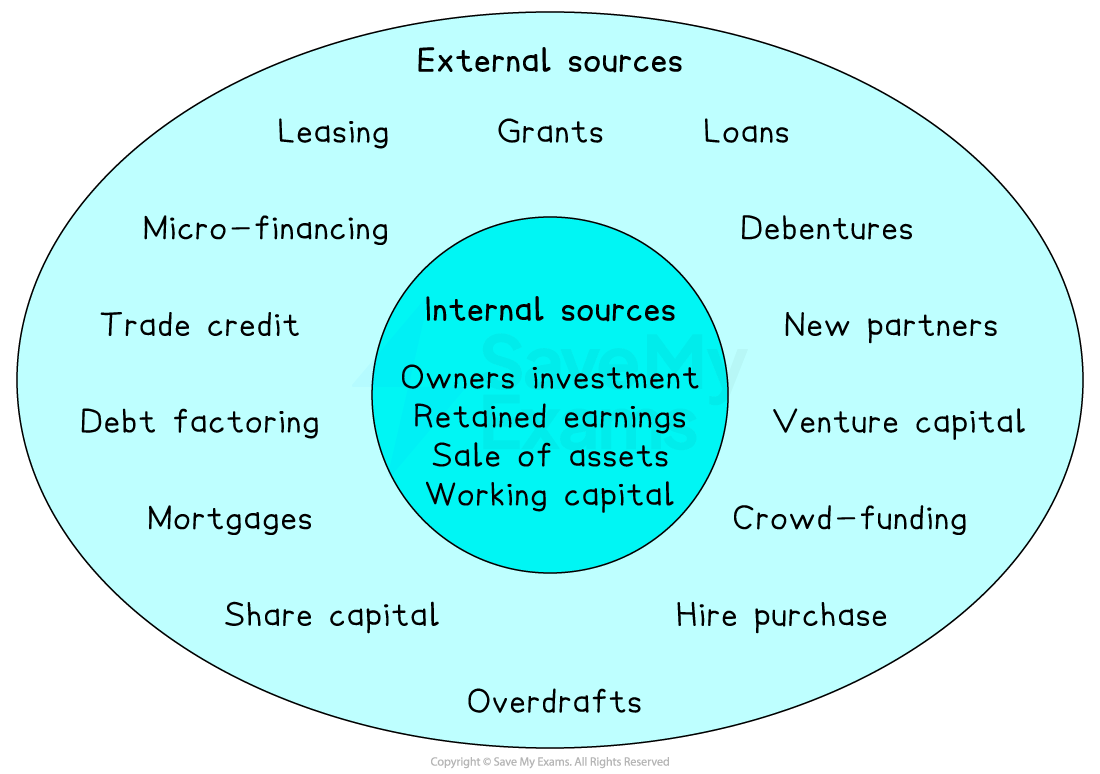
The range of internal and external sources of finance available to businesses
Owners investment
Owner's investment
-
Owners' investment is a key source of funds when a business starts up
- Owners may introduce their savings or another lump sum, e.g. money received following a redundancy
-
Owners may invest more as the business grows or if there is a specific need, e.g. a short-term cash-flow problem
Evaluating owner's investment
| Advantages | Disadvantages |
|---|---|
| - No interest has to be paid, making it a cheap source of finance - It may not need to be repaid, reducing pressure on cash flow - It gives the owner full control, as there is no need to involve banks or external investors - It is suitable for small start-ups that may not qualify for loans | - The owner may not have enough savings to meet all business needs - Using personal funds increases the owner's financial risk - Relying on owner's funds may limit future growth if additional funds are needed but not available - If the business fails, the owner could lose all the money they invested |
Retained earnings
- This is profit generated in previous years and not distributed to owners that is reinvested **in the business
- This is a cheap source of finance, as it does not involve borrowing and associated interest and arrangement fees
- The opportunity cost of investing the money back into the business is that shareholders do not receive extra profit** for their investments
Evaluating the use of retained earnings
| Advantages | Disadvantages |
|---|---|
| - No interest or repayments are required, making it a cost-effective source of finance - The owners maintains full ownership and control of the business - It can be accessed quickly, without needing approval from banks or investors - It helps fund growth without increasing debt | - It may not be available if the business has not made enough profit - Using retained profit means there is less money available for dividends or reserves - Relying too heavily on retained profit can limit reinvestment in other key areas - It is not suitable for start-ups or new businesses with little or no retained earnings |
Sale of unwanted assets
-
Selling fixed assets that are no longer required, such as machinery, land or buildings, generates finance
-
Businesses use this method for a range of reasons
- To raise cash quickly without taking on debt
- To free up capital tied up in unused or outdated assets
- To support short-term cash flow needs or fund new investment
Evaluating raising finance by selling unwanted assets
| Advantages | Disadvantages |
|---|---|
| - No interest or repayments are required, making it a cost-free source of finance - It frees up cash tied up in underused or unwanted assets - It can reduce maintenance and storage costs for unused equipment | - It is not a regular or reliable source of finance, as it depends on having surplus assets - It may not raise much money if the asset is old or has lost value - Once sold, the asset cannot be used again, which may affect operations |
Sale and leaseback of non-current assets
-
A non-current asset is an interchangeable term with fixed asset
-
A sale and leaseback arrangement may be made if a business wants to continue to use an asset but needs cash
-
The business sells an asset, such as a building, for which it receives cash
-
The business then rents the asset from the new owners or a specialist leasing company
- E.g. in early 2023, Sainsbury’s announced that it was in talks to sell some of its prime retail property for £500m, which it would then lease back from the new owners, LXi Reit
-
Evaluating sale and leaseback of non-current assets
| Advantages | Disadvantages |
|---|---|
| - It provides an immediate cash injection without giving up use of the asset - It frees up capital tied in non-current assets such as buildings or equipment - It is useful for raising finance without taking on a traditional loan - It can improve liquidity while allowing the business to continue using key assets | - The business must pay regular lease payments, adding to running costs - Over time, the total lease payments may exceed the original value of the asset - The business no longer owns the asset, which may reduce its value on the balance sheet - The lease agreement may have conditions or limits on how the asset can be used e.g. mileage limits for vehicles |
Working capital
-
Working capital is the money a business has available for day-to-day operations, such as paying wages, suppliers, and utility bills
-
A business can adjust the way it manages working capital to free up cash and improve its short-term financial position without needing to borrow money
- Delaying payment to suppliers gives the business more time to hold onto cash
- Reducing stock levels means less money is tied up in unsold goods
- Speeding up payments from customers brings in cash more quickly
- Using existing cash reserves to cover expenses
Evaluating working capital as a source of finance
| Advantages | Disadvantages |
|---|---|
| - It frees up internal funds without needing loans or paying interest - It improves short-term cash flow and liquidity - It allows faster access to finance compared to applying for external funding - It can be used flexibly by adjusting receivables, payables or stock levels | - It may reduce stock levels or delay supplier payments, which can affect operations - Over-reliance on working capital can strain supplier relationships or damage credit terms - Reducing working capital too much can lead to cash shortages or missed payments - It is not suitable for large or long-term investments |
- Further notes on managing working capital can be reviewed here
Internal sources of finance and business ownership
-
The type of business ownership, such as a sole trader, partnership, or limited company, can influence which internal sources of finance are available and suitable
- Sole traders and partnerships tend to rely more on owner's investment and working capital because they often have limited retained profit and fewer fixed assets to sell
Case Study Ali’s Mobile Repairs
- Ali’s Mobile Repairs is a small sole trader business based in Nairobi
- Ali needs money to buy new tools but doesn’t want to take out a loan
- As a sole trader, he decides to use his own savings (owners’ investment) and delays a stock order by a week to free up some working capital
- Companies are more likely to use retained profit, sale of fixed assets, or sale and leaseback, as they operate on a larger scale and have more internal resources
Case Study Ecosap Ltd
- Ecosap Ltd is a medium-sized Netherlands-based fruit wholesaler
- The private limited company wants to upgrade its cold storage systems
- It decides to fund this by using retained profit from the previous year and selling an unused delivery van (sale of fixed assets)
Was this revision note helpful?
Build on this topic