Business Growth (Cambridge International A-Level Business)
Why do businesses grow?
- Business growth involves a business increasing its size, scope, or scale
- Their leaders or owners may have ambitions for growth for a range of reasons
| Reason | Explanation | Example |
|---|---|---|
| Rising customer demand | - When more people want a company’s products, it can open new stores or hire extra staff to meet that need | - Deliveroo expanded into new cities when food-delivery orders surged during lockdown |
| Economies of scale | - As firms get bigger, they spread fixed costs over more units, cutting the unit cost and boosting profits | - A carmaker that builds 1 million vehicles each year pays less per car for parts and factory costs than a business that builds 100,000 cars |
| Entering new markets or products | - By selling to new customer groups or introducing related products, a business can find extra sources of revenue | - Netflix moved from DVD rentals to streaming and then launched in dozens of countries worldwide |
Internal (organic) growth
-
Organic growth (internal) is usually generated by
- Gaining greater market share
- Product diversification
- Opening a new store
- International expansion
- Investing in new technology or production machinery
-
Firms will often grow organically to the point where they are in a financial position to integrate with others
- Integration speeds up growth but also creates new challenges
Evaluating organic growth
| Advantages | Disadvantages |
|---|---|
| - The pace of growth is manageable - Less risky, as growth is financed by profits and there is industry expertise - Avoids diseconomies of scale - The management knows & understands every part of the business | - The pace of growth can be slow and frustrating - Not necessarily able to benefit from economies of scale - Access to finance may be limited |
External growth
- Integration in the form of mergers, takeovers, and joint ventures results in rapid business growth and is referred to as external (or inorganic) growth
Methods of external growth
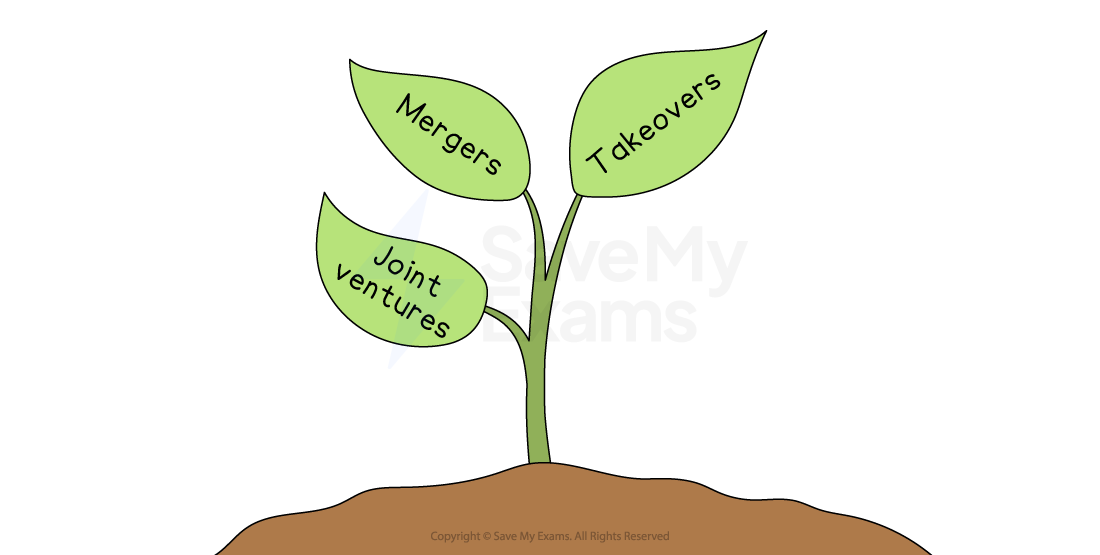
Methods of external growth include mergers, takeovers and joint ventures
-
A merger occurs when two or more companies combine to form a new company, usually on a friendly basis
-
The original companies cease to exist, and their assets and liabilities are transferred to the newly created entity
-
Firms merge to become stronger together than they would be apart
- That strength comes from lower costs, more customers, new capabilities or less competition
-
-
A takeover occurs when one company purchases another company, often against its will (hostile takeover)
- The acquiring company buys a controlling stake (more than 50% of shares) in the target company's shares and gains control of its operations
-
A joint venture occurs when two businesses join together to share their knowledge, resources, and skills to form a separate business entity, usually for a limited period of time
- E.g., the mobile network EE is in a joint venture formed by the French mobile network, Orange, and the German mobile network, T-Mobile
-
There are several reasons why companies may choose to pursue external growth
Reasons for external growth
| Reason | Explanation | Example |
|---|---|---|
| Strategic fit | - Acquiring another company to enter new markets, offer new products, or gain new technology | - In 2010, Kraft Foods bought Cadbury to expand its product range and boost sales in the UK |
| Economies of scale | - Growing larger lets companies cut costs and work more efficiently by combining operations and spreading fixed costs over more output | - When a factory doubles output, its cost per unit falls because overheads are spread across more items |
| Synergies | - Benefits that arise when two companies combine, such as higher revenue, lower costs, or better products | - Two merged airlines share routes and staff, reducing costs and offering more flight options |
| Elimination of competition | - Buying rivals removes competition and increases the buyer’s market share | - Meta(Facebook’s parent company) acquired WhatsApp in 2014, adding its users to Facebook’s network |
| Shareholder value | - Mergers and takeovers can boost profits, dividends, and share prices, creating higher returns for investors | - After a merger, a company’s combined profits rise, leading to a higher dividend and a stronger share price |
Types of integration
- External growth usually takes place when firms join in one of three broad ways
1. Vertical integration
-
This is a merger or takeover of another firm in the supply chain or different stage of the production process
- E.g. An ice cream manufacturer merges with a dairy farm or an ice cream cafe chain
Examples of vertical integration
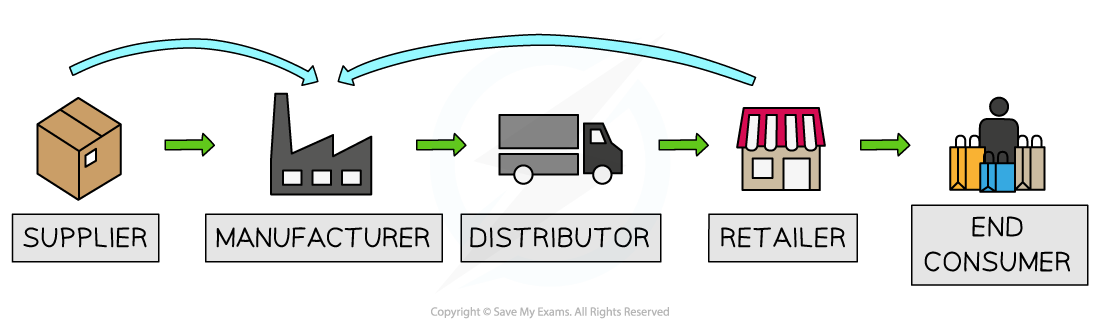
A diagram that illustrates how a firm can grow through forward or backward vertical integration
-
Forward vertical integration involves a merger or takeover with a firm further forward in the supply chain
- E.g. A dairy farmer merges with an ice cream manufacturer
-
Backward vertical integration involves a merger/takeover with a firm further backwards in the supply chain
- E.g. An ice cream retailer takes over an ice cream manufacturer
Evaluating vertical integration
| Advantages | Disadvantages |
|---|---|
| - Reduces the cost of production as middleman profits are eliminated - Lower costs make the firm more competitive - Greater control over the supply chain reduces risk as access to raw materials is more certain - The quality of raw materials can be controlled - Forward integration adds additional profit as the profits from the next stage of production are assimilated - Forward integration can increase brand visibility | - Diseconomies of scale occur as costs increase, e.g. unnecessary duplication of management roles - There can be a culture clash between the two firms that have merged - Possibly little expertise in running the new firm results in inefficiencies - The price paid for the new firm may take a long time to recoup |
2. Horizontal integration
-
This is a merger or takeover of a firm at the same stage of the production process
- E.g. An ice cream manufacturer buys another ice cream manufacturer
Evaluating horizontal integration
| Advantages | Disadvantages |
|---|---|
| - A rapid increase of market share - Reductions in the cost per unit due to economies of scale - Reduces competition - Existing knowledge of the industry means the merger is more likely to be successful - The firm may gain new knowledge or expertise | - Diseconomies of scale may occur as costs increase, e.g. unnecessary duplication of management roles - There can be a culture clash between the two firms that have merged |
3. Conglomerate integration
-
This is a merger or takeover between firms in entirely different industries
- E.g., An ice cream manufacturer buys a clothing company
Evaluating conglomerate integration
| Advantages | Disadvantages |
|---|---|
| - Spreads risk across industries - Uses surplus cash and skills elsewhere - Key expertise, such as strong financial management or marketing know-how, can be shared with all part of the business | - Limited management know-how in unfamiliar sectors - Research may be required to understand trends and customer needs - Greater organisational complexity |
Was this revision note helpful?
Build on this topic