Legal Influences (Cambridge International A-Level Business)
An introduction to legal influences
-
Legal factors are laws and regulations that businesses must follow for a range of reasons, including:
- To protect consumers from harmful substances
- To protect consumers from misinformation
- To ensure that businesses operate ethically
- To ensure that business competition is healthy for society and does not become harmful or destructive
-
Governments use laws to guide how businesses behave
- This helps protect workers, consumers, and the wider economy
-
The main areas of legal influence are shown on the diagram below
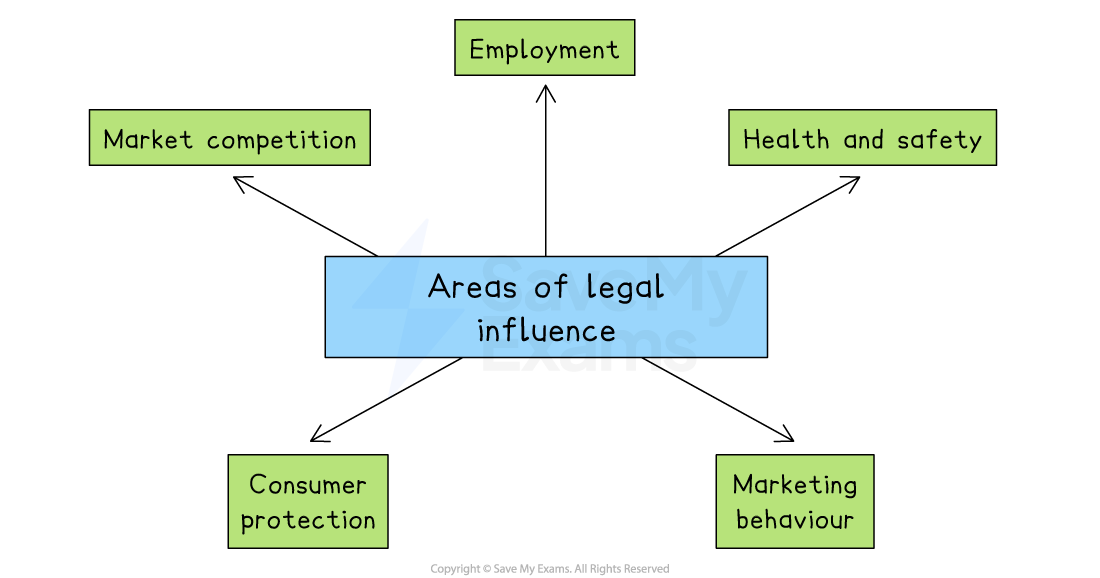
Businesses are influenced by laws related to employment, health and safety, marketing behaviour, consumer protection and market competition.
Employment law
-
Employee protection legislation prevents exploitation of workers
-
It covers areas including
- Pay and working conditions
- Equality of employment rights for marginalised groups (e.g. those with disabilities) to avoid discrimination
- The right to belong to a trade union *and take industrial action
- Contracts and termination of employment
- Health and safety of employees and contractors
| Area of law | Typical coverage | Impact on business |
|---|---|---|
| Pay and working conditions | - Minimum-wage levels - Limits on working hours, overtime and rest breaks - Safe working environment standards - Paid-leave entitlements (holidays, sick leave, parental leave) | - Employers must keep within legal limits or face fines and court action - Government inspections/audits check compliance - Firms may need to adjust shift patterns, rewrite contracts or upgrade staff facilities |
| Equality of employment rights | - Fair treatment regardless of gender, race, disability, religion, age or sexual orientation - Reasonable adjustments for disabled workers - Equal pay for equal work | - Recruitment, promotion and training must be merit-based - Job adverts and interviews must be fair and inclusive - Discrimination can lead to lawsuits, fines and reputational damage |
| Right to belong to a trade union and take industrial action | - Employees free to join a union to represent their interests - Collective-bargaining rights (negotiating pay and conditions) - Rules on lawful industrial action (e.g., strikes) | - Employers cannot punish or dismiss staff for union membership - Where required, firms must recognise and negotiate with union representatives - During strikes, legal procedures (ballots, notice periods) must be followed |
| Contracts and termination of employment | - Right to a written employment contract - Protection against unfair dismissal - Entitlement to notice periods, redundancy pay and the right to appeal a dismissal | - Employers must issue contracts and follow fair procedures when ending employment - Dismissals must be justified (e.g. misconduct, redundancy) - Ignoring fair procedures can lead to compensation claims and bad publicity |
Health and safety law
-
Health and safety law is intended to protect the physical and mental wellbeing of employees and contractors
-
Laws in different countries typically cover
- Provision of adequate rest periods
- Acceptable workplace temperature and noise levels
- Provision of safety equipment
- Hygienic, safe and sanitary conditions
- Manageable workloads
- Safety procedures and equipment, e.g., fire exits and first aid kits
-
To comply with health and safety laws, businesses need to
- Train and supervise staff properly on how to work safely
- Adjust working hours and ensure proper rest is taken
- Arrange manuals, signage, and legally required safety documentation
- Purchase and maintain personal protective equipment and safety tools
- Create and follow a health and safety policy or code of practice
-
Serious breaches of health and safety laws can lead to investigations, fines or prosecution.
- Poor health and safety practices can also cause accidents, reduce staff morale and damage a business’s reputation
Case Study IronForge Engineering Ltd
IronForge operates a busy metal fabrication plant. Workers often complain about
- High indoor temperatures
- Loud machinery with no hearing protection
- Lack of proper safety gear when cutting and welding
- Long shifts without proper breaks
Scenario
After a serious accident where a worker was injured by a falling object, the business was reported to the local health and safety authority
The company was ordered to
- Install proper ventilation and provide ear protection
- Reduce shift lengths and allow more frequent rest breaks
- Provide hard hats, gloves, and protective clothing
- Develop a written health and safety policy
- Train all workers in equipment safety and emergency procedures
Impact
While the improvements increased costs at first, the business
- Avoided prosecution
- Saw fewer accidents and reduced staff turnover
- Gained a better reputation with clients and employees
Marketing behaviour
-
Laws regulate marketing behaviour and protect consumers from unfair, misleading or harmful practices
-
They ensure that businesses advertise products truthfully, responsibly and ethically
-
Marketing strategies must comply with legal standards in areas such as
- Advertising content
- Data protection
- Pricing and promotions
- Comparisons with competitors
-
Failure to follow these laws can lead to fines, legal action or reputational damage
Areas of marketing law
| Type of law | Explanation |
|---|---|
| False or misleading advertising | - Businesses must not make claims that are untrue, exaggerated, or deceptive - Misleading marketing can damage trust and lead to legal penalties. - E.g. A company claiming a health drink cures illness without scientific evidence could face legal action |
| Use of personal data in marketing | - Laws control how businesses collect, store and use customer data - Customers have the right to know how data is used and can opt out of marketing communications |
| Advertising to children | - Some countries restrict how businesses market to children to protect them from harm - E.g. A toy company may not be allowed to show unsafe play or unrealistic product effects in ads targeting children |
| Unfair pricing | - Businesses must not advertise very low prices or special offers that are unavailable or limited without stating so clearly |
| Comparative and competitive advertising | - Comparisons with competitors must be fair, truthful, and not designed to mislead or damage a rival’s reputation |
Consumer law
-
Consumer protection laws defend the rights of buyers and ensure that businesses act fairly, safely, and honestly
-
These laws create trust in the market by making sure that products sold meet certain standards and that consumers are not misled
-
Laws often cover
- Product safety
- Accuracy of information
- Unfair contracts
- Refunds or returns
- Online and distance purchases
-
If businesses fail to follow these laws, they can face legal action, financial penalties or reputational damage
Areas of consumer law
| Type of law | Explanation |
|---|---|
| Product safety | - Goods and services sold to consumers must be safe - They must meet manufacturing standards, use safe materials and quality checked |
| Right to information | - Clear, accurate product information, such as ingredients, materials, safety warnings, instructions and pricing, must be provided - E.g. A food product must list all allergens and expiry dates clearly on the packaging |
| Right to refunds, repairs or replacements | - Consumers may be entitled to refund, repair or replacement of faulty goods |
| Protection against unfair contract terms | - Businesses cannot include terms in customer contracts that are unfair, unclear or one-sided |
| Online and distance selling | - Consumers have extra protections when buying online or by phone, including a 'cooling-off period' where they may cancel the order |
Competition law
-
Competition law helps ensure markets are open, fair and competitive
-
Powerful companies are prevented from using their position to dominate the market
-
Competition law can
- Prevent price fixing and unfair collusion
- Stop mergers or takeovers that reduce market competition
- Ban abuse of monopoly power
-
If a company breaks competition law, it may face heavy fines, restrictions or forced break-up of business operations
Laws affecting market competition
| Type of law | Explanation |
|---|---|
| Ban on price fixing and cartels | - Businesses are not allowed to agree with competitors to fix prices, limit production, or divide up markets - E.g. Two airlines agreeing to keep ticket prices high |
| Control of mergers and takeovers | - Governments may block or investigate mergers if they create a business that would dominate the market - E.g. A proposed merger between two telecom giants might be stopped if it would leave only one major provider in the country |
| Abuse of market power | - A dominant business must not use its power to force out competitors unfairly, such as by setting extremely low prices or refusing to supply others - E.g. A tech company refusing to let rival apps work on its platform could be investigated for abusing its position |
| Access to markets for new entrants | - Large firms cannot use tactics that block others from entering or growing in the market - E.g. A supermarket chain forcing suppliers not to sell to rival stores could be breaking competition law |
Was this revision note helpful?