International Trade (Cambridge International A-Level Business)
An Introduction to international influences
-
International trade is the exchange of goods and services across national borders
-
Exporting is the selling of goods or services from the home country to a customer in another country
- E.g. A UK chocolate manufacturer ships bars to supermarkets in Germany
-
Importing is buying goods or services from producers in another country for use or resale at home
- E.g. A Mexican furniture shop sells flat-pack desks manufactured by a producer in Poland
-
-
Exports generate extra sales revenue for businesses selling their goods abroad
-
Imports result in money leaving the country, which generates extra revenue for foreign businesses
Trends in international trade
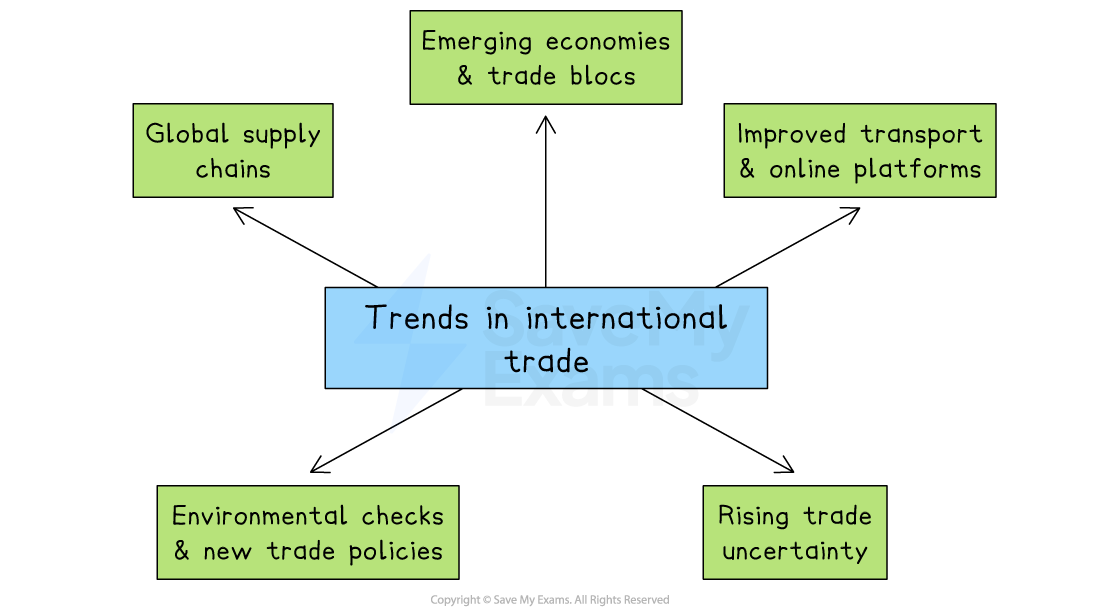
International trade is changing, with the growing importance of emerging economies, global supply chains and improved transportation
Global supply chains and digital services
-
Many products are made in several countries before they reach the customer.
- E.g. A smartphone can be designed in the United States, use chips from Taiwan, be assembled in Vietnam and sold around the world
Emerging economies and trade blocs
- China, India and Mexico now produce much of the world’s manufactured goods
- Trade blocs like the EU and USMCA lower tariffs for members, but businesses must follow each bloc’s rules
Improved transport and online platforms
- Container ships and air freight make international delivery faster and cheaper
- Even small firms can sell online to customers in other countries
Environmental checks and new trade policies
- Customers and governments examine carbon footprints, working conditions and data security before buying or approving goods
- New trade rules encourage firms to adjust their supply chains to meet these higher standards and reduce risk
Rising trade uncertainty
-
Exchange rates, tariffs and political tensions change more often, making international trade less predictable
- E.g. The USA has recently applied high levels of tariffs to a wide range of consumer goods manufactured in China
-
This encourages firms to develop more flexible supply chains
Benefits of increased international trade
| Benefit | Explanation |
|---|---|
| Larger customer base | - Selling in many countries boosts potential sales and spreads revenue sources beyond the home market |
| Economies of scale | - Higher global output lets factories run more efficiently, lowering the unit cost |
| Lower input costs | - Importing cheaper or higher-quality materials reduces overall production costs and can improve product quality |
| Risk spreading | - If demand falls in one country but rises in another, total revenue stays more stable over time |
| Access to new ideas and technology | - Working with overseas partners brings innovative designs and processes that can improve products and operations |
The importance of international trade links
-
International trade links, such as shared markets,digital agreements and transport routes, lower barriers to trade and reduce risk when trading internationally
-
They can help managers make decisions, including
- Where to source supplies
- Where to produce
- How to distribute goods or services
International trade links and business decisions
| International trade link | How it shapes business decisions |
|---|---|
| - Transport corridors and port networks - Examples include - The Suez Canal and Panama Canal - China's Belt & Road project - Major air-cargo hubs such as Dubai - Mega ports such as Rotterdam | - Firms choose suppliers and customers located on fast, reliable routes to cut delivery times. - They may build factories near big ports or rail hubs to save on shipping. |
| - Digital trade agreements - Examples include - Singapore–Australia Digital Economy Agreement - UK–Japan Digital Partnership | - Clear rules on data transfer and online payments encourage companies to sell software, streaming or other digital services across borders - Businesses can confidently invest in secure cloud systems that meet the agreement’s data-protection rules |
| - Regional supply chain clusters - Examples include - The auto parts network across Thailand, Malaysia and Indonesia | - Manufacturers split production stages among neighbouring countries to use each one’s strengths (labour cost, skills, raw materials) - Managers plan just-in-time' deliveries and have extra suppliers in the region to avoid stoppages |
The impact of trade agreements on business
-
International trade agreements set the ground rules for buying and selling across borders
- By lowering tariffs, standardising product rules or protecting foreign investors, these agreements reduce risk and cost for firms
-
As a result, managers decide where to locate factories, how to price products and which new markets to enter based on the protection and opportunities each agreement offers
Examples of trade agreements
| Trade agreement | Example | How it shapes business decisions |
|---|---|---|
| Free Trade Agreements (FTAs) | - United States–Mexico–Canada Agreement (USMCA) | - Tariff-free sales encourage firms to export or set up factories inside the free trade area - Managers adjust prices and forecast demand knowing that tariffs are low or zero |
| Customs unions and common markets | - European Union (EU) single market | - One set of product standards allows a single version of a product for all member states - Warehouses and distribution centres can be placed in the country with the best transport links or lowest costs to serve the whole bloc |
| Global trade rules | - World Trade Organisation (WTO) | - More than 160 countries agree maximum tariff levels and fair-trade rules - Firms can have confidence that costs will not jump suddenly - If a partner country breaks the rules, their government can take the dispute to the WTO |
The role of technology in international trade
- Technology removes many barriers, such as distance, paperwork and payment difficulties, that once limited international trade
Uses of technology in international trade
| Technology | Explanation | How it helps firms trade across borders |
|---|---|---|
| Mobile payment systems | - Secure apps that store cards or e-money and process payments in seconds - Examples include Alipay, M-Pesa and Apple Pay | - Customers in different countries can pay instantly in their local currency - Small exporters avoid high bank fees and get cash sooner, improving cash flow |
| Digital sales platforms | - Online marketplaces that list products, translate pages, handle taxes and connect to couriers - E.g. Amazon Global, Alibaba, Shopify | - Even the smallest firm gains a virtual shop window open 24/7 to millions of overseas buyers - Built-in links to logistics automate shipping labels, customs forms and parcel tracking |
| Cloud collaboration & digital freight tools | - Cloud software lets buyers, suppliers and carriers share designs, stock levels and shipment details live | - Teams in different time zones co-edit orders and book transport without long e-mail chains - Real-time stock and route data cuts delays and lowers storage costs |
| Blockchain for trade finance and traceability | - A tamper-proof digital record of each step of a shipment - Smart contracts release payment once checkpoints are met | - Fewer paper documents and fast customs clearance reduce fraud and administration costs - Buyers can verify product origin (e.g. fair-trade cocoa) and meet strict import rules |
| Artificial Intelligence (AI) applications | - Big data is analysed to forecast demand and set dynamic prices | - Better forecasts mean leaner inventories and fewer stockouts |
Was this revision note helpful?