Management and Workforce Relations (Cambridge International A-Level Business)
Cooperation between management and the workforce
-
Workplace relations refers to the interactions between managers and workers in a business, including
- How change is communicated and implemented
- How grievances and disciplinary action are pursued
- The level of consultation on key decisions
- Fairness and effectiveness of business processes
-
Positive workplace relations between management and workers brings a range of benefits
Benefits of positive workplace relations
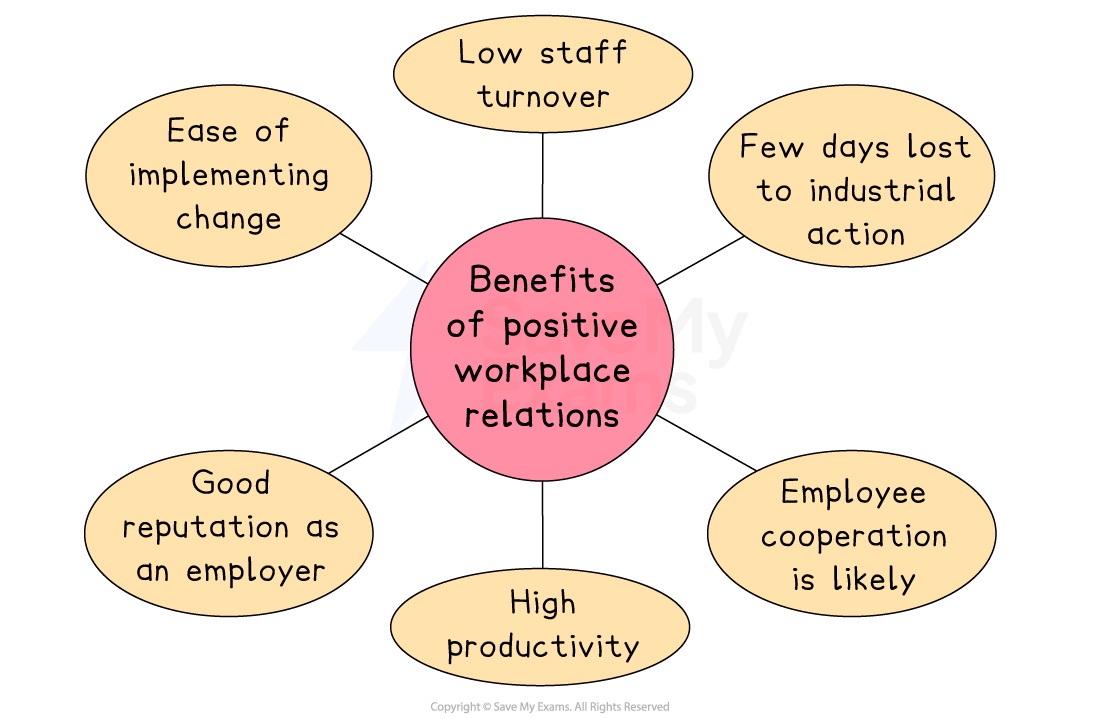
Good relationships between managers and workers leads to benefits including increased productivity, low levels of staff turnover, improved cooperation and fewer days lost due to industrial action
- Low staff turnover
- When workers have a positive relationship with their managers, they are less likely to leave or face dismissal
- Few days lost to industrial action
- Industrial action is where trade union members, in dispute with management, protest or take action, such as strikes, to achieve their aims
- Effective workplace relations mean that disruption as a result of industrial action is unlikely
- Employee cooperation
- Employees may 'go the extra mile' for the business if they feel valued
- Support from employees for key decisions means that objectives are more likely to be met
- High productivity
- Good working relationships mean workers are less likely to be absent from work and more likely to be focused on maximising output
- Workers are more likely to contribute ideas that lead to improved performance
- Good reputation as an employer
- Businesses with good relationships avoid negative publicity
- These businesses attract and retain the best staff
- Ease of implementing change
- Significant change is more likely to be welcomed rather than feared
- Employees look to play their part in implementing change
Employee morale and welfare
-
Some businesses make great efforts to improve employees' welfare
- Looking after workers is likely to lead to long-term loyalty and high levels of motivation, which can have a positive impact on labour productivity
Strategies to improve welfare
| Strategy | Explanation |
|---|---|
| Equality and diversity | - Ensuring fair recruitment, pay, and promotion helps build a skilled, productive workforce - A diverse team can also attract a wider range of customers |
| Provision of facilities | - Providing rest areas, worship spaces, refreshments, and access to guidance supports employee wellbeing |
| Wellbeing policies | - Policies such as leave and limiting out-of-hours communication help improve work–life balance. |
| Perks | - Offering extras like social events, staff discounts, or gym memberships can boost morale and motivation |
Work-life balance
-
Ensuring employees have a healthy work-life balance can lead to several advantages
- Less stress-related absence lowers business costs and reduces disruption to production
- Increased employee output, as when they are at work, their focus is likely to be improved
- A more diverse workforce that has time to enjoy leisure and creative activities outside of working hours
Ways to improve work-life balance
| Teleworking | Flexible working |
|---|---|
| - Teleworking has become increasingly popular since the Covid-19 pandemic, when many workplaces were required to close - Some businesses offer workers the option to work from home for some or all of the working week - Online tools, such as virtual meeting spaces **and messaging apps, have made teleworking possible - Significant cost savings can be made as businesses no longer require large premises to accommodate staff - Businesses often need to provide equipment, such as computers, to ensure workers can work effectively from home | - Flexible working removes some of the rigidity of contracts of employment - Employees can fit their working commitments around family responsibilities or interests - Forms of flexible work include - Flexitime, where workers to arrange their weekly working hours according to their own needs - Annualised hours, where workers determine how and when they allocate working hours over a whole year - Compressed hours, where workers complete the hours in a standard working week in fewer days |
| Job sharing | Sabbaticals |
| - Job sharing is where two people share the work and pay of a single full-time job - This approach is popular where workers have** care responsibilities and wish to continue to work alongside these - Businesses can benefit from the input of two individuals whilst incurring the cost of one employee - Careful coordination and communication between job-sharers are required to avoid duplication or omission of tasks | - Some businesses grant workers the right to take an extended period of leave, often after a determined period of service - The businesses promises to keep the employee's job open until their arranged return to work - Sabbaticals are generally unpaid, though paid sabbaticals are sometimes used to attract the best talent to hard-to-fill positions |
Exam Hint Flexible working may appear to offer benefits that are largely focused on the employee
In the exam, you could be asked to analyse the impact on a business of flexible working
You should focus your answer on improved employee motivation and productivity, as well as the ability to attract a larger number of candidates to advertised job roles
The impact on employers and employees of trade union involvement in the workplace
-
A trade union is an organisation whose members come together to achieve common goals
- Union members pay a membership fee and elect representatives in the workplace
-
They negotiate with employers to improve terms and conditions of employment for workers
- Improved pay
- Increases in paid holidays
- Reduced hours of work
- Sufficient rest breaks
- Improved training and development
- Better facilities
-
Trade unions can also give individual advice when employees have a problem at work
- They also lobby governments to pass laws that favour employees, such as improved health and safety regulations
Examples of trade unions
 | Communication Workers Union (CWU) - For people working for telephone, cable, digital subscriber line and postal delivery companies in the UK |
|---|---|
 | IG Metall - The dominant metalworkers' union in Germany, making it the country's largest union as well as Europe's largest industrial union |
 | Unión General de Trabajadores (UGT) - Spain's major general trade union, representing production workers in a variety of industries |
-
Trade unions can use a range of approaches to resolve conflict in the workplace. These include:
- Collective bargaining
- Work-to-rule
- Strike action
Collective bargaining
-
A process where trade unions negotiate with employers to reach agreements on terms and conditions of employment
- It is a structured way for employers and employees to come to a mutually acceptable agreement
- Trade unions have greater negotiating power than individual employees
- Negotiations typically cover a range of issues, including wages, working hours, benefits and workplace conditions
The collective bargaining process
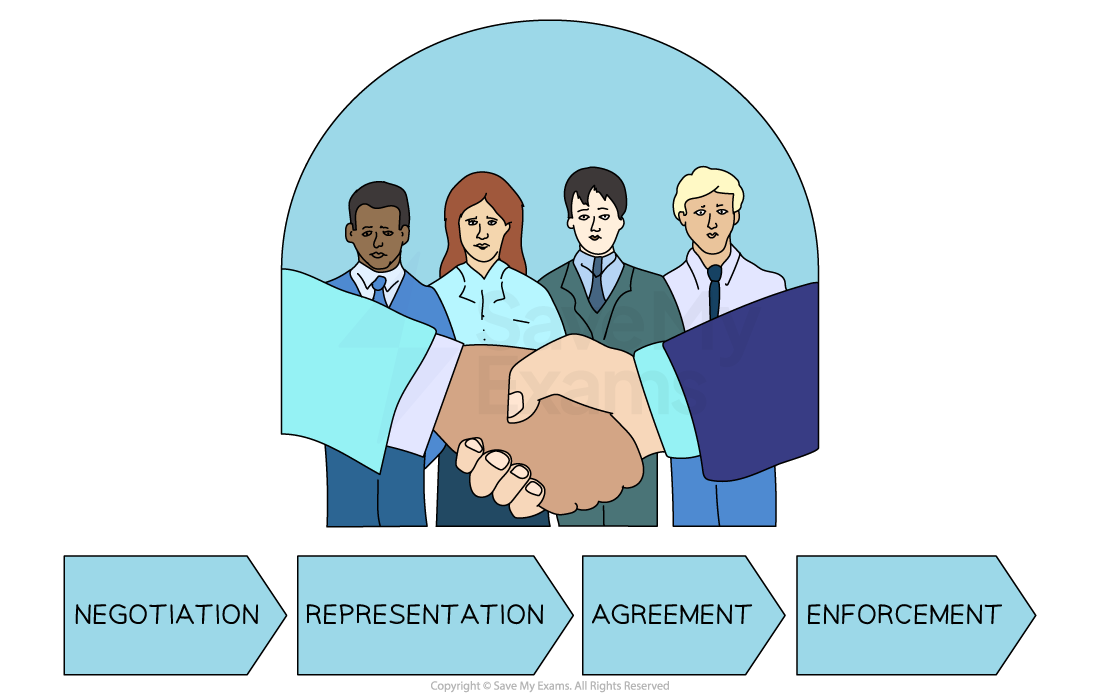
This process leads to conflict resolution and collective agreement
-
The goal of collective bargaining is to reach a collective bargaining agreement
-
This is a legally binding document that determines the employment relationship for a specified period
- Both parties must adhere to the terms of the agreement
- If further disputes arise, tools such as mediation and arbitration can be used
-
Other forms of industrial action
| Industrial action | Explanation | Example |
|---|---|---|
| Work-to-rule | - Workers complete only tasks explicitly stated in the contract of employment - Work begins and ends at times stated in the contract - Staff refuse to cover for absent colleagues | - The UK's NASUWT union instructed its members in schools and colleges to work to rule - This included refusing to carry out extracurricular activities, midday supervision and work during lunch breaks |
| Strike action | - Workers collectively refuse to work - They are not paid when taking strike action - Action may take place continuously or on specified days of work - A ballot of trade union members must find a majority in favour of taking such action | - Two of the biggest unions representing French ski resort workers called for strike action during the 2023 ski season - The intention was to disrupt operations during the peak tourist season to achieve pension reforms, better pay and improved working conditions |
Was this revision note helpful?