When is the volume of this cylinder inside a cone a maximum?
Question
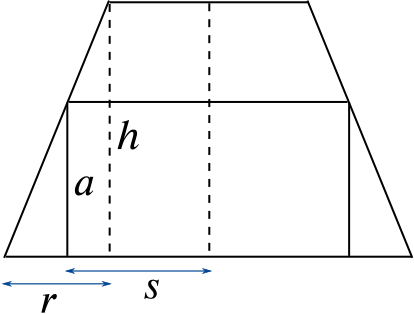
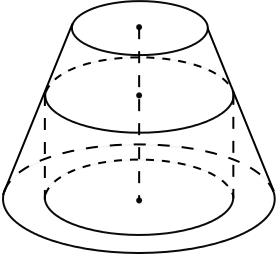
A truncated cone of height has circular ends of radii and . In this cone is inserted a circular cyclinder having its axis along the axis of the cone. One end of the cylinder lies in that face of the cone which is of radius and the circumference of the other end lies in the curved surface of the cone (see diagram). Given that the radius of the base of the cylinder is , show that the volume of the cylinder is
If is allowed to vary, find, in terms of and , the maximum volume of the cylinder.
Solution
A truncated cone of height has circular ends of radii and . In this cone is inserted a circular cylinder having its axis along the axis of the cone. One end of the cylinder lies in that face of the cone which is of radius and the circumference of the other end lies in the curved surface of the cone (see diagram). Given that the radius of the base of the cylinder is , show that the volume of the cylinder is
The volume of a cylinder is given by (area of the base)(height).
Since the radius of the cylinder is , the area of its base is .
We now need to find the height of the cylinder which we shall call . For this, consider the following cross section of the diagram above.
From the two similar triangles at the left hand side we can see that
In order to find , we'll choose axes as follows.
Since the radii of the two faces of the truncated cone differ by , the equation of the left-hand line is . Note that in this coordinate system, the left side of the cylinder has equation . Thus, the intersection point of this line with the truncated cone has -coordinate which is the height of the cylinder.
Thus the volume of the cylinder is as required.
We have
Putting , we have
The second case is clearly the one we require, giving . This yields