Average turning points
Excerpt: Can a cubic have a stationary (turning) point midway between two intersection points?
Problem
While working on part (c) of Can you find… curvy cubics edition, which asked: “Can you find a cubic curve that has a local minimum when ?”, two students had the following conversation:
A: I can find a cubic with a stationary point at by having two of the -axis intersection points at and , because the stationary point is half-way between the two intersection points. I need a third intersection point, too, not between these, so I may as well choose , so my cubic is (with a minus sign so the cubic is the right way up).
B: I’m not sure that’s right; is the stationary point really half-way between the -axis intersection points?
Can you resolve their debate?
If student A is right in this case, does this approach always work for finding a cubic with a given stationary (turning) point, or only sometimes?
If student B is right in this case, does student A’s approach ever work?
Things you might think about
What do we need to do to check who is right in this case?
What exactly is student A’s approach? Can you describe it precisely?
Answering this first will ensure that we agree about what we are trying to show!
How could we show whether this approach always works?
- What methods are there for proving whether something is always, sometimes or never true?
If student B is right in this case, then how might we go about proving whether student A’s approach ever works?
-
Can you think of a visual argument? You might consider the graphs of a cubic function and its derivative, and ask how they relate to each other.
-
Can you think of an algebraic argument?
-
How do these (or other) arguments compare?
Solution
A good start could be to check if student A or student B is right in this case.
Checking for this case
Student A suggests the function has the required features.
Expanding this gives .
The -coordinates of the turning points are the solutions of , so .
We could solve this to get , which does not equal , or we could just substitute into , getting . Either way, student A is wrong in this case.
What exactly is student A’s approach? Can you describe it precisely?
Answering this first will ensure that we agree about what we are trying to show!
It seems that student A’s approach can be described as:
- To have a stationary point at , I will put two of my -axis intercepts at and , where is midway between and , and my third intercept will be at , where is not between and .
This is what we will work with.
To prove that student A’s approach doesn’t always work, we only need to find one counterexample, and we have now done this.
To find out whether student A’s approach ever works, we either need to find an example where it does or to prove that it never works.
We could test several examples, and that might give us some insight (if they all fail) towards a reason why it never works, or it will give us an example of where it does. But if they all fail, that alone does not constitute a proof that student A’s approach never works.
An alternative is to try to prove that student A’s approach never works. If our proof is successful, we will be done, and if it is not, we may discover an example which works instead.
We will use this second route, and try to prove that student A’s approach never works.
A visual argument
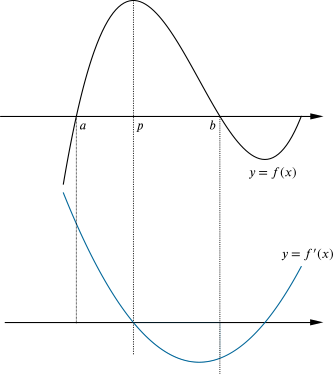
We will start by sketching a cubic with -axis intercepts at , and a turning point between and at . (We don’t assume that lies midway between and ; we want to work out whether this is possible.)
We also sketch the corresponding gradient function (derivative) on a separate graph, lined up; this must be a quadratic function.
In this case, it seems that is closer to than to .
Is this always going to be the case? Is there anything we can see from the graph of the cubic or its derivative which we can use to argue either way?
It might be helpful to think about ways in which the two graphs are related.
An argument
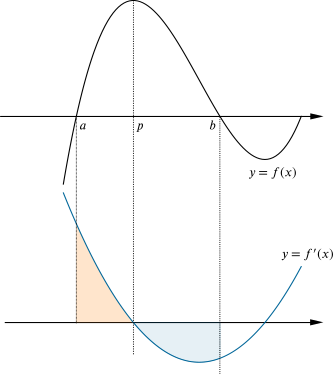
The “area under the graph” on the derivative graph equals the change in function value on the original graph. We can write this algebraically as: (This uses the second fundamental theorem of calculus.) The first integral is positive, as the derivative graph is above the -axis, while the second one is negative. Also, as , we can write these as
We can illustrate these areas on our graph:
The (unsigned) shaded areas must be the same because the (signed) area above the graph is and the (signed) area below the graph is .
So can be midway between and ?
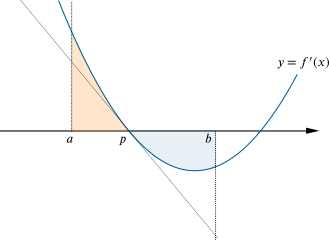
If we draw a tangent to the gradient function graph at , as shown, we end up with two similar triangles. The one between and has area less than , whereas the one between and has area more than . But if were midway between and , then the two triangles would be congruent, and so have equal areas. This is a contradiction, and so it is impossible for there to be a case where the stationary point is midway between the roots of a cubic.
We might ask questions about this argument. For example:
-
This argument has been about the left-hand stationary point, the one between and . What about the stationary point between and ?
-
Could the stationary point be midway between and , perhaps?
-
We have drawn our cubic having a maximum between and . But the original question asked for a minimum at , not a maximum! So can we modify our argument for a cubic which has a minimum between and and a maximum between and instead?
An algebraic argument
In this argument, we will write down the formula for a cubic with three -axis intercepts (that is, three roots), then differentiate it to find its stationary points. Instead of trying to solve the resulting quadratic, which will be algebraically messy, we will simply test whether the value midway between two roots is (or can be) a solution of .
A general cubic with three
-axis intercepts (or three roots)
,
and
can be written as
where is some non-zero constant.
We can differentiate this to obtain
The point midway between
and
(which are any two roots of the cubic) is
, so we substitute this into
:
To simplify the algebra, we multiply both sides by
and divide both by
, so
So if and only if , or . And means that the cubic has a double (or triple) root at , so the cubic is tangent to the -axis at this point.
Therefore the original Can you find… curvy cubics edition question may have a solution for some suitable values of and , but student A’s approach can never work for distinct values of , and : a stationary point of a cubic can never occur midway between two distinct roots of the cubic.
There are some ways to simplify the algebra in this argument.
Firstly, we could notice that a vertical stretch of the function does not change either the -axis intercepts or the -coordinates of the stationary points, so we may as well assume .
Secondly, translating the function in the -direction does not affect the property of having a stationary point lying midway between two -axis intercepts. Therefore we can translate the function so that one of the intercepts is at the origin, so our cubic is now simply . This is easier to work with, and so the chances of making an algebraic error are reduced.
How do these arguments compare? What advantages does each one offer?