Can you find... curvy cubics edition
Excerpt: This activity asks students to think about how they can use information about derivatives and stationary points to work "backwards" to possible curves.
Problem
It would be a good idea to try to sketch some of the cubics first before trying to form an equation.
Can you find a cubic curve that…
- … has no stationary points?
- … has two stationary points: one when and another when ?
- … has a local minimum when ?
- … has a local minimum when and a local maximum when ?
Things you might have noticed
Here, we are going to use our knowledge of the calculus of cubic curves to help us to find some equations satisfying each of the conditions. That is, if is a cubic, what can we say about ?
Once we have an equation for our cubic curve we could use Desmos to check the features.
If you have an example that meets the conditions for one part of the problem
-
could you modify it to meet the conditions in a different part?
-
could you take a similar approach to a different part?
What does this mean for the derivative of the cubic function?
You might want to take a look at Curvy cubics.
- … has a stationary point when and another when ?
If we want a cubic curve to have two stationary points, we know from calculus that needs to have two distinct solutions. We can then use integration to give us possibilities for the cubic curve.
What could look like if has two distinct solutions?
Can we create a cubic curve with a stationary point at ? Could it be any type of stationary point? How many stationary points in total can we have for a cubic curve?
What shape did the curve you created in part (b) have? Could we use this to help create a cubic curve with these conditions?
Student work
You may like to share one or two pieces of this sample student work during the task to help prompt discussion and encourage students to reflect on different ways to approach the problem.
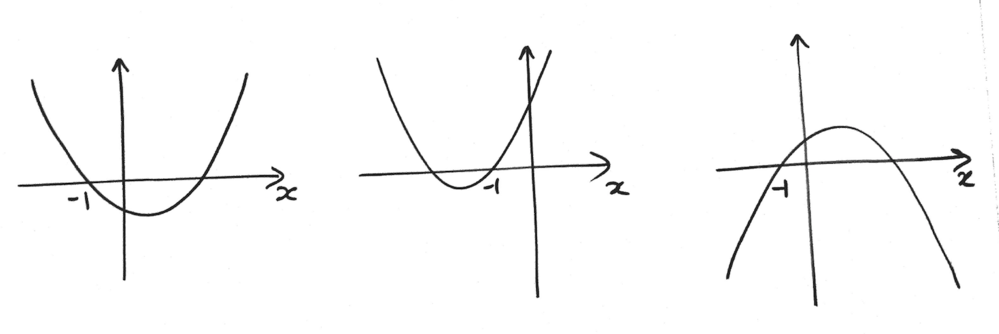
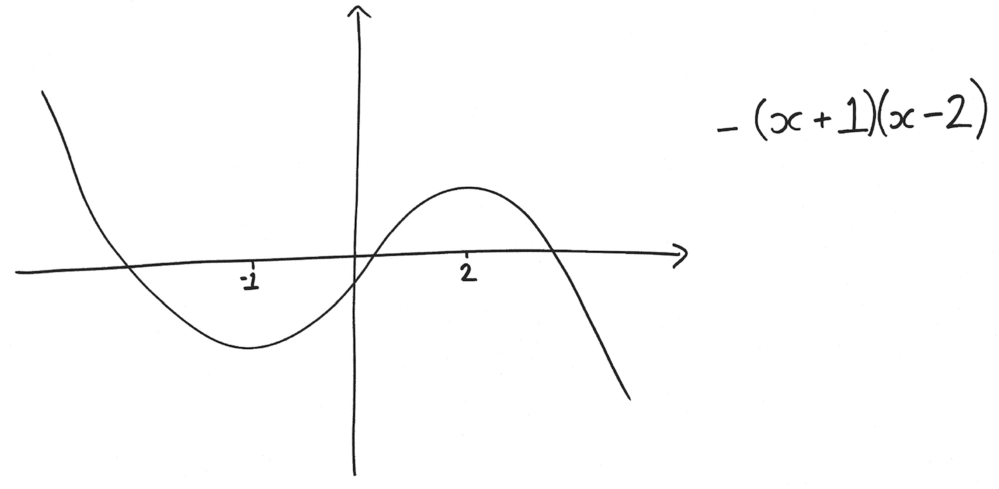
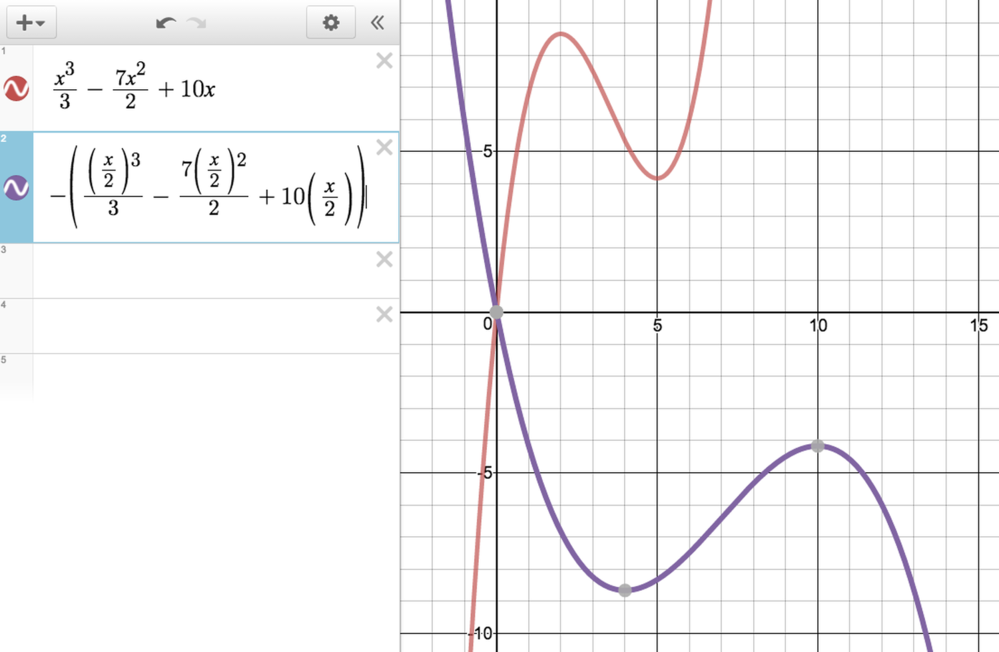
Students A and B were working on part (c) of the problem. Student C was working on part (d) of the problem.
Student A
Questions
-
Why has this student drawn quadratic graphs?
-
How could you continue this piece of work to find suitable cubic equations?
Student B
Questions
-
What is the connection between the graph sketched and the expression written on the right of the image?
-
How could you continue this piece of work to find a suitable cubic equation?
Student C
Questions
-
Why might this student have started with this red curve?
-
How have they changed it to make the purple curve and why does this help?
-
How could you continue from here?