Evaporation (Cambridge International IGCSE Science)
Exam board Cambridge International · IGCSEUpdated 2025-12-19
Evaporation
-
Evaporation is a change in state of a liquid to a gas
-
It happens:
- At any temperature
- Only from the surface of a liquid
-
The molecules in a liquid have a range of energies
- Some have lots of energy, others have very little
- Their average energy relates to the temperature of the liquid
-
Evaporation occurs when more energetic molecules moving near the surface of the liquid have enough energy to escape
- The average energy of the liquid is reduced when the particles with most energy leave
- Therefore liquids are cooled down by evaporation
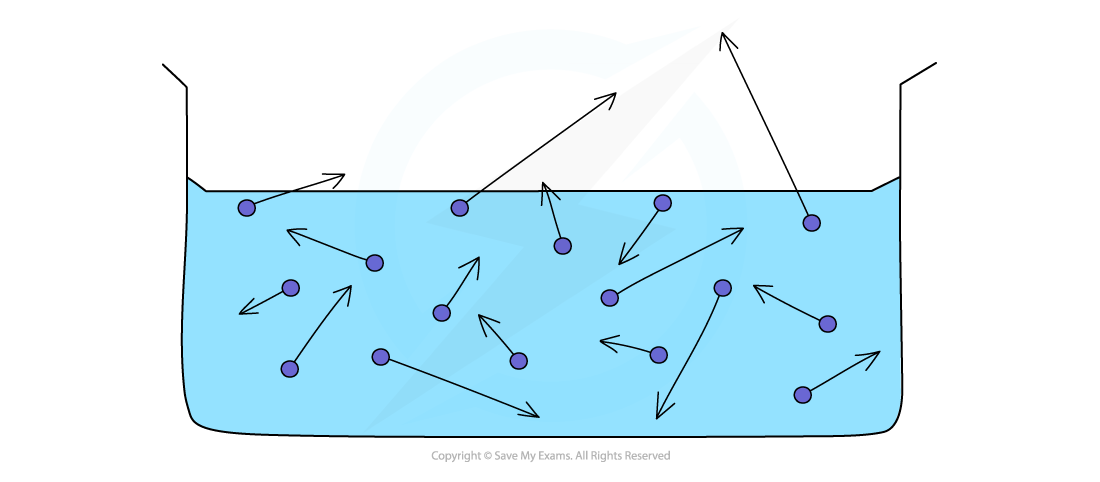
Evaporation occurs when more energetic molecules near the surface of a liquid escape
Factors affecting evaporation
Extended Tier Only
- These factors all affect the rate of evaporation
Temperature of the liquid
-
Increased temperature increases the kinetic energy of the molecules in the liquid
- Molecules with more energy are more likely to overcome the intermolecular forces holding them in the liquid state and escape the surface
- Therefore higher temperature leads to a higher rate of evaporation
Surface area of the liquid
-
Molecules only escape the intermolecular forces of attraction at the surface of the liquid
- Therefore a larger surface area leads to a higher rate of evaporation
Air movement
-
Air movement carries away the water vapour which has just evaporated
- This replaces the air above the liquid with drier air, which accept water vapour more easily
- Therefore increasing air movement (e.g. wind or a fan) increases the rate of evaporation
Boiling vs evaporation
Extended Tier Only
Difference between evaporation and boiling
-
Boiling is also a change in state from liquid to gas
- Boiling happens only at the boiling point of the liquid
- The change of state happens throughout the liquid (seen as bubbles at the bottom of a pan of boiling water, for example)
Table showing the difference between evaporation and boiling
| Evaporation | Boiling | |
|---|---|---|
| Change of state? | Liquid to gas | Liquid to gas |
| Temperature? | Any temperature between melting and boiling point | Boiling point |
| Location in liquid? | From the surface | Throughout the whole liquid |
Was this revision note helpful?
Build on this topic