11 markmedium
A boat travels due east and then due north.
Which row correctly shows the total distance and displacement magnitude?
| Total distance | Displacement magnitude | |
|---|---|---|
| A | 50 km | 70 km |
| B | 70 km | 50 km |
| C | 70 km | 70 km |
| D | 50 km | 50 km |
Choose your answer
29 questions · 81 marks · ≈ 1 hour · spans 22 of 58 topics
Assembled from the topic question banks — not an official Cambridge International paperA boat travels due east and then due north.
Which row correctly shows the total distance and displacement magnitude?
| Total distance | Displacement magnitude | |
|---|---|---|
| A | 50 km | 70 km |
| B | 70 km | 50 km |
| C | 70 km | 70 km |
| D | 50 km | 50 km |
Choose your answer
The diagram shows a speed–time graph for a car travelling along a straight road.
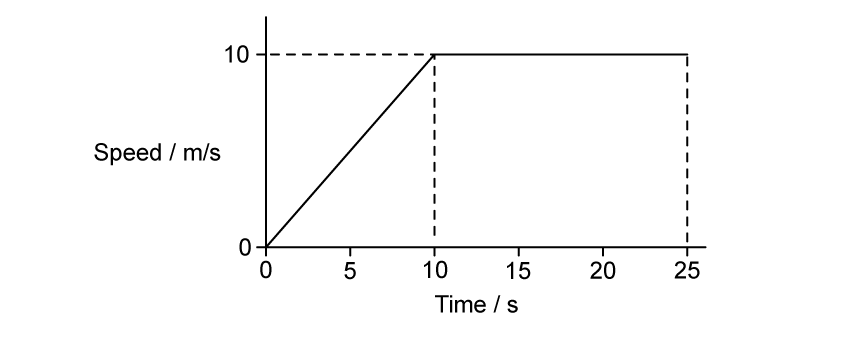
What is the distance travelled by the car while it is moving at constant speed?
Choose your answer
Extended tier only
How is the weight of an object defined?
Choose your answer
The force of the ground pushing on an object
A measure of the quantity of matter of an object at rest to the observer
The mass per unit volume of an object
The gravitational force acting on an object with mass
Two students were discussing Newton's first law of motion.
Which statement correctly summarises this law?
Choose your answer
An object will not change its speed or direction unless a resultant force acts upon it
An object will not move unless a resultant force acts upon it
An object will not speed up unless a resultant force acts upon it
An object will not change its direction unless a resultant force acts upon it
A beam is pivoted at one end, as shown.
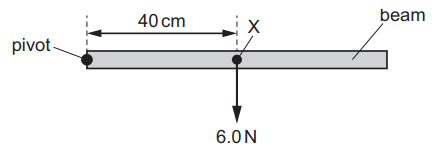
The beam weighs 6.0 N and its weight acts at a point X 40 cm from the pivot.
A force of 4.0 N is applied to the beam causing it to balance horizontally.
In which direction and where is the 4.0 N force applied?
Choose your answer
vertically downwards at 20cm to the left of X
vertically downwards at 20cm to the right of X
vertically upwards at 20cm to the left of X
vertically upwards at 20cm to the right of X
Two students, X and Y, race up the same flight of stairs. Student X has a greater mass than student Y. They both start from rest and develop the same average power during the race.
Which student reaches the top of the stairs first and why?
Choose your answer
Student X reaches the top of the stairs first because they do more work against gravity than student Y.
Student Y reaches the top of the stairs first because they do less work against gravity than student X.
Both students reach the top of the stairs at the same time because their power is equal.
Student Y reaches the top of the stairs first because they transfer more energy to their gravitational potential store than student X.
Which source of energy is renewable?
Choose your answer
coal
natural gas
oil
wind
A water-filled tank is resting on a table as shown in Fig. 1
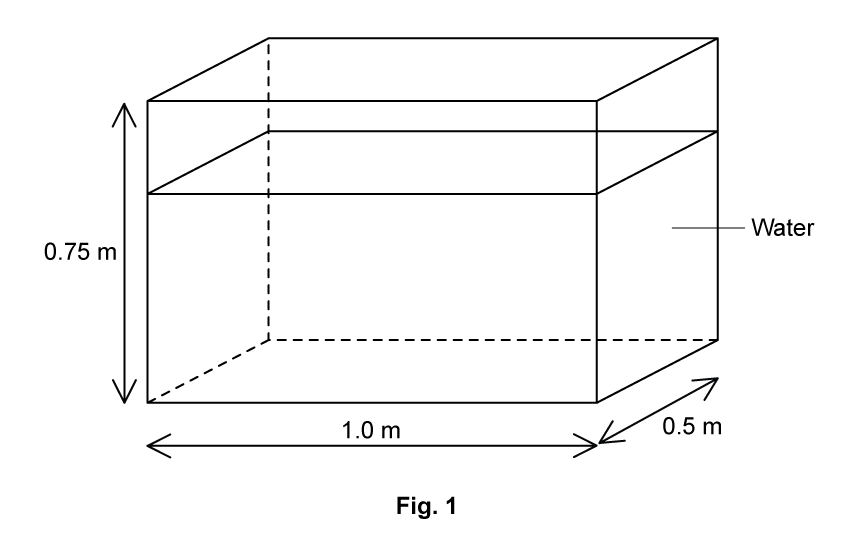
Using the measurements in the diagram, determine the area which should be used to calculate the pressure the tank exerts on the table.
Choose your answer
0.25 m2
0.5 m2
0.75 m2
1.0 m2
The list gives three properties of different states of matter.
Which properties are correct for liquids?
Choose your answer
1 and 2 only
2 and 3 only
1 and 3 only
1, 2 and 3
A beaker of water is heated from room temperature until the water boils.
Which statement about the water is correct?
Choose your answer
The temperature of the water increases at a constant rate throughout the heating.
The temperature of the water increases until it boils, then continues to increase slowly.
The temperature of the water increases until it reaches 100 °C, then remains constant while it boils.
The water begins to boil as soon as heating starts.
A saucepan is used to heat water on a stove.
Which row correctly describes the best materials for the base and the handle of the saucepan?
| base of saucepan | handle of saucepan | |
|---|---|---|
| A | glass | copper |
| B | copper | wood |
| C | wood | copper |
| D | glass | wood |
Choose your answer
In a shallow tank, a water wave moves through a barrier with a narrow gap. The diagram shows the waves on the left-hand side and the right-hand side of the barrier.
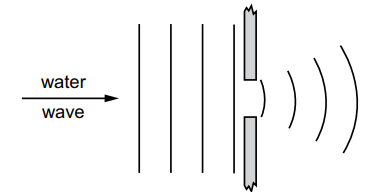
Which term describes the effect shown?
Choose your answer
reflection
dispersion
refraction
diffraction
Extended tier only
Bluetooth devices rely on electromagnetic radiation to transmit signals.
Which of the following statements is correct?
Choose your answer
Visible light is used by Bluetooth-enabled devices because it undergoes total internal reflection in optical fibres
Gamma waves are used by Bluetooth-enabled devices because they penetrate easily through walls
Microwaves are used by Bluetooth-enabled devices because they can reach satellites in orbit as they are not absorbed by the ionosphere
Radio waves are used by Bluetooth-enabled devices because they transmit very well over short distances
The diagram represents a sound wave.
The sound wave changes from X to Y
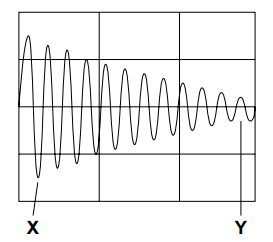
Which statement about the sound wave is correct?
Choose your answer
The amplitude of the wave is increasing.
The frequency of the wave is decreasing.
The pitch of the sound is increasing.
The volume of the sound is decreasing.
A student has what he believes to be a permanent magnet. He wants to find out which end is the magnet’s North pole.
What could he do to find out?
Choose your answer
Put the magnet under a piece of paper, and sprinkle iron filings on top.
Put it near to a piece of magnetic material, like a steel paperclip.
Place a compass near it.
Put it near to a piece of ferrous material.
Which line correctly states the equation for electrical energy?
Choose your answer
The diagram shows two resistors connected in series with a battery.
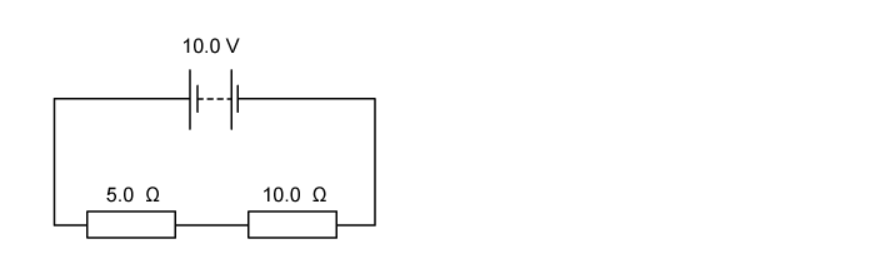
What is the current through the battery?
Choose your answer
1.5 A
150 A
0.67 A
15 A
A simple electric generator induces an electromotive force (e.m.f.).
Which modification would increase the induced e.m.f.?
Choose your answer
Increase the number of turns in the coil of the generator.
Increase the distance between the magnetic poles.
Reduce the strength of the magnetic field around the coil.
Reverse the direction of the magnetic field.
Extended Tier Only
How do the sizes of the two nuclei produced in a nuclear fission reaction compare to the size of the original nucleus?
Choose your answer
both larger than the original nucleus
one larger and one smaller than the original nucleus
both smaller than the original nucleus
one smaller and one the same size as the original nucleus?
Which statement about α-particles and β-particles is correct?
Choose your answer
α-particles are less ionising than β-particles.
α-particles are more penetrating than β-particles.
α-particles have greater mass than β-particles.
α-particles have the same charge as β-particles.
Extended tier only
The orbit of Venus around the Sun is treated as a circular path with an average radius of 108.2 million km. The orbital period of Venus is 225 days.
What is the orbital speed of Venus?
Choose your answer
40 000 km / h
62 900 km / h
126 000 km / h
810 000 km / h
Extended tier only
Hubble's law gives an expression for the Hubble constant
What does the equation allow astronomers to calculate?
Choose your answer
1 only
1 and 3
3 only
1, 2 and 3
A student is determining the acceleration of free fall g using a pendulum. Fig. 1.1 shows the pendulum. Fig. 1.2 shows one complete oscillation of the pendulum.
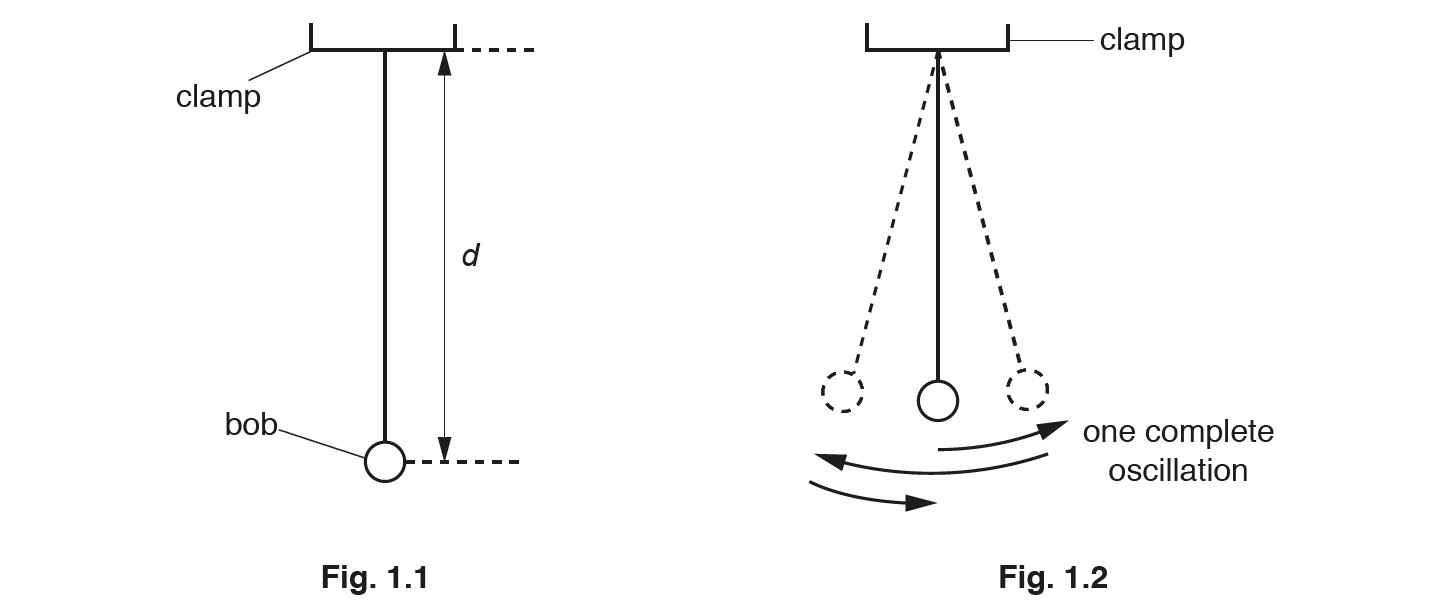
On Fig. 1.1, measure the distance d.
*d *= ................................................... cm
Extract:
Measured distance from Fig. 1.1: d = 5.0 cm (from part (a)) The scale of drawing to actual size = 1/10th The time t shown on the stopwatch = 14.06 seconds The time for 10 oscillations t = 14.06 seconds Equation: g = 20 / T^2
Fig. 1.1 is drawn 1/10th actual size. Assume that distance d from part (a) is 5.0 cm.
(i) Calculate the actual distance D from the bottom of the clamp to the centre of the bob.
D = ................................................... cm [1]
The student displaces the bob slightly and releases it so that it swings. He measures the time t for 10 complete oscillations. The time t is shown on the stopwatch in Fig. 1.3.

(ii) Write down the time t shown in Fig. 1.3.
t = ......................................................... [1]
(iii) Calculate the period T of the pendulum. The period is the time for one complete oscillation.
T = ......................................................... [1]
(iv) Calculate T2.
T2 = ......................................................... [1]
(v) Calculate the acceleration of free fall g using the equation .
g = ......................................................... [1]
The student adjusts the pendulum until the distance D measured to the centre of the bob is 100.0cm.
He repeats the procedure and obtains another value of T2.
T2 = 3.92
(i) On the dotted line above, write the unit for T2.
(1 mark)
(ii) Calculate the acceleration of free fall *g *using the equation and the value of T2 from (c). Give your answer to a suitable number of significant figures for this experiment.
g = ......................................................... [1]
Extract:
A student is determining the acceleration of free fall g using a pendulum. Fig. 1.1 shows the pendulum. Fig. 1.2 shows one complete oscillation of the pendulum.
On Fig. 1.1, measure the distance d.
Fig. 1.1 is drawn 1/10th actual size. Assume that distance d from part (a) is 5.0 cm.
(i) Calculate the actual distance D from the bottom of the clamp to the centre of the bob.
The student displaces the bob slightly and releases it so that it swings. He measures the time t for 10 complete oscillations. The time t is shown on the stopwatch in Fig. 1.3.
(ii) Write down the time t shown in Fig. 1.3.
(iii) Calculate the period T of the pendulum. The period is the time for one complete oscillation.
(iv) Calculate T^2.
(v) Calculate the acceleration of free fall g using the equation g = 20 / T^2.
The student adjusts the pendulum until the distance D measured to the centre of the bob is 100.0cm. He repeats the procedure and obtains another value of T^2.
T^2 = 3.92
(ii) Calculate the acceleration of free fall g using the equation g = 40 / T^2 and the value of T^2 from (c).
Another student states that repeating the experiment improves the reliability of the value obtained for g.
Suggest two changes that you would make to improve the reliability. The stopwatch cannot be changed.
State one precaution that you would take in this experiment in order to obtain accurate readings.
Fig. 1.1 shows a dripping tap and a measuring cylinder. The water drops all have the same volume. The drops fall from the tap at equal time intervals.
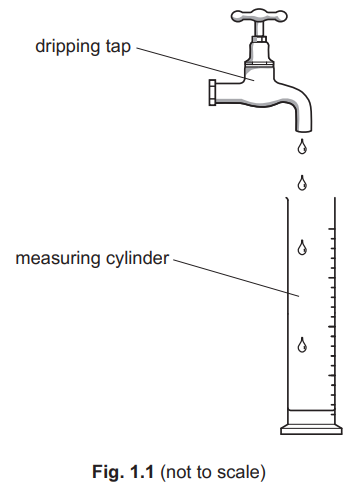
(i) The student collects 200 of the drops in a measuring cylinder. The total volume collected is 60 cm3.
Calculate the average volume of one drop of water.
volume = .................................................. cm3 [3]
(ii) Another student uses a stop-watch to measure the time taken for the tap to produce 200 drops. Fig. 1.2 shows the time reading on the stop-watch.
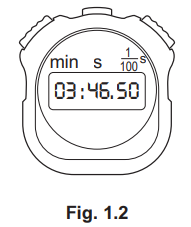
Determine the time, in seconds, for the tap to produce 200 drops.
time = ...................................................... s [2]
(iii) Determine the average time interval between one drop starting to fall and the next drop starting to fall.
time interval = ...................................................... s [2]
Fig. 1.3 shows the volume of water collected in the measuring cylinder by another student.
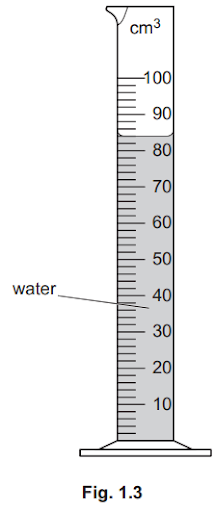
Determine the volume of water in the measuring cylinder in Fig. 1.3.
volume = .................................................. cm3
Fig. 1.1 shows the speed-time graph for a car.
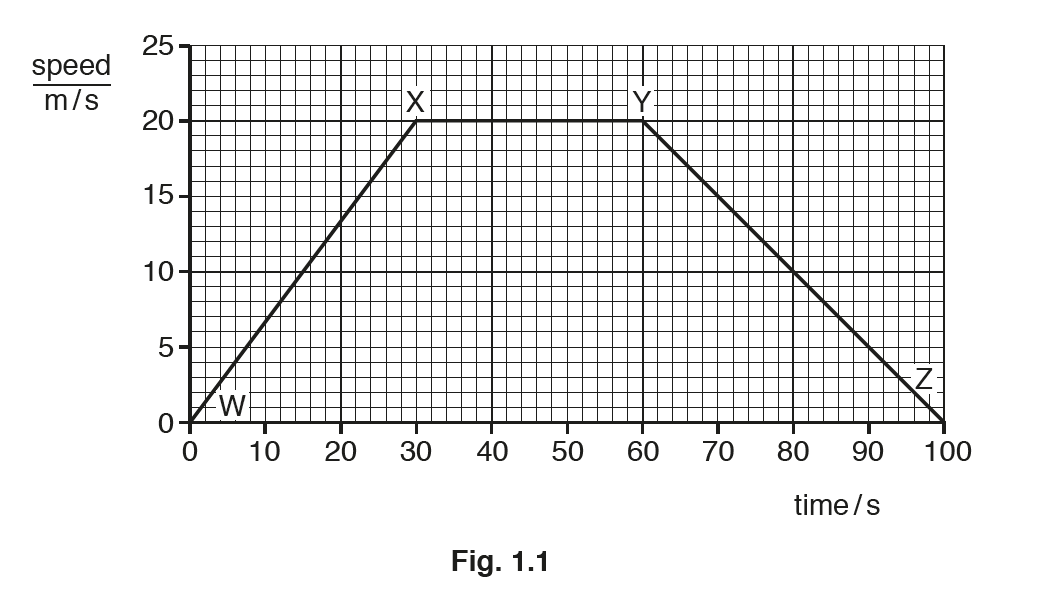
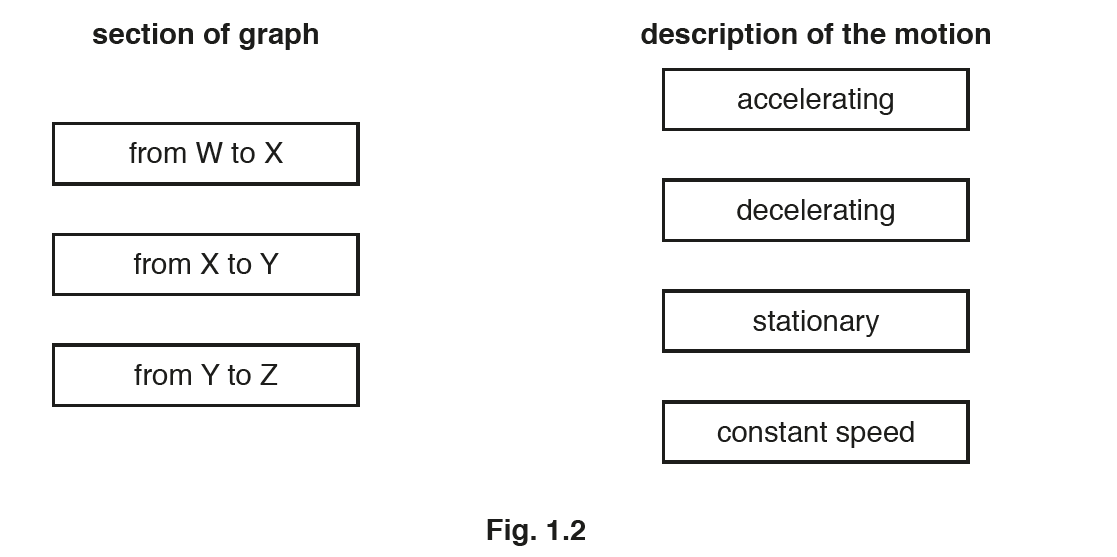
On Fig. 1.1, the labels W, X, Y and Z show the points when the car’s motion changed.
On Fig. 1.2, draw a line from each section of the graph to the correct description of the motion.
Extract:
Fig. 1.1 shows the speed-time graph for a car.
The horizontal axis is labelled time/s and the vertical axis is labelled speed/m/s. The graph shows a section between 30 s and 60 s where the speed is constant at 20 m/s.
Calculate the distance that the car travels between 30 s and 60 s.
distance travelled = ...................................................... m
Extract:
Fig. 1.1 shows the speed-time graph for a car. On Fig. 1.1, the labels W, X, Y and Z show the points when the car's motion changed.
State, using Fig. 1.1, whether the acceleration or deceleration of the car is greater.
A piece of metal has an irregular shape. The weight of the metal is 3.0 N.
Calculate the mass of the metal.
mass = .....................................................kg
Fig. 2.1 shows the piece of metal, a measuring cylinder and a beaker containing water.
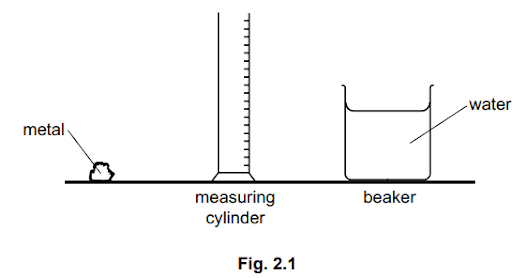
(i) Describe how to determine the volume of the piece of metal, using the equipment in Fig. 2.1.
(4 marks)
(ii) Explain why the procedure in (b)(i) is not suitable for finding the volume of a piece of low-density wood that is a similar shape and size to the piece of metal.
(1 mark)
(iii) The mass of another piece of metal is 405 g and its volume is 150 cm3. Calculate the density of this piece of metal.
density = .............................................. g/cm3 [3]
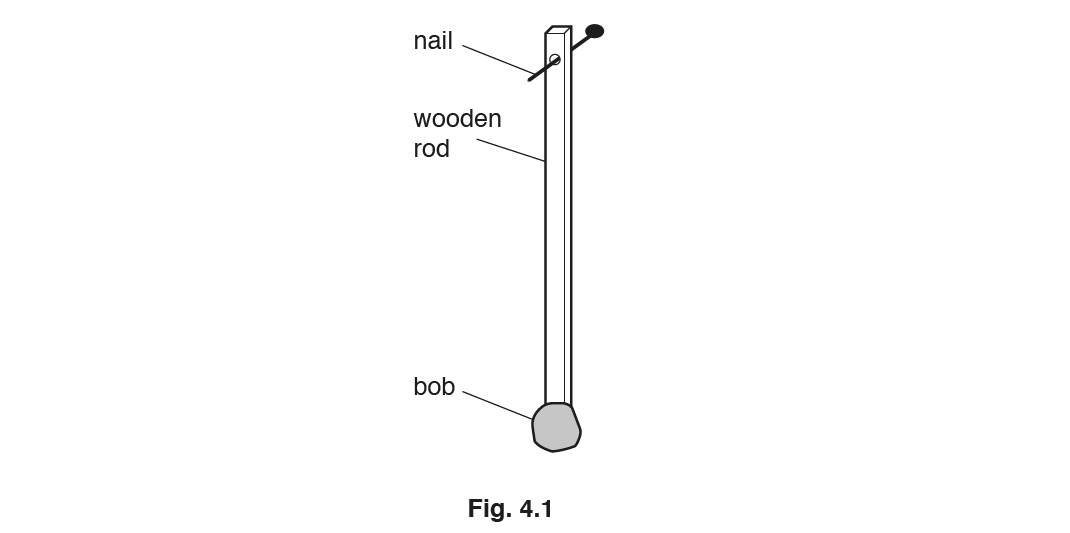
A student wants to investigate the effect of air resistance on the swing of a pendulum.
Plan an experiment which will enable him to investigate how air resistance changes the way in which a pendulum swings.
The apparatus available includes:
In your plan, you should:
You may add to Fig. 4.1 or draw an additional diagram if it helps to explain your plan.
A student stretches a spring by adding different loads to it. She measures the length of the spring for each load. She plots a graph of the results.
Fig. 2.1 shows the graph of her results.
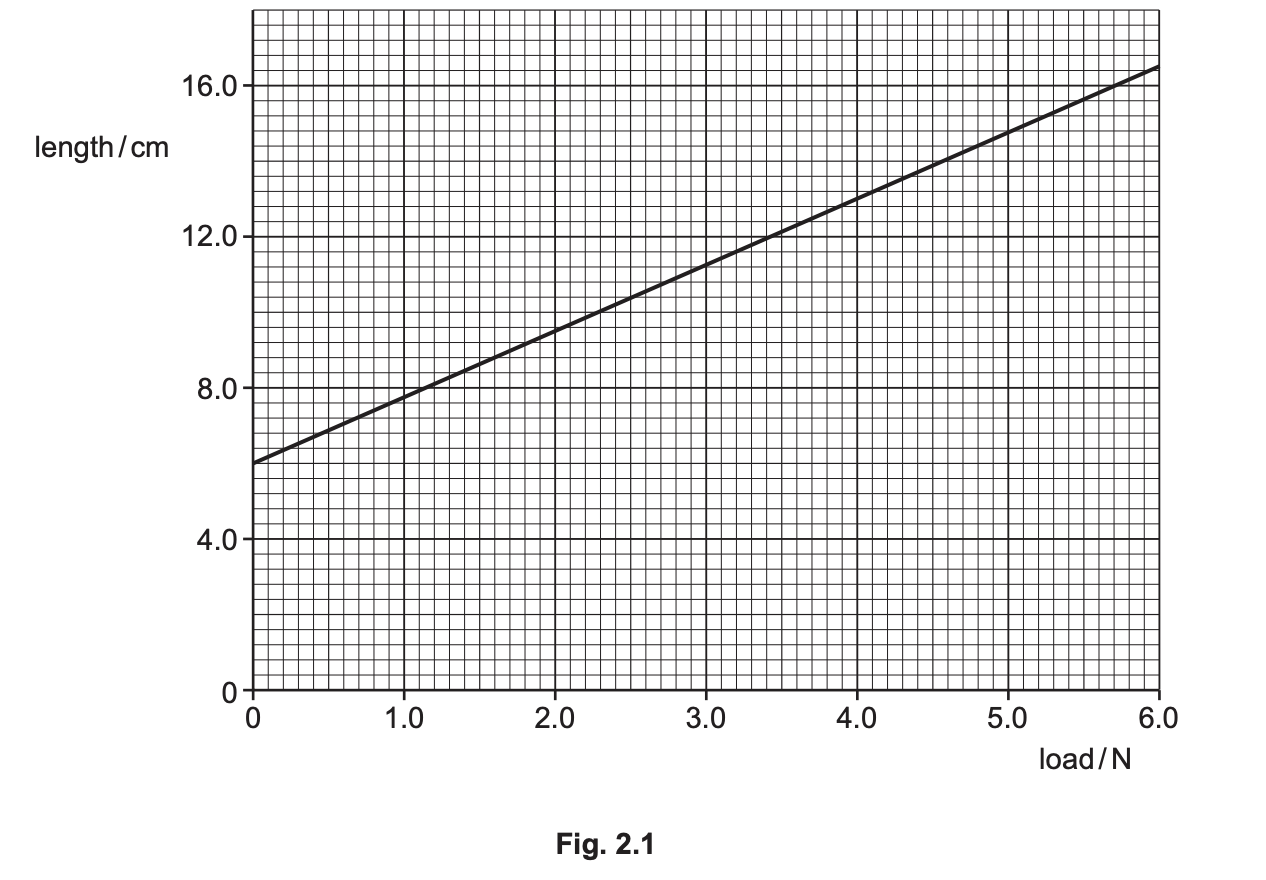
Use the graph to determine:
(i) the length of the spring without a load
length = .................................................. cm [1]
(ii) the length of the spring with a load of 4.0 N
length = .................................................. cm [1]
(iii) the extension due to a 4.0 N load.
extension = .................................................. cm [1]
Complete the sentence about effects of forces. Choose words from the box.
| colour friction pressure shape size speed |
|---|
Stretching a spring with a load is an example of how a force can change the .................................... and the .................................... of an object.
Extended tier only
A student is determining the weight of a metre rule using a balancing method.
Fig. 1.1 shows the apparatus.
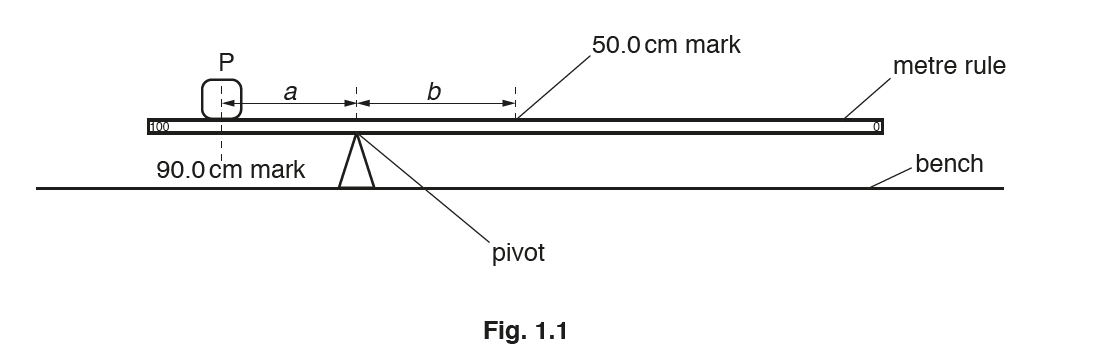
The student places the metre rule on the pivot. He places the load P on the metre rule at the 90.0 cm mark. Keeping load P at the 90.0 cm mark, he adjusts the position of the metre rule on the pivot so that the metre rule is as near as possible to being balanced.
He records the distance a from the 90.0 cm mark to the pivot.
He records the distance b from the pivot to the 50.0 cm mark.
He repeats the steps, placing the load P at the 85.0 cm, the 80.0 cm, the 75.0 cm and the 70.0 cm marks.
The readings are shown in Table 1.1.
Table 1.1
| a/cm | b/cm |
|---|---|
| 21.0 | 19.1 |
| 18.0 | 17.2 |
| 16.0 | 14.1 |
| 13.0 | 11.8 |
| 10.5 | 9.5 |
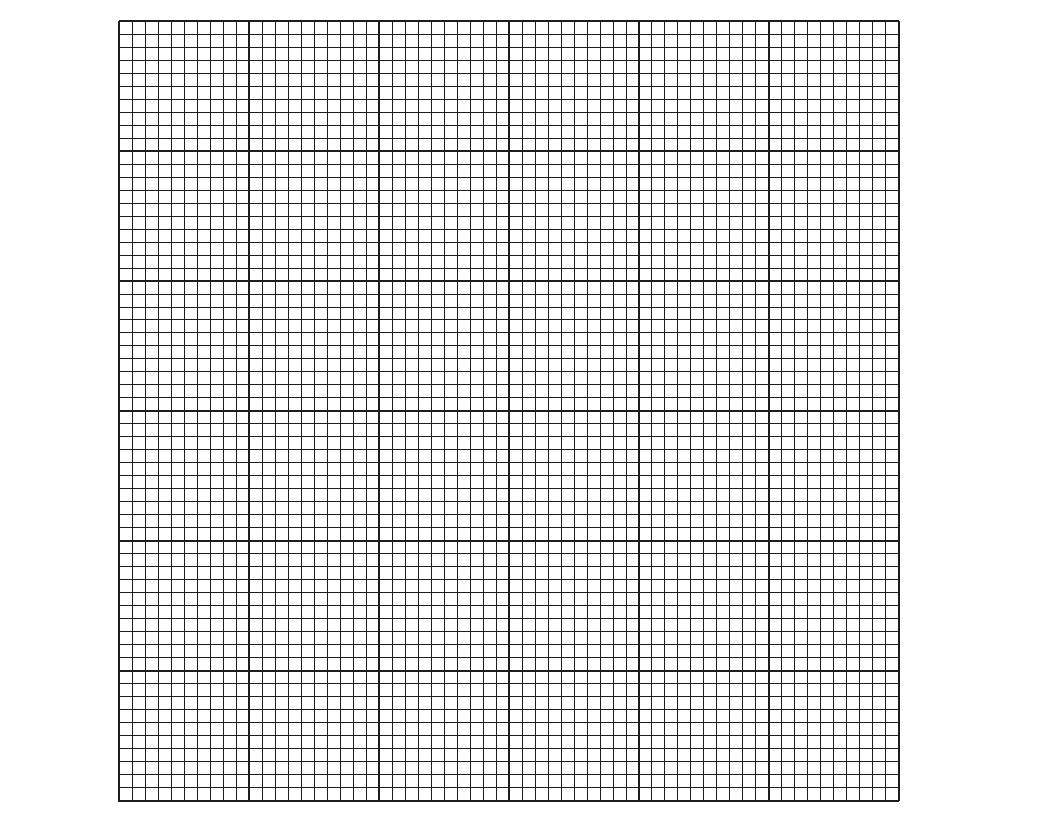
Plot a graph of a/cm (y-axis) against b/cm (x-axis). You do not need to begin your axes at the origin (0,0).
Extract:
A student is determining the weight of a metre rule using a balancing method.
Fig. 1.1 shows the apparatus.
The student places the metre rule on the pivot. He places the load P on the metre rule at the 90.0 cm mark. Keeping load P at the 90.0 cm mark, he adjusts the position of the metre rule on the pivot so that the metre rule is as near as possible to being balanced.
He records the distance a from the 90.0 cm mark to the pivot.
He records the distance b from the pivot to the 50.0 cm mark.
He repeats the steps, placing the load P at the 85.0 cm, the 80.0 cm, the 75.0 cm and the 70.0 cm marks.
The readings are shown in Table 1.1.
Table 1.1 | a/cm | b/cm | | 21.0 | 19.1 | | 18.0 | 17.2 | | 16.0 | 14.1 | | 13.0 | 11.8 | | 10.5 | 9.5 |
Plot a graph of a/cm (y-axis) against b/cm (x-axis). You do not need to begin your axes at the origin (0,0).
Determine the gradient G of the graph. Show clearly on the graph how you obtained the necessary information.
G = ........................................................
Extract:
Calculate the weight W1 of the metre rule using the equation W1 = G × P, where P = 1.0 N.
W1 = ........................................................
Extract:
The student places the metre rule on the pivot. He places the load P on the metre rule at the 90.0 cm mark. Keeping load P at the 90.0 cm mark, he adjusts the position of the metre rule on the pivot so that the metre rule is as near as possible to being balanced. He records the distance a from the 90.0 cm mark to the pivot. He records the distance b from the pivot to the 50.0 cm mark. He repeats the steps, placing the load P at the 85.0 cm, the 80.0 cm, the 75.0 cm and the 70.0 cm marks. The readings are shown in Table 1.1.
| a/cm | b/cm | | 21.0 | 19.1 | | 18.0 | 17.2 | | 16.0 | 14.1 | | 13.0 | 11.8 | | 10.5 | 9.5 |
Extended tier only
Suggest one practical reason why it is difficult to obtain accurate readings for a and b in this type of experiment.
The student measures the mass of the rule on a balance. Write down the mass m shown on the balance in Fig. 1.2 to the nearest gram.
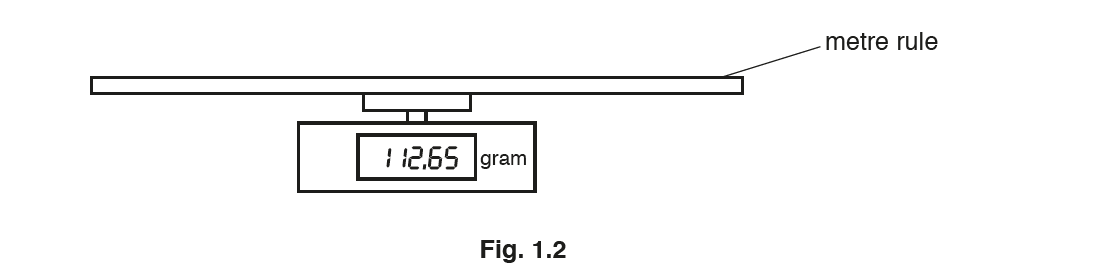
m = ..................................................... g
Extract:
m = 113 g W1 = 1.0 N
(i) Calculate the weight W2 of the metre rule using the equation W2 = mg, where g = 9.8 N/ kg.
W2 = .................................................... N [1]
(ii) State and explain whether this value of W2 can be considered equal to the value of W1 obtained in part (c) within the limits of experimental accuracy.
(1 mark)