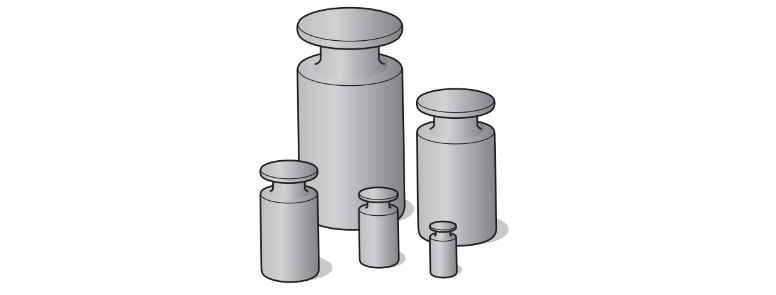
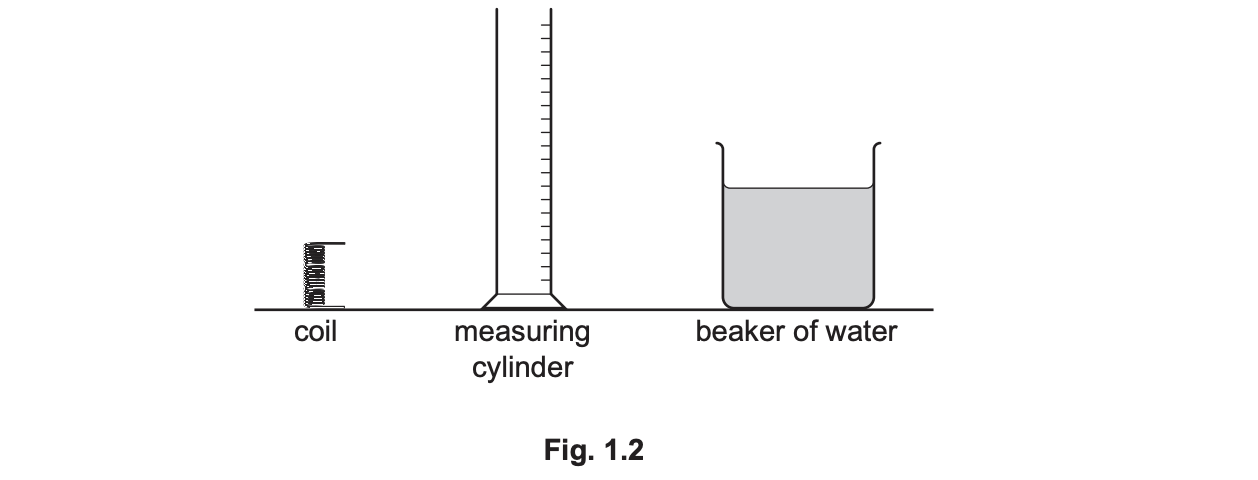
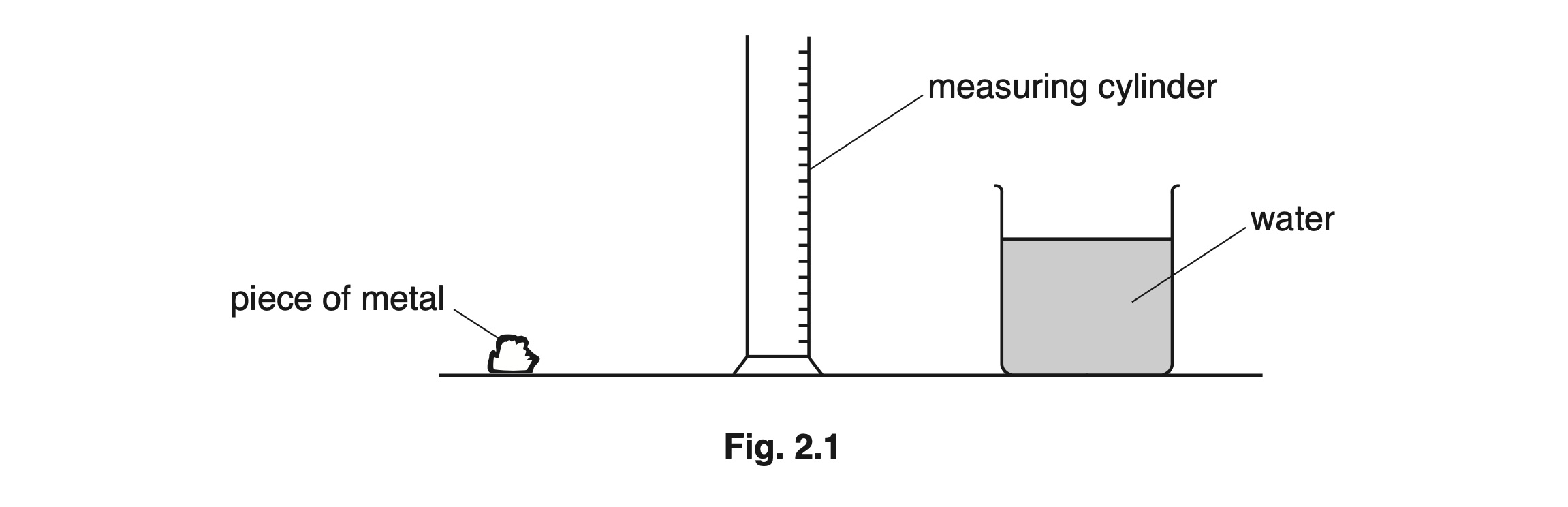
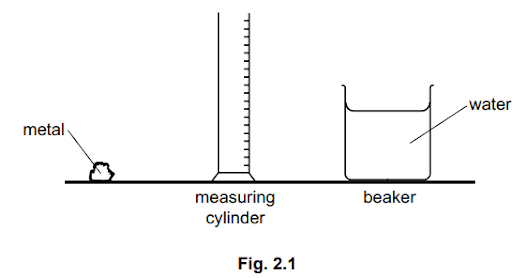
Fig. 1.1 shows laboratory equipment used to find the density of an irregularly shaped solid.
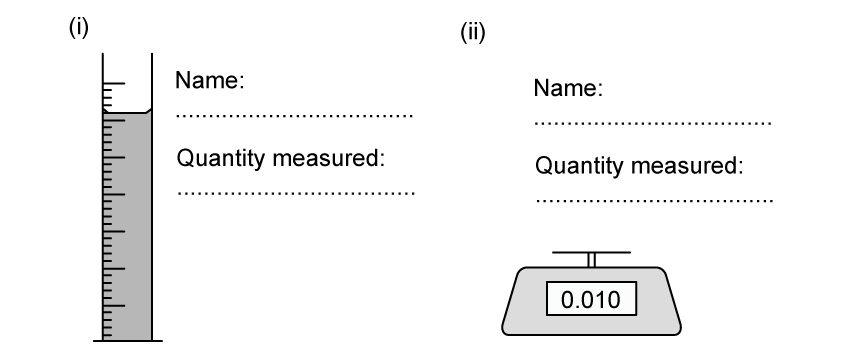
Fig. 1.1
For each piece of equipment add a label stating the name and the quantity measured.
Extract:
The equipment needed to find density is:
-
Measuring cylinder (containing water); [1 mark]
-
Volume; [1 mark]
-
(Digital) balance / scales; [1 mark]
-
Mass; [1 mark]
Explain how a student can find the volume of a piece of modelling clay of irregular shape using only the equipment in part (a)
Extract:
Fig. 1.1 shows laboratory equipment used to find the density of an irregularly shaped solid.
The volume of the modelling clay is found to be 64 cm3.
State the volume in m3.
Extract:
The volume of the modelling clay is found to be 64 cm^3. To convert cm^3 to m^3: ... Calculate the answer:
- 64 cm^3 = 64 × 10^-6 m^3
- Volume = 64 × 10^-6 m^3 OR 0.000064 m^3
The mass of the modelling clay is 60 g.
(i) Determine the mass in kg.
(1 mark)
(ii) Calculate the density of the modelling clay, stating your answer in terms of S.I. units.
(3 marks)