11 markeasy
Which of the quantities below is weight an example of?
Choose your answer
Field strength
Acceleration
Mass
Force
41 questions · 41 marks · ≈ 41 min
Which of the quantities below is weight an example of?
Choose your answer
Field strength
Acceleration
Mass
Force
Which of the following statements about mass or weight is true?
Choose your answer
weight is measured in kilograms
mass = weight x gravitational field strength
weight is measured in Newtons
mass is a force
Extended tier only
How is the weight of an object defined?
Choose your answer
The force of the ground pushing on an object
A measure of the quantity of matter of an object at rest to the observer
The mass per unit volume of an object
The gravitational force acting on an object with mass
Which row in the table gives the correct units for mass and for weight?
| Mass | Weight | |
|---|---|---|
| A | kg | kg |
| B | N | kg |
| C | N | N |
| D | kg | N |
Choose your answer
Which of the following quantities is measured in kilograms?
Choose your answer
weight
mass
pressure
density
A student is given four objects, a mass balance and a metre ruler.
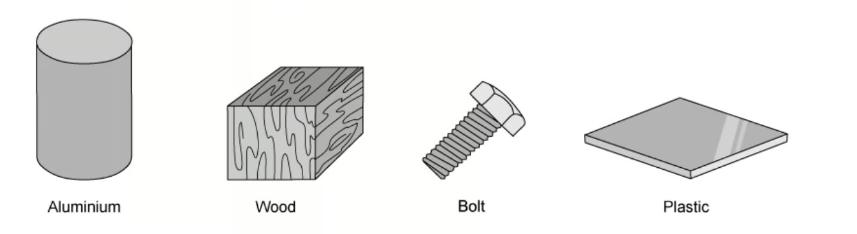
Which of the objects can he determine the density of , using only the metre ruler and the mass balance?
Choose your answer
Bolt , aluminium and plastic
Wood, bolt and plastic
Aluminium , wood and plastic
Aluminium , wood and bolt
Which statement about the mass and the weight of an object is correct?
Choose your answer
They are both affected by changes in the acceleration of free fall.
They are both forces.
They have different units.
Weight is calculated by dividing mass by the acceleration of free fall
The gravitational field strength on the Moon is 1.6 N/kg.
An astronaut has a mass of 75 kg.
What is the weight of the astronaut on the Moon?
Choose your answer
47 N
75 N
120 N
740 N
Which unit is a unit of weight?
Choose your answer
kilogram
kilojoule
kilometre
kilonewton
A shopkeeper pours rice into a dish that hangs from a spring balance. He records the reading.
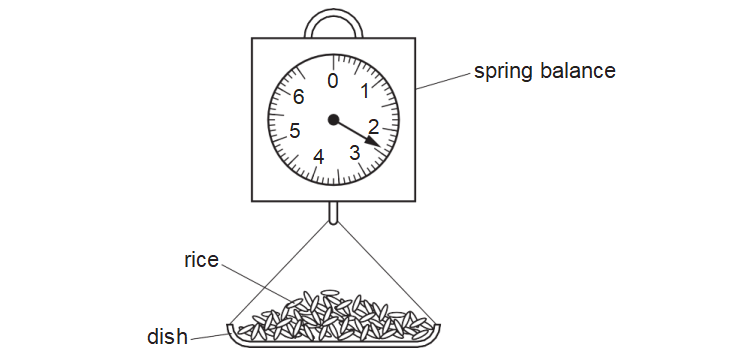
A customer buys some pasta. The shopkeeper notices that the reading on the spring balance, with just pasta in the dish, is the same as it was with just rice in the dish.
Which quantity must be the same for the rice and for the pasta?
Choose your answer
density
temperature
volume
weight
A student determines the density of an irregularly shaped stone. The stone is slowly lowered into a measuring cylinder partly filled with water.
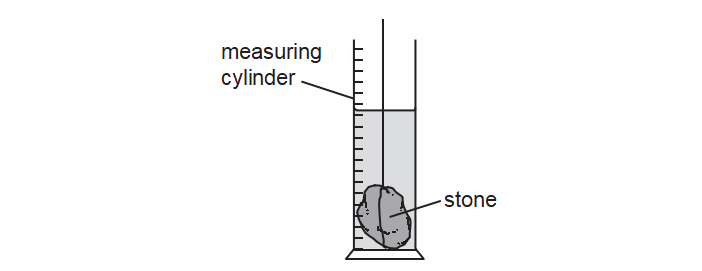
Which other apparatus does the student need to calculate the density of the irregularly shaped stone?
Choose your answer
a balance
a thermometer
a metre rule
a stop-watch
An object has a mass of on Earth, where the acceleration of free fall is .
The object is taken to the Moon, where the acceleration of free fall is .
Which row gives the correct mass and weight of the object on the Moon?
| mass / kg | weight / N | |
|---|---|---|
| A | 2.5 | 4.0 |
| B | 4.0 | 6.4 |
| C | 4.0 | 39 |
| D | 6.4 | 39 |
Choose your answer
Which piece of equipment is used to measure the mass of an object?
Choose your answer
A burette
A balance
A thermometer
A trundle wheel
A baker uses a balance to weigh out some ingredients to make bread. She weighs out some white flour, then she weighs out some wholemeal flour. She notices that the reading on the balance is the same for both types of flour.
The baker can conclude that the two flours have the same:
Choose your answer
volume
density
weight
internal energy
The diagram shows a measuring cylinder containing a liquid , and that same measuring cylinder when it is empty.
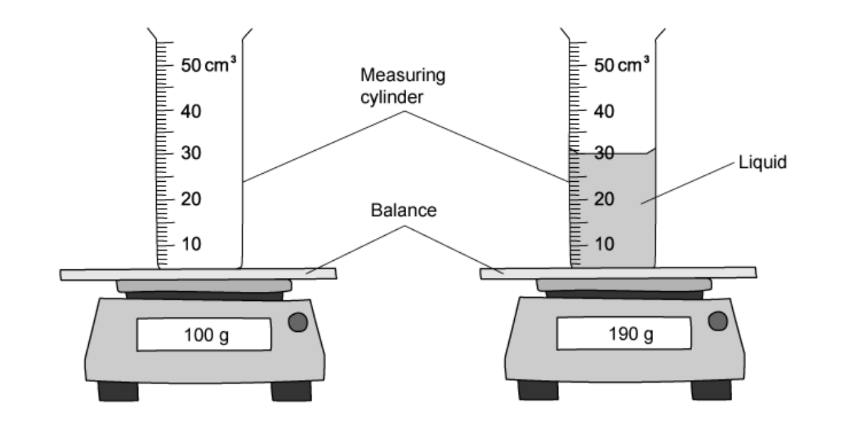
What is the density of the liquid?
Choose your answer
6.30 g/cm3
3.00 g/cm3
0.33 g/cm3
0.16 g/cm3
A geologist wants to determine the density of the object shown below.
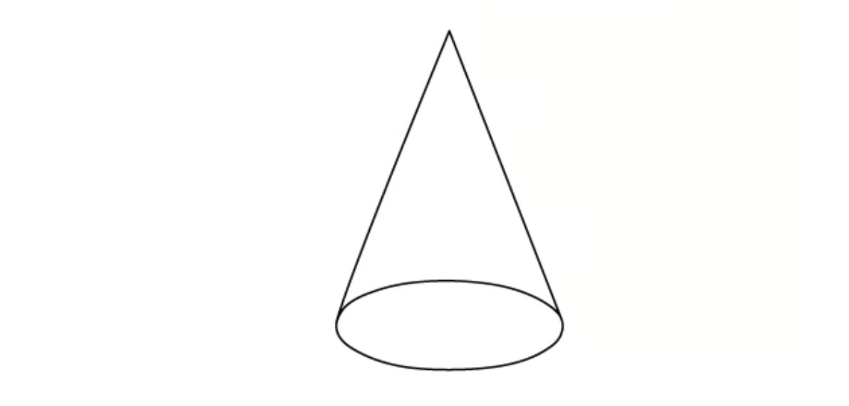
What needs to be known in order to calculate its density ?
Choose your answer
The radius of the base of the cone and the weight of the cone.
The surface area of the base of the cone and the height of the cone.
The volume of the cone and the mass of the cone.
The height of the cone and the mass of the cone.
Two beams have the same rectangular cross section, but one is longer than the other.
Both beams are made from the same material.

Which quantity is the same in both beams?
Choose your answer
The volume
The weight
The mass
The density
A student wants to measure the density of a piece of rock. She starts by measuring its mass , and finds that it is 2500 g.
Next she puts 500 cm3 of water into a large measuring cylinder , then adds the rock. The level in the measuring cylinder rises to 800 cm3.
What is the density of the rock?
Choose your answer
8.33 g/cm3
3.125 g/cm3
0.12 g/cm3
0.32 g/cm3
Some unknown liquid in a beaker has a mass of 200 g and a volume of 230 cm3.
The density of water is 1.0 g/cm3
How does the density of the unknown liquid compare with the density of water?
Choose your answer
Its density is greater than the density of water
Its density is less than the density of water
Its density is the same as the density of water
With the information given, it is impossible to tell.
The two diagrams below show a measuring cylinder.
In the diagram on the left, the measuring cylinder is empty. In the diagram on the right, the measuring cylinder contains a liquid.
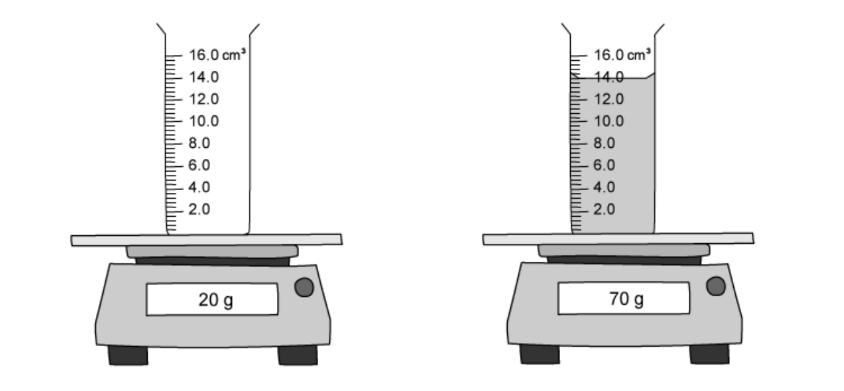
What is the density of the liquid?
Choose your answer
0.20 g/cm3
5.00 g/cm3
0.28 g/cm3
3.57 g/cm3
A lump of butter has a volume of 350 cm3 and a mass of 319 g.
What is the density of the butter?
Choose your answer
31 g/cm3
1.10 g/cm3
1.00 g/cm3
0.911 g/cm3
A cube of side length 5 cm is placed on a mass balance.
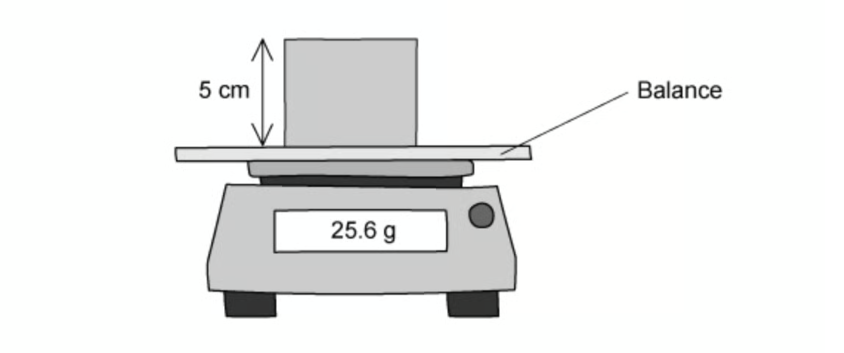
What is the density of the cube?
Choose your answer
1.0 g/cm3
0.20 g/cm3
5.12 g/cm3
4.88 g/cm3
An astronaut has a mass of 80 kg on the Earth.
The gravitational field strength on the Moon is 1.6 N/kg.
What is the weight of the astronaut on the Moon?
Choose your answer
50 kg
128 N
800 N
80 kg
The density of a block of wood is 2.7 g/cm3 and a mass of 583.8 g.
What is its volume?
Choose your answer
0.5 cm3
21.6 cm3
216.2 cm3
1574.9 cm3
Two objects P and Q are placed in a beaker containing a liquid.
Object P floats in the liquid and object Q sinks.
Which row for the densities of object P, object Q and the liquid is possible?
| density of object P g/cm3 | density of object Q g/cm3 | density of liquid g/cm3 | |
|---|---|---|---|
| A | 1.2 | 0.6 | 0.8 |
| B | 1.2 | 1.4 | 1.0 |
| C | 11.3 | 8.9 | 13.6 |
| D | 11.3 | 19.3 | 13.6 |
Choose your answer
A measuring cylinder contains 30 cm3 of a liquid
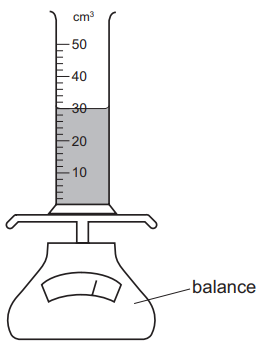
Some more of the liquid is added until the liquid level reaches the 50 cm3 mark.
The reading on the balance increases by 30 g.
What is the density of the liquid?
Choose your answer
0.60 g/cm3
0.67 g/cm3
1.5 g/cm3
1.7 g/cm3
Extended Tier Only
On the Moon, all objects fall with the same acceleration.
Which statement explains this?
Choose your answer
On the Moon, all objects have the same weight.
The Moon has a smaller gravitational field strength than the Earth.
The weight of an object is directly proportional to its mass.
The weight of an object is inversely proportional to its mass.
A space rocket travels to the Moon.
The acceleration of free fall is greater on the Earth than it is on the Moon.
How do the mass and weight of the space rocket on the Moon compare with their values on the Earth?
| mass on the Moon | weight on the Moon | |
|---|---|---|
| A | less than on the Earth | same as on the Earth |
| B | less than on the Earth | more than on the Earth |
| C | same as on the Earth | less than on the Earth |
| D | same as on the Earth | more than on the Earth |
Choose your answer
The table shows the mass and the volume of two objects, P and Q. The objects are placed in a tank of water which has a density of .
| object | mass / g | volume / cm3 |
|---|---|---|
| P | 15 | 5 |
| Q | 15 | 20 |
Which statement is correct?
Choose your answer
Object P floats because its density is greater than the density of water.
Object P sinks because its mass is equal to the mass of object Q.
Object Q sinks because its volume is greater than the volume of object P.
Object Q floats because its density is less than the density of water.
A teacher has a hot cup of tea.
Some of the liquid in the cup evaporates.
Choose the line from the table below that correctly describes what happens to the mass and the weight of the tea in the cup.
| Mass | Weight | |
|---|---|---|
| A | increases | decreases |
| B | increases | increases |
| C | decreases | decreases |
| D | decreases | increases |
Choose your answer
A dummy, named Starman, dressed in a white racing suit, was launched into space by Elon Musk’s first Falcon Heavy rocket. Starman was sent on a journey towards Mars.
Compared with being on the Earth’s surface, how do Starman’s mass and weight change when he is on his journey to Mars?
| Mass | Weight | |
|---|---|---|
| A | stays the same | decreases |
| B | stays the same | stays the same |
| C | decreases | decreases |
| D | decreases | stays the same |
Choose your answer
The diagram shows a ball of bread dough before and after it has been compressed (squashed) so its volume decreases.
Assume no material leaves the dough during compression.
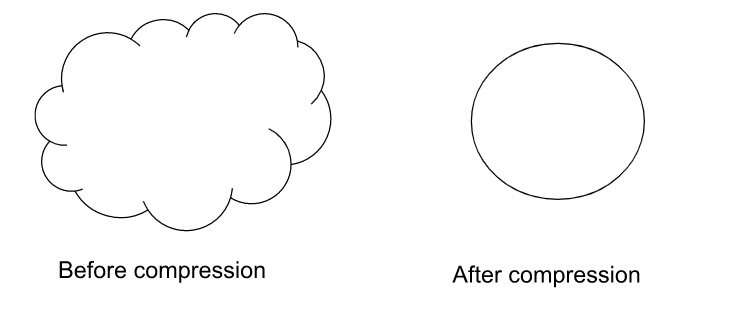
What happens to the mass and the weight of the dough when it is compressed?
| Mass | Weight | |
|---|---|---|
| A | stays the same | decreases |
| B | stays the same | stays the same |
| C | decreases | decreases |
| D | decreases | stays the same |
Choose your answer
An astronaut buys a 5.0 kg tin of Quality Street chocolates on Earth. She takes that 5.0 kg tin of Quality Street chocolate to the Moon. What is the mass of the tin of Quality Street chocolate on the Moon?
Choose your answer
More than 5.0 kg
Less than 5.0 kg, but more than 0.0 kg
5.0 kg
0.0 kg
An object is put on the left hand side of the balance, shown below, in order to determine its weight.
Masses are added to the right hand side until it balances.
The table below shows the effect of various weight combinations.
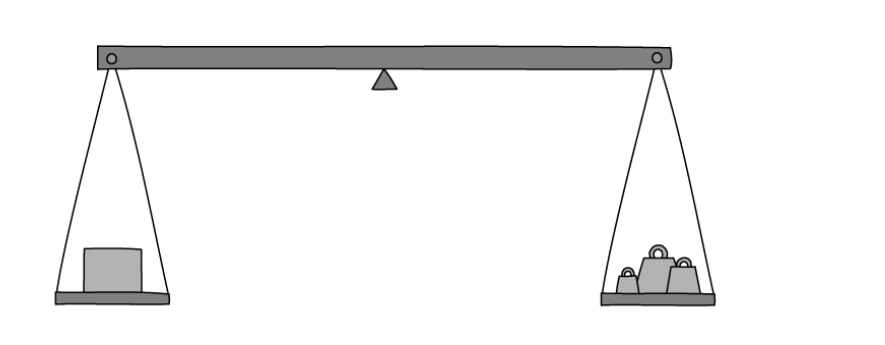
| Masses on the right hand side | Effect |
|---|---|
| 100g, 50g, 50g, 20g, 5g, 2g | Balance tips slightly to the right |
| 200g, 10g, 10g, 5g | Balance tips slightly to the left |
Which of the masses below is most likely to be the mass of the object?
Choose your answer
226 g
230 g
220 g
225 g
A cheesemonger uses a newton meter to measure the weight of a block of cheese.
The cheese has a weight of 5.0 N
What is the approximate mass of the cheese?
Choose your answer
0.05 kg
0.5 kg
5 kg
50 kg
A block of an unknown material is shown in the diagram.
It's mass is 500 g.
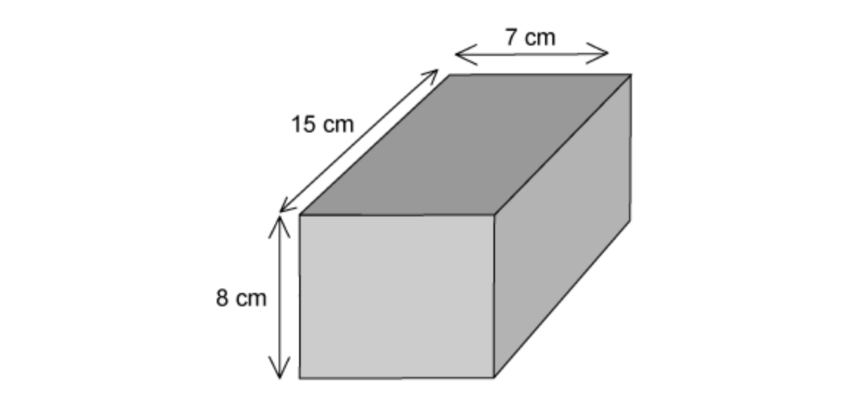
What is the density of the block?
Choose your answer
A teacher wants to measure the density of a wooden cylinder.
She measures the radius, height and mass of the cylinder.
Which of the measurements that she has taken are required to calculate the density of the cylinder?
Choose your answer
Radius, height and mass
Radius and height only
Mass and height only
Mass only
The masses and volumes of four different objects are given in the table.
Which of the objects has the lowest density?
| Mass / g | Volume / cm3 | |
|---|---|---|
| A | 100 | 100 |
| B | 150 | 50 |
| C | 85 | 17 |
| D | 10 | 20 |
Choose your answer
A block is shown in the diagram. It has a mass of* m*.
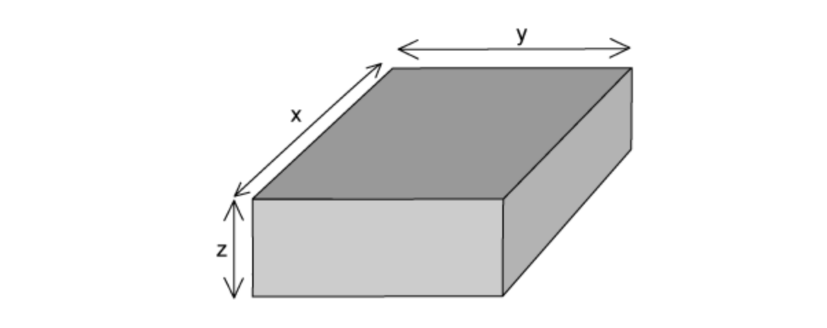
Which expression, below, could be used to calculate the density of the block?
Choose your answer
Four blocks, W,X , Y and Z are shown below.
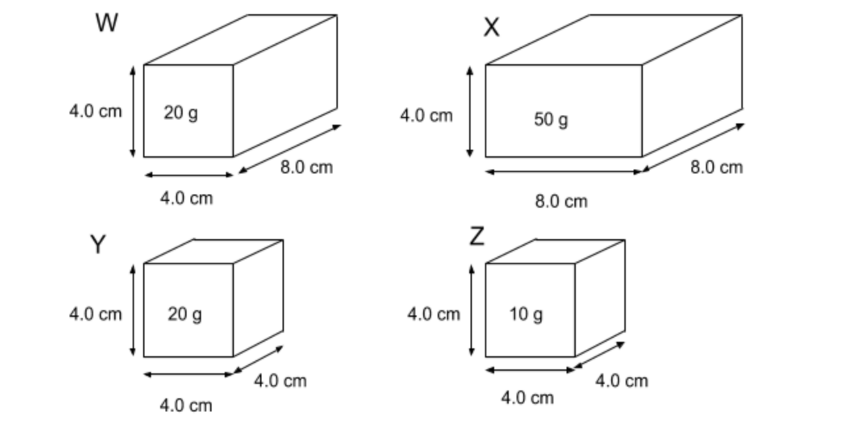
Which of the two blocks have the same density?
Choose your answer
W and X
W and Y
Y and Z
W and Z
A spring balance operates by the compression of a spring. It has been calibrated on the Earth in grams.
A beam balance operates by balancing standard masses against the unknown mass to be measured.
The same unknown mass is measured with each balance on the Earth and on the Moon.
The gravitational field strength on the Earth is greater than that on the Moon.
How would the measurements on the Earth compare with those on the Moon?
| spring balance measurements | beam balance measurements | |
|---|---|---|
| A | larger on the Earth than on the Moon | larger on the Earth than on the Moon |
| B | larger on the Earth than on the Moon | same on the Earth as on the Moon |
| C | same on the Earth as on the Moon | larger on the Earth than on the Moon |
| D | same on the Earth as on the Moon | same on the Earth as on the Moon |
Choose your answer